Saturday, 6 November 2021

3 ways to enhance your cloud journey: break, prepare, and optimize your apps in Azure

Azure, Azure Exam Prep, Azure Certification, Azure Learning, Azure Guides, Azure Preparation, Azure Tutorial and Materials, Azure Learning, Azure Jobs

At our Microsoft Ignite conference this week, we’re sharing new ways to continue to enhance your cloud adoption journey. First, we are excited to announce the preview of Azure Chaos Studio—a fully managed experimentation service to help you track, measure, and mitigate faults with controlled chaos engineering, systemically improving the resilience of your cloud applications. Second, we continue to build a better, easier, and more comprehensive approach to guide your cloud environment preparation, with Azure landing zone—an environment for hosting your workloads, pre-provisioned through code—without losing sight of the application to be deployed. And third, to maximize your organization's investment in the cloud, we have fresh guidance on cloud economics to build your cloud business case with key financial and technical guidance from Azure.

1. Azure Chaos Studio: Track, measure, and mitigate faults in your applications 

Are you confident in knowing how your mission-critical Azure apps will respond to different failure scenarios? Today we’re announcing the preview of Azure Chaos Studio, which enables customers to model and deliberately introduce faults that simulate real-world outages and validate how your application performs under those scenarios. These are the same tools used by Microsoft engineers to build the resilience of cloud services. Chaos Studio enables customers to build on your terms, seeing how apps will respond to real-world disruptions. Gain chaos engineering insights and accelerate the discovery of hard-to-find issues, from late-stage development through to production, all within Azure.

With Azure Chaos Studio you can:

◉ Spend more time learning about application resiliency, without managing tools and scripts.

◉ Get started quickly with agent-based faults that disrupt within resources, and service-based faults that disrupt resources at the control plane.

◉ Validate product quality wherever and whenever you want with CI/CD pipeline integration, using both to monitor production quality through continuous validation.

We continue to work on building a comprehensive and continuously expanding library of fault types (including resource pressure faults for CPU, memory, and disk, network faults to add latency or block access to resources, and faults for service-specific disruptions like Cosmos DB failover, VM Shutdown, and Redis restart) for you and your team to understand how your application would perform in such scenarios and to help you implement a cohesive strategy to make informed decisions to make your application more reliable. 

2. Azure landing zone: Eyes on the target end-state

As you approach every new cloud project, preparing your environment for cloud application is critical for your success. Whether you are creating a brand-new application or modernizing an existing one, adopting cloud technologies is a journey—where you're traveling towards a target end-state. Azure landing zone conceptual architecture is the master architectural plan, based on Microsoft best practices and reference implementations described in the Microsoft Cloud Adoption Framework for Azure. Its scaled-out controls enable you to innovate safely, in alignment with the cloud operating model that works best for your organization, and progress through different stages, arriving at your destination at your own pace.

If the target Azure landing zone conceptual architecture fits within the operating model and resource structure you're already planning to use, we can help you deploy it with a ready-made deployment experience. To help you successfully prepare your cloud environments for any projects, including migration to the cloud, modernization of existing apps, or building cloud-native apps on Azure, with proper scaled-out governance and security in the cloud, quickly, we have developed Azure landing zone accelerators. These are Azure-portal-based templates that allow you to deploy a pre-configured environment implementation with key components in place, such as management groups and policies providing a full implementation of the conceptual architecture based on standards and best practices. Simply point and click through the template by answering a few environment architecture questions to customize it to your needs, in your Azure Portal experience, and to deploy your environment automatically and quickly.

3. Cloud economics: Make your cloud investment count

“More than 70 percent of the customers have cost optimization as their top cloud initiative.” Through research and many customer interactions, we have made available new cost management approaches to guide your business strategy and goals definition. Our updated approach is here to help you understand the cloud economics of your investments and now includes financial tools and templates to build your business case and optimize your cloud investment.

We have also created a Power BI template, backed by an Excel model, that can help you forecast your costs early on as you’re planning your cloud journey. Use the Power BI template and on-premises compute unit list to understand how you can take advantage of Azure offers and benefits like Azure Hybrid Benefit and reserved instances to save against pay-as-you-go pricing and optimize your costs.

Check this new video guidance and learn about some lesser-known tips for estimating and managing your cloud spend. From the Azure Cost Management Portal to Power BI for custom views and reporting, to API-based integration that feeds cost data into your existing financial systems, we'll help you to keep track of your cloud spend and optimize your investment in the cloud.

Source: microsoft.com

Thursday, 4 November 2021

Transform your business with Microsoft's unrivaled end-to-end data platform

Microsoft Exam Prep, Microsoft Tutorial and Materials, Microsoft Career, Microsoft Certification, Microsoft, Microsoft Guides, Microsoft Jobs

Businesses today are experiencing the most significant change in our economy in a generation and the ability to realize the full potential of the cloud through digital transformation has never been greater. There are three core capabilities businesses need that together drive successful transformation: limitless database scale and performance, unmatched analytics and insights, and unified data governance.

Today we shared a number of announcements to help organizations evolve rapidly even in the face of sustained uncertainty. Across industries, companies are investing in these core capabilities to ensure they have the flexibility to innovate anywhere and meet evolving business needs.

Limitless database scale and performance

We are announcing the preview of SQL Server 2022, the most Azure-enabled SQL Server release yet. This enables easier cloud integration than ever before with new disaster recovery functionality for Azure SQL Managed Instance and seamless analytics over on-premises operational data with Synapse Link for SQL Server. Microsoft continues to invest in our Azure SQL family of databases providing flexible options for app migration, modernization, and development. Azure SQL Managed Instance has a number of key announcements, including business offers with significantly more memory per vCore and increased storage to 16 TB in both the general purpose and business-critical service tiers, providing more room for app growth.

Azure is also the best cloud for NoSQL and open source databases. Azure Cosmos DB is a fully managed NoSQL database built to support production applications at any size or scale. Financially backed service-legal agreements (SLA's) guaranteeing consistency, high throughput, less than 10 ms latency reads and writes, and 99.999 percent availability make it simple for developers to independently and elastically scale applications across any Azure region. Today we are announcing the general availability of Azure Managed Instance for Apache Cassandra, providing the ability to provision managed native Apache Cassandra clusters with automated deployment and scaling operations, accelerating hybrid scenarios, and reducing ongoing maintenance. Flexible Server (preview), a new deployment option for Azure Database for MySQL is also now generally available. With Flexible Server, customers can benefit from a fully managed service designed to provide maximum control of your databases, high availability options to ensure zero data loss, built-in capabilities for cost optimization, and increased productivity enabled by the Azure ecosystem.

Unmatched analytics and insights

When it comes to analytics and insights, Azure is simply unmatched. When we debuted Azure Synapse Analytics, we effectively removed the barriers between enterprise data warehousing and big data analytics to enable data professionals to collaborate, build, and manage their analytic solutions with ease. Since its launch, the number of Azure customers running petabyte-scale workloads has increased fivefold. 

But we didn’t stop there. We introduced Azure Synapse Link for Azure Cosmos DB last year, creating a simple, low-cost, cloud-native HTAP implementation that enables immediate, in-the-moment business insights. We continue our investments today with the general availability of Azure Synapse Link for Dataverse, enabling immediate insights with high-value Dynamics 365 data, and a preview of Azure Synapse Link for SQL Server 2022. We are also announcing that Azure Synapse Data Explorer is joining the existing SQL and Apache Spark analytical runtimes in Azure Synapse—a highly scalable engine to automatically index structured, semi-structured, and free-text data commonly found in telemetry, time series, and logs to surface enriched insights that can directly improve business decisions. 

Unified data governance

The need for a comprehensive data governance service has never been stronger. Azure Purview, our unified data governance service, helps businesses manage and govern their on-premises, multi-cloud, and software as a service (SaaS) data. It’s exciting to see the strong interest in Azure Purview since its general availability, with over 57 billion data assets discovered by customers already. Azure Purview ensures your Microsoft data estate is governed through deep integrations with data services in Azure, Microsoft 365, Microsoft Power Platform, and more. Every organization can now build a unified data governance solution to maximize the value of their data in the cloud.

Microsoft Exam Prep, Microsoft Tutorial and Materials, Microsoft Career, Microsoft Certification, Microsoft, Microsoft Guides, Microsoft Jobs

Customers like the London Heathrow Airport, for example, have already achieved tremendous success with Azure Purview. The airport’s data teams use lineage data in Azure Purview to find correlations between datasets which is critical in determining how each airport service affects broader operations.

“We used to have a lot of data about things we generally already understood but now that we’ve adopted Azure Purview, we have insight into the unknown, meaning we can aggregate multiple data sources in a more user-friendly way to discover where we can create efficiencies and make better predictions.”—Dave Draffin, Azure Cloud and Data Architect, Heathrow Airport

Source: microsoft.com

Tuesday, 2 November 2021

5 trends transforming business—2021 IoT Signals report

5 Trends Transforming Business—2021, IoT Signals Report, Azure Exam Prep, Azure Tutorial and Material, Azure Career, Azure Online Guides, Azure Prep, Azure Skills

The technology behind the internet of things (IoT) has been a long time in the making. But it wasn’t until the early 2000s when home automation solutions began hitting the market that IoT started becoming a household term.

Fast-forward a couple of decades and IoT has exploded, not only in power and sophistication but in importance, helping to fuel the fourth industrial revolution. Today, businesses across every industry are using IoT to drive efficiency, productivity, safety, and growth across their operations.

And it’s only picking up steam, as evidenced by the newly released 2021 IoT Signals report. As IoT evolves—along with innovations like AI, digital twins, and edge computing—businesses are combining these technologies to connect complex environments and deliver results never before imagined.

Below, we’ve highlighted five key adoption trends from the 2021 IoT Signals report. Plus, we’ll share how advancements in Azure IoT technology are helping customers streamline and secure solutions and revolutionize business.

5 key trends in IoT adoption for 2021

Now in its third edition, IoT Signals compiles inputs from more than 3,000 business and IT decision makers and developers, surfacing insights across industries and revealing trends, emerging technologies, common challenges, and more. This year’s edition also takes a deeper dive into areas such as security and best practices, implementation strategies, and IoT for sustainability.

1. 90 percent of the organizations surveyed are adopting IoT

IoT isn’t slowing down. Levels of IoT adoption remain high, on par with 2020, with 90 percent of adopters stating that IoT is critical to their success. The top reasons for adopting IoT include quality, security, and resource optimization. In fact, organizations that adopt IoT in the areas of cloud security, supply chain, and sustainability consider IoT as even more critical to their overall success.

2. COVID-19 continues to accelerate IoT adoption across industries

One of the unexpected impacts of the global health pandemic is that 44 percent of the organizations surveyed plan to invest even more in IoT as a result of COVID-19, compared to 31 percent in 2020. Most of these companies are already using IoT, and close to half attribute increased revenue to the technology. 

3. Reducing technical complexity helps speed IoT time to market

Technical challenges can slow progress, often stalling projects in the proof-of-concept (PoC) phase. The need to solve existing challenges before adding or using IoT thwarts a third of implementations and contending with technology demands impacts 28 percent. Solving these challenges can help organizations benefit from IoT more quickly and pave the way for widespread IoT adoption.

4. Unsurprisingly, IoT security is a major priority

In fact, 91 percent of survey participants expressed concerns about IoT security. Data privacy tops the list of security worries at 46 percent, followed by network-level security at 40 percent. Other concerns include device security endpoints, managing and tracking each device, and ensuring software and firmware updates are made. Interestingly, organizations are not using a common best practice approach to security, with only 43 percent designing measures that assume breaches at every level of their IoT projects.

5. The vast majority of IoT adopters integrate emerging technologies

Most organizations are leveraging technologies such as AI, digital twins, and edge computing as part of their IoT solutions. 81 percent of organizations that leverage edge computing or digital twins as part of IoT state that these technologies are core or secondary components. We will go into more detail on emerging tech below.

Streamlining highly secure IoT solutions

While IoT adoption is trending upward, it’s clear that solutions must be more secure and easier to implement. The Azure team continues to prioritize investments that remove friction and technical complexity and streamline solutions at scale. We’re also continuing to prioritize stringent, built-in, cloud-to-silicon security measures to help safeguard data, devices, and operating environments.

A great example is Azure IoT Central, which provides a common platform for creating and managing secure, enterprise-grade IoT solutions. Recent innovations are helping organizations to minimize technical and security hurdles and bring solutions to market more quickly. In late 2020, we released IoT Plug and Play, which simplifies secure, end-to-end IoT solutions through no-code device configuration, drastically reducing cost and development time. We’ve also added Azure IoT support for multi-tenant solutions, making it easier to scale, manage, and safeguard IoT across multiple organizations.

Integrating emerging technologies with IoT

Augmenting IoT with emerging technologies like AI, edge computing, and digital twins is a priority for most IoT adopters. Together with IoT, emerging technologies are connecting highly complex environments to power experiences and scenarios never before imagined. Microsoft offers a range of solutions that are helping bring these projects to fruition.

AI and IoT

According to IoT Signals, 79 percent of businesses are successfully adopting AI within their IoT solutions. The top reasons cited include predictive maintenance at 67 percent, followed by prescriptive maintenance at 65 percent. Additionally, 56 percent of organizations are combining AI and IoT to create a better user experience.

At the same time, 46 percent of businesses with AI strategies are struggling to get their projects past the PoC stage. Azure AI simplifies integration by enabling access to high-quality AI models—including vision, speech, language, and even decision-making—using simple API calls. Azure AI integrates with Azure IoT solutions, enabling organizations to unleash a multitude of custom use cases. For example, RXR Realty, one of the largest real estate companies in New York, combined Azure AI with Azure IoT to monitor building health, supporting a safer return to the office during COVID-19.

Edge computing and IoT

By shifting AI, analytics, and business logic to edge devices, edge computing can help solve speed, latency, security, and reliability challenges. Combining edge computing with IoT opens a world of possibilities.

52 percent of IoT Signals respondents indicate that they are very familiar with edge computing as compared to 42 percent one year ago. Of those organizations, 79 percent have an edge computing strategy, 81 percent of whom are combining edge computing and IoT. The most common use cases include cloud security at 40 percent, device and asset security at 36 percent, and quality assurance at 35 percent.

These organizations also face technical challenges in getting solutions out of PoC, which means removing friction and complexity are vital. Built on Azure IoT Hub, Azure IoT Edge simplifies running cloud workloads at the edge on certified IoT devices. Using familiar coding languages, developers can enable data processing at the device level, ensuring only what’s needed is sent to the cloud. Additionally, the tiny but mighty Azure RTOS seamlessly connects popular microcontroller units (MCUs) to the power of Azure IoT, providing embedded developers the ability to quickly build applications on resource-constrained devices.

To make it easier to combine AI and IoT at the edge, we recently introduced Azure Percept. This comprehensive solution contains prebuilt AI models and built-in security measures and works out-of-the-box with Azure Cognitive Services and Azure Machine Learning. The city of Kortrijk in Belgium used Azure Percept to gain insights into pedestrian movement and density to help keep people safer and improve city operations.

Digital twins and IoT

The ability of digital twins to replicate physical environments and model relationships and interactions is truly revolutionary. The technology has caught the attention of IoT Signals survey participants, most of whom indicate that they are aware of digital twins and 77 percent of whom have a strategy in place. Of the 81 percent that incorporates digital twins into their IoT solution, three quarters report improved quality as a benefit. In addition, 63 percent enjoy increased revenue and 59 percent experience reduced operation costs.

Again, these adopters list technical complexity as a challenge. To help alleviate complexity, Azure Digital Twins combines digital twins and IoT into a single platform. It allows organizations to model entire connected environments using an open modeling language. For example, Doosan worked with Bentley Systems to create a digital replica of wind farms using Azure Digital Twins. The digital twin enables them to maximize energy production and remotely monitor facilities. Other companies, like Johnson Controls, are using Azure Digital Twins to transform how buildings and spaces are built and managed.

Download the 2021 IoT Signals report

We’ve only just scratched the surface of how IoT is reshaping business and how Azure IoT is rising to the challenge of providing secure, streamlined solutions. As technologies evolve, IoT is becoming simpler and more affordable. To learn how IoT is accelerating growth for businesses like yours, we urge you to download the 2021 IoT Signals report.

Source: microsoft.com

Saturday, 30 October 2021

Microsoft powers transformation at NVIDIA GTC Fall—GPU technology conference

Microsoft Powers Transformation, NVIDIA GTC Fall—GPU Technology, Microsoft Exam Prep, Microsoft Certification, Microsoft Career, Microsoft Preparation, Microsoft Prep, Microsoft Jobs

Customers around the world rely on Microsoft Azure to drive innovations related to our environment, public health, energy sustainability, weather modeling, economic growth, and more. Finding solutions to these important challenges requires huge amounts of focused computing power. Customers are increasingly finding the best way to access such high-performance computing (HPC) through the agility, scale, security, and leading-edge performance of Azure’s purpose-built HPC and AI cloud services.

Azure’s market-leading vision for HPC and AI is based on a core of genuine and recognized HPC expertise, using proven HPC technology and design principles, enhanced with the best features of the cloud. The result is a capability that delivers performance, scale, and value, unlike any other cloud. This means applications are scaling 12 times higher than other public clouds. It means higher application performance per node. It means powering AI workloads for one customer with a supercomputer fit to be among the top five in the world. It also means delivering massive compute power into the hands of medical researchers over a weekend to prove out life-saving innovations in the fight against COVID-19.

This year during NVIDIA GTC 21, we’re spotlighting some of the most transformational applications powered by NVIDIA accelerated computing that highlights our commitment to edge, on-premises, and cloud computing. Registration is free, so sign up to learn how Microsoft is powering transformation.

AI and supercomputing scale

The AI and machine learning space continues to be one of the most inspiring areas of technical evolution since the internet. The trend toward using massive AI models to power a large number of tasks is changing how AI is built. Training models at this scale requires large clusters of hundreds of machines with specialized AI accelerators interconnected by high-bandwidth networks inside and across the machines. We have been building such clusters in Azure to enable new natural language generation and understanding capabilities across Microsoft products.

The work that we have done on large-scale compute clusters, leading network design, and the software stack, including Azure Machine Learning, ONNX Runtime, and other Azure AI services, to manage it is directly aligned with our AI at Scale strategy.

Machine learning at the edge

Microsoft provides various solutions in the intelligent edge portfolio to empower customers to make sure that machine learning not only happens in the cloud but also at the edge. The solutions include Azure Stack Hub, Azure Stack Edge, and IoT Edge.

Whether you are capturing sensor data and inferencing at the edge or performing end-to-end processing with model training in Azure and leveraging the trained models at the edge for enhanced inferencing operations—Microsoft can support your needs however and wherever you need to.

Visualization and GPU workstations

Azure enables a wide range of visualization workloads, which are critical for desktop virtualization as well as professional graphics such as computer-aided design, content creation, and interactive rendering. Visualization workloads on Azure are powered by NVIDIA’s world-class graphics processing units (GPUs) and RTX technology, the world’s preeminent visual computing platform.

With access to graphics workstations on Azure cloud, artists, designers, and technical professionals can work remotely, from anywhere, and from any connected device.

Recapping 2021 moments with Azure and NVIDIA technologies

Wildlife Protection Services

Microsoft Powers Transformation, NVIDIA GTC Fall—GPU Technology, Microsoft Exam Prep, Microsoft Certification, Microsoft Career, Microsoft Preparation, Microsoft Prep, Microsoft Jobs
From deforestation to wildfire management to protecting endangered animals, studying wildlife populations is essential to a sustainable future. Learn how Wildlife Protection Services works with Microsoft AI for Earth to provide the monitoring technology that conservation groups need to keep watch over wild places and protect wildlife, using an infrastructure of Azure High Performance Computing virtual machines with NVIDIA V100 GPUs.

Van Gogh Museum

Microsoft Powers Transformation, NVIDIA GTC Fall—GPU Technology, Microsoft Exam Prep, Microsoft Certification, Microsoft Career, Microsoft Preparation, Microsoft Prep, Microsoft Jobs
With tens of thousands of Chinese visitors each year, the Van Gogh Museum wanted to create something unique for this audience. Enter WeChat, an app that could transform portrait photos into digital paintings reminiscent of Van Gogh’s art. Users, able to see how the artist would have painted them, would ideally be drawn closer to his art through this unique, personal experience.

FLSmidth

Microsoft Powers Transformation, NVIDIA GTC Fall—GPU Technology, Microsoft Exam Prep, Microsoft Certification, Microsoft Career, Microsoft Preparation, Microsoft Prep, Microsoft Jobs
FLSmidth has an ambitious goal of zero emissions by 2030 but they were hampered by latency and performance limitations of their on-premises infrastructure. By moving to Microsoft Azure in collaboration with partner Ubercloud, FLSmidth found the perfect vehicle for optimizing the engineering simulation platforms that depend on high-performance computing. The switch has removed all latency, democratized their platform, and produced results 10 times faster than their previous infrastructure.

Previous 2021 Azure HPC and AI product launches

Azure announces general availability of scale-out NVIDIA A100 GPU Clusters: the fastest public cloud supercomputer—the Azure ND A100 v4 Virtual Machine—powered by NVIDIA A100 Tensor Core GPUs -  are designed to let our most demanding customers scale up and scale out without slowing down.

In the June 2021 TOP500 list Microsoft Azure took public cloud services to a new level, demonstrating work on systems that took four consecutive spots from No. 26 to No. 29 on the TOP500 list. They are parts of a global AI supercomputer called the ND A100 v4 cluster, available on demand in four global regions today.  These rankings were achieved on a fraction of our overall cluster size. Each of the systems delivered 16.59 petaflops on the HPL benchmark also known as Linpack, a traditional measure of HPC performance on 64-bit floating point math that’s the basis for the TOP500 rankings.

Azure announces the DeepSpeed-and Megatron-powered Megatron-Turing Natural Language Generation model (MT-NLG), the largest and the most powerful monolithic transformer language model trained to date, with 530 billion parameters. It is the result of a research collaboration between Microsoft and NVIDIA to further parallelize and optimize the training of very large AI models.

Join us at the NVIDIA GTC Fall 2021 conference

Microsoft Azure is sponsoring NVIDIA GTC 2021 conference workshops and training. The NVIDIA Deep Learning Institute (DLI) offers hands-on training in AI, accelerated computing, and accelerated data science to help developers, data scientists, and other professionals solve their most challenging problems. These in-depth workshops are taught by experts in their respective fields, delivering industry-leading technical knowledge to drive breakthrough results for individuals and organizations.

On-demand Microsoft sessions with GTC

Microsoft session recordings will be available on the GTC site starting April 12, 2021.

Source: azure.microsoft.com

Thursday, 28 October 2021

Upgrade your network protection with Azure Firewall Premium

Azure Exam Prep, Azure Tutorial and Materals, Azure Exam, Azure Materials, Azure Career, Azure Online Guides, Azure Firewall Premium

We continue to be amazed by the adoption, interest, positive feedback, and the breadth of use cases customers are finding for our service. Today, we are excited to share several new Azure Firewall Premium capabilities based on your feedback:

◉ Azure Firewall Premium availability in more regions. In Azure, we make it our mission to be the world’s computer and as part of fulfilling this mission we are available in more regions and data centers than any other public cloud. The Azure Firewall team follows the same ethos by bringing Firewall Premium’s next generation threat protection and security closer to the applications and customers.

◉ Terraform support for Firewall Policy Premium is now available. Terraform is a popular open-source tool used by DevOps for implementing infrastructure as code. Azure Firewall Premium supports a range of DevOps tools including Azure CLI, PowerShell, REST API. Customers can now use Terraform to manage their Azure Firewall Premium.

◉ Web categories Category Check is now available in preview. Web categories lets administrators allow or deny user access to web site categories such as gambling websites, social media websites, and others. Often customers want to check what categories does a specific URL fall under. Customers can now use the convenience of Azure Portal to determine URL web categories and share feedback if the category is not accurate.

◉ Migrate to Premium SKU using Stop/Start approach. Stop/Start is a convenient approach adopted by customers to stop firewall billing during evaluation period. This approach deallocates the firewall virtual instances while preserving the underlying firewall resource. Customers are looking for a simple migration to Azure Firewall Premium can now use the Stop/Start approach. This approach is supported for both Secure Hub and Hub VNET firewalls.

Azure Firewall Premium is now available in new regions

Azure Firewall Premium is now available in both Microsoft Government Cloud and Azure China 21Vianet. This expansion makes Azure Firewall Premium now available in 44 Azure regions.

◉ USGov Texas

◉ USGov Arizona

◉ USGov Virginia

◉ China North 2

◉ China East 2

Terraform support for Firewall Policy Premium

Terraform community recently added support for Firewall Policy Premium SKU properties. Customers using Firewall Policy can now leverage Terraform to manage both Standard and Premium SKU attributes.

Web categories—Category Check and Mis-Categorization request

Web categories is a feature that allows you to filter application traffic based on defined categories, such as gambling, social media, and download sites. With Web Categories Category Check, administrators can now perform a fully qualified domain name (FQDN) or URL check to identify which category a website falls under. This is particularly useful when defining your rules. In addition, you can now provide feedback by submitting a Mis-Categorization request if you believe a website should fall under a different category.

Azure Exam Prep, Azure Tutorial and Materals, Azure Exam, Azure Materials, Azure Career, Azure Online Guides, Azure Firewall Premium

Migrate to Premium SKU using Stop/Start approach


If you use Azure Firewall Standard SKU with Firewall Policy, you can use the Allocate/Deallocate method to upgrade your Firewall SKU to Premium. This migration approach is supported on both VNET Hub and Secure Hub Firewalls. Secure Hub deployments will be upgraded while preserving the public IP of the firewall.

Source: microsoft.com

Tuesday, 26 October 2021

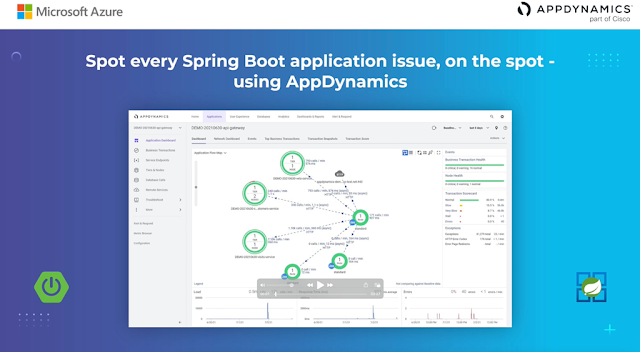
Spot every Spring Boot application issue on the spot using AppDynamics

Today, we are excited to announce the integration of AppDynamics in Azure Spring Cloud for full stack observability.

Over the past 20 months, we worked with many enterprise customers to learn about the scenarios they face. Many of these customers have thousands of Spring Boot applications running in on-premises data centers. As they migrate these applications to the cloud, they need to instrument them for application performance monitoring (APM) using solutions their developers are familiar with and have been using for years. In addition, they must ensure continuity for desktop and mobile applications that are already pre-instrumented for end-to-end monitoring using agents like AppDynamics, which automatically discovers and maps all applications, microservices, and infrastructure as well as any dependencies in dynamic hybrid, multicloud environments. With the integration of AppDynamics in Azure Spring Cloud, you can continue your journey and easily instrument your Spring Boot applications with AppDynamics.

"Our deployment of Azure Spring Cloud is just one component of a much broader multi-region, multicloud architecture. We’ve used AppDynamics at Digital Realty for several years and had a strong desire to have this single pane of glass to capture performance metrics and monitor availability across the full stack. But not only that, AppDynamics is a powerful APM tool that is one component of adopting an event-driven architecture. We are experimenting with self-healing and AIOps and need to expand our capabilities in this area, which we can now do."—Devon Yost, Enterprise Architect, Digital Realty Trust

"As our customers look to modernize their applications and leverage the ease of use and scaling of cloud platforms like Azure Spring Cloud, the need for full stack observability is more important than ever. Many of Presidio’s customers leverage the instrumentation capabilities of AppDynamics to run their Spring Boot applications in the high performing, cost efficient, and highly available manner that their businesses demand. As they plan their migrations to Azure and the Azure Spring Cloud Platform, they will need more than ever consistency of insights and visibility into their applications. Azure Spring Cloud support for AppDynamics brings together the two platforms and gives Presidio and its customers a clear path forward."—Rich Gondek, Senior Technical Director, Digital Business Solutions and Services, Presidio.

“I’m excited by our continued partnership with Microsoft. AppDynamics will provide developers working within Azure Spring Cloud with real-time visibility, with correlated insights that enable them to isolate the root cause of any performance issues and optimize microservices with context to the business impact.”—Gregg Ostrowski, Executive CTO at AppDynamics

“Microsoft is committed to making it easier for Spring developers to run their apps at scale on Azure. AppDynamics is a critical part of full stack observability for many of our customers, and through our partnership they can now get this functionality integrated into Azure Spring Cloud. Supporting APM tools of choice for developers—like AppDynamics—minimizes change so they can focus on delivering new capabilities.”—Julia Liuson, Corporate Vice President, Developer Division, Microsoft

Azure AppDynamics, Azure Prep, Azure Preparation, Azure Certification, Azure Career, Azure Guides, Azure Jobs, Azure Skills
Watch the video above to learn about using AppDynamics to monitor Spring Boot applications.

The ability to observe and correlate applications to the infrastructure, network, and security throughout the entire IT stack is now essential in a digitally transformed world. Technologists demand full-stack observability so they can foresee issues before they affect customers and the business. At the same time, developers continue to innovate and evolve the IT stack by adopting the latest and most agile cloud platforms like Azure Spring Cloud to deploy and run applications at scale quickly and easily. As they do, it is critical that they can move rapidly towards full-stack visibility, insights, and actions transforming siloed data into actionable insights that provide shared context to IT teams so they can deliver exceptional digital experiences, optimize for cost and performance, and maximize digital business revenue.

AppDynamics and Microsoft continue to partner together to ensure that Azure customers can maintain that level of business observability with cloud-native applications on Azure. Now, customers can observe what matters most across their services and workloads deployed on Azure Spring Cloud using AppDynamics—with no code changes required.

Azure AppDynamics, Azure Prep, Azure Preparation, Azure Certification, Azure Career, Azure Guides, Azure Jobs, Azure Skills

Activating the AppDynamics agent in an Azure Spring Cloud deployment is as simple as configuring the JVM options and environment variables when deploying a service via the Azure CLI.

Azure AppDynamics, Azure Prep, Azure Preparation, Azure Certification, Azure Career, Azure Guides, Azure Jobs, Azure Skills
Figure 1: Shows Azure CLI command to activate AppDynamics as part a deployment

The AppDynamics agent can also be activated within Azure Spring Cloud through the Azure Portal, by utilizing Azure Resource Manager (ARM) templates, Bicep templates, or via Terraform.

Upon activation, open the AppDynamics Portal to begin monitoring. In the view shown below, AppDynamics shows all the Spring Boot applications in Azure Spring Cloud.

Azure AppDynamics, Azure Prep, Azure Preparation, Azure Certification, Azure Career, Azure Guides, Azure Jobs, Azure Skills
Figure 2: Shows all the Spring Boot applications running in a production workload

You can also see automated flow maps that show the flow of data through your applications, revealing Spring Boot apps and their dependencies and the exact locations of any issues to be addressed to mitigate business impact. In the view shown below, automated flow maps are automatically available to you—no additional configuration required.

Azure AppDynamics, Azure Prep, Azure Preparation, Azure Certification, Azure Career, Azure Guides, Azure Jobs, Azure Skills
Figure 3: Shows automated app flow maps for Spring Boot applications and their dependencies

AppDynamics traces key business transactions based on production application behavior. It dynamically baselines performance and automatically discovers what is normal, so customers and developers get alerts only when thresholds are exceeded. In the view shown below, it shows the flow of data from api-gateway app to customers-services app, and then to a MySQL database.

Azure AppDynamics, Azure Prep, Azure Preparation, Azure Certification, Azure Career, Azure Guides, Azure Jobs, Azure Skills
Figure 4: Shows flow of data from one Spring Boot app to another Spring Boot app, and then to a MySQL database

You can also get deep diagnostics such as full call stacks and granular method-level code details and database queries. You can turn on development mode for occasional troubleshooting, in which certain default limits on the data that AppDynamics collects are turned off, giving you additional visibility on application activities. In the view shown below, we are zooming into all the database calls, in the last few hours, there were about 5 million calls with good response times.

Azure AppDynamics, Azure Prep, Azure Preparation, Azure Certification, Azure Career, Azure Guides, Azure Jobs, Azure Skills
Figure 5: Zooms into all the database calls from a Spring Boot application

You can look for slowest database calls. In the view shown below for customers-service app, these are the slowest database calls—particularly, plenty of time is spent in setting up connections. As always, there is some room for improvement.

Azure AppDynamics, Azure Prep, Azure Preparation, Azure Certification, Azure Career, Azure Guides, Azure Jobs, Azure Skills
Figure 6: Shows slowest database calls from a Spring Boot application

AppDynamics also has a good JVM metric browser where you can look at JVM metrics across time. In the view shown below, you can look at number of JVM threads versus JVM CPU usage. Certainly, you can draw out many more insights through the metric browser.

Azure AppDynamics, Azure Prep, Azure Preparation, Azure Certification, Azure Career, Azure Guides, Azure Jobs, Azure Skills
Figure 7: Shows JVM Metrics across time in AppDynamics Metric Browser

By using AppDynamics, you can enable seamless collaboration among developers, operators, and business teams. Unified monitoring and real-time insights bring these teams together to maintain application performance, the user experiences and business performance.

Build your solutions and monitor them today


Azure Spring Cloud is jointly built, operated, and supported by Microsoft and VMware. It is a fully managed service for Spring Boot applications that abstracts away the complexity of infrastructure and Spring Cloud middleware management, so you can focus on building your business logic and let Azure take care of dynamic scaling, patches, security, compliance, and high availability. With a few steps, you can provision Azure Spring Cloud, create applications, deploy and scale Spring Boot applications, and start monitoring in minutes. We will continue to bring more developer-friendly and enterprise-ready features to Azure Spring Cloud. We would love to hear how you are building impactful solutions using Azure Spring Cloud.

Source: microsoft.com

Saturday, 23 October 2021

Increase ROI and business impact with Azure Machine Learning

Azure Machine Learning, Azure Exam Prep, Azure Learning, Azure Certification, Azure Career, Azure Online Guides

A growing number of organizations are taking advantage of machine learning to increase efficiency, enhance customer experiences and drive innovation. With increasing use of machine learning, customers might wish to consider a cost-benefit and value analysis across infrastructure, operations, and processes—across their teams and organizations.

Azure Machine Learning is the enterprise-grade service to build and deploy models faster and accelerate the machine learning lifecycle. Thousands of customers, including many Fortune 100 customers are already realizing the impact and benefits provided by Azure Machine Learning. To provide a detailed analysis of the potential return on investment (ROI) with Azure Machine Learning, Microsoft commissioned the Forrester Consulting Total Economic Impact™ (TEI) study to examine the cost savings and business benefits enabled by Azure Machine Learning.

Key findings

Azure Machine Learning provides advanced machine learning operations (MLOps) capabilities for operationalizing the lifecycle. Forrester interviewed five customers that used Azure Machine Learning and surveyed 199 data science, machine learning, or AI decision makers. For the purposes of this study, Forrester aggregated the results from these customers into a single composite organization.

Forrester found that after investing in Azure Machine Learning, customers experienced many efficiencies in their ability to execute machine learning projects, drive greater revenue, and lower operating costs. Benefits were calculated for a three-year period and Forrester concluded that benefits scaled as the organization’s adoption of Azure Machine Learning increased.

Highlighted benefits of using Azure Machine Learning:

◉ Three-year projected ROI of 189 percent to 335 percent.

◉ Improved data scientist productivity by up to 25 percent and data engineering productivity by up to 40 percent.

◉ Up to 40 percent reduction in time to onboard new data scientists, resulting in reduced costs.

◉ Increase in operational efficiency by streamlining model development, training, validation, deployment, and monitoring.

◉ Improved time-to-value of machine learning initiatives and model accuracy resulting in increased revenue and cost savings.

◉ Cost savings from retiring legacy technology.

Source: microsoft.com