Showing posts with label Data Science. Show all posts

Friday, 19 June 2026

What DP-100 Azure Data Science beginners wish they knew

A person looking at a holographic display showing a clear, simplified learning path for DP-100 Azure Data Science, with complex concepts resolving into an understandable roadmap and subtle Azure branding. The text 'DP-100 Azure Data Science: Clarity Unlocked' is prominently displayed.

Embarking on a new certification journey can be daunting, especially when it involves cutting-edge technology like data science on Microsoft Azure. If you’re a beginner looking to master the DP-100 Azure Data Science exam, you’re in the right place. Many who’ve successfully navigated this path often reflect on the crucial insights they wish they’d known from the start. This comprehensive guide aims to arm you with that foresight, simplifying your preparation for the Microsoft Certified - Azure Data Scientist Associate certification. We’ll uncover essential strategies, break down complex topics, and provide the friendly, supportive advice you need to confidently begin your Azure data science adventure.

Understanding the DP-100 Exam: Your Gateway to Azure Data Science

The DP-100 exam, officially known as Designing and Implementing a Data Science Solution on Azure, is more than just a test; it’s a validation of your ability to apply data science and machine learning principles using Microsoft Azure services. Earning the Microsoft Certified - Azure Data Scientist Associate certification demonstrates your proficiency in setting up Azure Machine Learning workspaces, performing data experimentation, training predictive models, and deploying solutions for real-world scenarios. This certification is a significant step for anyone aspiring to become an Azure Data Scientist.

What Does an Azure Data Scientist Do?

An Azure Data Scientist plays a pivotal role in organizations, transforming raw data into actionable insights and intelligent solutions. This involves a wide array of tasks, from gathering and cleaning data to building sophisticated machine learning models and deploying them into production environments. They leverage Azure's powerful cloud capabilities, including Azure Machine Learning, Azure Databricks, and various Azure AI services, to tackle complex business problems. The job role often demands a blend of strong analytical skills, programming expertise (especially Python), and a solid understanding of machine learning algorithms.

Why Pursue the DP-100 Certification?

The benefits of achieving the MCA Azure Data Scientist certification are manifold. Firstly, it offers a credible, industry-recognized stamp of approval from Microsoft, significantly boosting your professional profile. For beginners, it provides a structured learning path, ensuring you cover essential concepts and practical skills required in the field. Secondly, this certification can unlock numerous career opportunities in a rapidly growing sector. Companies are actively seeking skilled data scientists who can harness cloud platforms like Azure to drive innovation. Lastly, it validates your expertise in key Azure Data Science tools and techniques, giving you a competitive edge in the job market. To learn more about the specific requirements and benefits, you can visit the official Microsoft Azure Data Scientist certification page.

Navigating the DP-100 Syllabus: A Beginner’s Blueprint

The `DP-100 Designing and Implementing a Data Science Solution on Azure syllabus` is meticulously designed to cover the breadth of tasks an Azure Data Scientist performs. Understanding the weighted percentages for each domain is key to effective `Microsoft DP-100 exam preparation`. The exam covers four main areas, each contributing to your overall score.

Design and Prepare a Machine Learning Solution (20-25%)

This initial section lays the groundwork for any successful data science project. For beginners, this often feels abstract, but it's crucial. You'll need to understand how to set up an Azure Machine Learning workspace, manage data stores and datasets, and identify compute resources like compute instances and clusters. Practical skills include understanding data sources, cleaning and transforming data using various techniques, and creating features that improve model performance. What beginners often wish they knew here is the importance of structured thinking – how to translate a business problem into a technical data science solution, and why data quality truly underpins everything. Don't rush through the initial data preparation steps; garbage in, garbage out!

Explore Data, and Run Experiments (20-25%)

Once your data is prepared, the next step involves exploring it and running initial experiments. This section covers exploratory data analysis (EDA), visualizing data patterns, and identifying relationships or anomalies. You'll learn how to create and manage experiments in Azure Machine Learning, track metrics, and manage model versions. A common beginner misconception is to jump straight to model training without sufficient data exploration. Understanding your data deeply – its distributions, correlations, and potential biases – is paramount. Running thoughtful experiments, logging results systematically, and comparing different approaches are fundamental skills that pay off immensely. This process helps you refine your features and choose appropriate models. For a detailed DP-100 exam syllabus breakdown, you can consult this resource.

Train and Deploy Models (25-30%)

This is where the magic of machine learning often comes alive for beginners. You'll delve into training machine learning models, which includes understanding various algorithms (regression, classification, clustering), using automated machine learning (AutoML) capabilities in Azure, and performing hyperparameter tuning to optimize model performance. Beyond training, a significant part of this section involves evaluating models using appropriate metrics and deploying them. Deployment can range from real-time endpoints to batch inference. Beginners often underestimate the complexities of deployment, including containerization (e.g., Docker), managing dependencies, and ensuring scalability and security. Focus on not just *how* to train, but *how to evaluate* and *how to make it accessible* for others to use.

Optimize Language Models for AI Applications (25-30%)

This newer, significant portion of the DP-100 exam reflects the rapidly evolving landscape of AI, particularly with large language models (LLMs). Here, you’ll learn about natural language processing (NLP) tasks and how to leverage Azure AI services for text processing, sentiment analysis, and entity recognition. A key focus is on prompt engineering – crafting effective prompts to get desired outputs from LLMs – and fine-tuning pre-trained models for specific tasks. For beginners, understanding the foundational concepts of LLMs, their limitations, and ethical considerations is vital. Don't just learn to use the tools; understand *why* certain prompts work better than others and *when* fine-tuning is necessary versus simple prompt adjustments. This section also touches upon responsible AI practices, which are becoming increasingly important in the field of data science.

Essential Skills for the DP-100 Exam and Your Career

Passing the DP-100 exam and excelling as an Azure Data Scientist requires a blend of foundational and specialized skills. Beginners often focus solely on Azure-specific tools, but a strong underlying knowledge base is equally, if not more, important.

Programming Proficiency (Python is Key)

Python is the de facto language for data science, and the DP-100 exam heavily relies on it. Familiarity with Python libraries like Pandas, NumPy, Scikit-learn, and Matplotlib is crucial. While R is also used in data science, Python holds a primary position in Azure Machine Learning contexts. Practice writing clean, efficient, and well-documented Python code for data manipulation, analysis, and model building.

Statistical and Mathematical Foundations

Understanding core statistical concepts (mean, median, mode, variance, standard deviation, hypothesis testing) and fundamental linear algebra (vectors, matrices, eigenvalues) is essential. These aren't just academic concepts; they underpin how machine learning algorithms work, how data is processed, and how model performance is evaluated. A solid grasp of these allows you to interpret results accurately and troubleshoot effectively.

Machine Learning Concepts and Algorithms

Beyond knowing *how* to implement an algorithm, you need to understand *why* and *when* to use it. Familiarize yourself with supervised learning (regression, classification), unsupervised learning (clustering), and reinforcement learning basics. Grasp concepts like bias-variance tradeoff, overfitting, underfitting, cross-validation, and various evaluation metrics (accuracy, precision, recall, F1-score, RMSE, R-squared).

Azure Fundamentals and Cloud Concepts

Since the DP-100 focuses on Azure, a basic understanding of Azure cloud services is invaluable. This includes knowledge of Azure subscriptions, resource groups, storage accounts, virtual machines, and networking concepts. While you don't need to be an Azure administrator, knowing how these components interact with Azure Machine Learning will greatly aid your understanding. These `skills for Azure Data Scientist Associate` are critical for practical application.

Problem-Solving and Critical Thinking

Data science is fundamentally about solving problems. This skill involves breaking down complex issues, formulating hypotheses, designing experiments, interpreting results, and making data-driven recommendations. The exam will test your ability to apply your knowledge to scenario-based questions, requiring critical thinking rather than just rote memorization.

Navigating Your DP-100 Exam Preparation Journey

Effective `Microsoft DP-100 exam preparation` requires a structured approach. It's not just about accumulating knowledge, but about strategizing how you learn, practice, and retain information.

Leverage Official Microsoft Learning Paths

Microsoft provides excellent free learning modules and paid courses. The DP-100T01-A: Designing and Implementing a Data Science Solution on Azure is the official training course that aligns directly with the exam objectives. Engaging with this material is non-negotiable for a beginner. It provides hands-on labs and conceptual explanations directly from the source.

Hands-On Practice is Paramount

Reading theory is one thing; applying it is another. Set up your own Azure subscription (leveraging the free tier or student benefits if available) and replicate the labs from the official training. Experiment with Azure Machine Learning Studio, create your own datasets, train models, and deploy them. This practical experience solidifies your understanding and builds muscle memory, which is crucial for the scenario-based questions on the exam.

Utilize Microsoft DP-100 Practice Tests

Once you’ve covered the syllabus, taking `Microsoft DP-100 practice test` helps you gauge your readiness, identify weak areas, and familiarize yourself with the exam format and question types. Don’t just look at the score; deeply analyze incorrect answers to understand the underlying concepts you missed. Several reputable platforms offer practice exams designed to simulate the real testing experience.

Create a Comprehensive Study Guide

As you study, synthesize information into your own `DP-100 study guide`. This active learning process helps embed knowledge. Include key concepts, Azure service definitions, important Python snippets, and diagrams. This personalized guide will become your go-to resource for quick review before the exam. Think of it as a condensed version of all the `best resources for DP-100 exam` you've encountered.

Join Study Groups and Online Communities

Connecting with other learners can provide valuable insights, motivation, and opportunities to clarify doubts. Online forums, Discord channels, and LinkedIn groups dedicated to Azure Data Science or DP-100 can be excellent resources. Sharing your struggles and successes with peers creates a supportive learning environment.

Manage Your Time Effectively

The `DP-100 exam difficulty` can vary, but effective time management during your preparation and during the exam itself is crucial. Break down your study plan into manageable chunks. Allocate specific time slots for theoretical learning, hands-on labs, and practice questions. During the exam, keep an eye on the clock and don't spend too long on any single question.

Understanding the DP-100 Exam Logistics

Before you even begin studying, it’s helpful to be aware of the practical details of the DP-100 exam. Knowing these aspects can help you plan your preparation and reduce pre-exam anxiety.

Exam Details at a Glance

  • Exam Name: Microsoft Designing and Implementing a Data Science Solution on Azure
  • Exam Code: DP-100
  • Exam Price: $165 (USD). This `MCA Azure Data Scientist Associate exam cost` is standard for many Microsoft associate-level certifications, though it can vary by region due to local taxes or currency conversion.
  • Duration: 120 minutes. This gives you ample time, but requires careful pacing, especially given the `DP-100 exam objectives` and potential for scenario-based questions.
  • Number of Questions: Typically between 40-60 questions. These can be multiple-choice, drag-and-drop, case studies, or even lab-based questions.
  • Passing Score: 700 out of 1000. This is a common passing threshold for Microsoft exams, meaning you need a solid understanding across all syllabus areas to succeed.

Scheduling Your Exam

Microsoft certifications are primarily administered through Pearson VUE. Once you feel ready, you can schedule your exam directly on their platform. Remember to check for any regional discounts, student offers, or promotions that might be available. You can schedule your Microsoft certification exam via Pearson VUE.

Common Mistakes DP-100 Beginners Make (and How to Avoid Them)

Learning from others' missteps is a powerful way to accelerate your own progress. Here are some common pitfalls beginners encounter during their DP-100 journey and how you can sidestep them.

Underestimating Hands-On Experience

Many beginners rely too heavily on theoretical knowledge from books and videos. The DP-100 is a highly practical exam. You cannot truly grasp concepts like `Azure Machine Learning services for data science` without getting your hands dirty. Solution: Spend at least 50% of your study time in the Azure ML Studio, deploying models, running experiments, and troubleshooting.

Ignoring the Theoretical Basics

Conversely, some eager learners jump straight to coding and Azure services without a solid foundation in statistics, machine learning algorithms, and data preprocessing. Without this foundational understanding, you'll be merely following steps rather than truly comprehending *why* you're doing them. Solution: Dedicate time to understanding the "why" behind the "how." Review core concepts of machine learning and statistics.

Failing to Practice Time Management

The 120-minute exam duration can feel short if you dwell on difficult questions. Beginners often spend too much time on a single challenging question, leaving insufficient time for others. Solution: Practice with timed `Microsoft DP-100 sample questions` and full-length practice tests. Develop a strategy for skipping difficult questions and returning to them later. Knowing when to move on is a critical exam skill.

Over-Reliance on Rote Memorization

The exam is designed to test your understanding and application of concepts, not just your ability to recall facts. Memorizing definitions without understanding their implications in various scenarios will likely lead to frustration. Solution: Focus on understanding the "what, why, and when" of each Azure service and machine learning technique. Work through scenario-based problems to apply your knowledge contextually.

Neglecting the ‘Optimize Language Models’ Section

As this is a newer and more specialized topic, some beginners might be tempted to skim over the “Optimize language models for AI applications” section. However, with its 25-30% weighting, it’s a significant portion of the exam. Solution: Embrace this topic. Understand the basics of NLP, prompt engineering, and how Azure AI services integrate with language models. It’s a highly relevant and growing area in data science.

The Value of the Microsoft Certified - Azure Data Scientist Associate Certification

Earning the Microsoft Certified - Azure Data Scientist Associate certification is more than just adding a badge to your resume; it’s an investment in your career trajectory and professional growth. This credential signifies that you possess the skills and knowledge sought after by employers in the burgeoning field of data science.

Enhancing Your Azure Data Scientist Job Role Prospects

In today's data-driven world, organizations are desperately seeking individuals who can not only analyze data but also build intelligent systems using cloud platforms. The `Azure Data Scientist job role` is in high demand, with companies across various sectors – from finance and healthcare to retail and manufacturing – leveraging data science for competitive advantage. This certification validates your capability to contribute meaningfully to these efforts, making you a more attractive candidate for open positions.

Industry Recognition and Credibility

Microsoft certifications are globally recognized and respected. The `Microsoft Certified Azure Data Scientist Associate benefits` include an immediate boost to your credibility. It tells potential employers, colleagues, and clients that you have a proven level of expertise vetted by one of the leading technology companies. This recognition can open doors to new opportunities, promotions, and higher earning potential. For general insights into career trends in the tech industry, you can refer to information on computer and information technology careers.

Foundation for Advanced Specialization

The DP-100 certification serves as a strong foundation. The skills acquired are transferable and essential for progressing to more advanced roles or specialized certifications within the Azure AI and Data platform. It prepares you for tackling more complex machine learning projects, delving deeper into MLOps, or specializing in areas like computer vision or advanced natural language processing.

Tips for Success: How to Pass the Microsoft DP-100 Exam

Passing the `Microsoft DP-100 exam` requires dedication, a strategic study plan, and smart test-taking techniques. Here's a summary of actionable tips to help you succeed.

Master the Exam Objectives

Go through the official `DP-100 exam objectives` point by point. Ensure you understand each objective thoroughly and can perform the associated tasks. Use the weighting percentages as a guide to allocate your study time wisely. Don’t neglect any section, especially the heavily weighted ones.

Hands-On Labs are Non-Negotiable

Implement every concept in Azure Machine Learning Studio. There’s a vast difference between knowing a concept theoretically and successfully executing it. Practice creating workspaces, managing data, designing experiments, training models, and deploying endpoints. This practical experience is crucial for scenario-based questions.

Utilize Microsoft Learn

Microsoft Learn offers free, self-paced learning paths that directly map to the DP-100 syllabus. These modules include conceptual explanations, interactive exercises, and knowledge checks, making them an invaluable resource for your `DP-100 study guide`.

Practice Tests and Sample Questions

As mentioned, utilize `Microsoft DP-100 sample questions` and full-length practice tests to simulate the exam environment. This helps with time management, identifies knowledge gaps, and familiarizes you with the question formats. Review every answer, especially the incorrect ones, to understand the reasoning.

Understand Concepts, Don’t Just Memorize

Focus on the "why" behind the "what." The exam tests your ability to apply knowledge in various scenarios. For instance, understand why you would choose one type of compute target over another, or when to use automated ML versus manual model building.

Time Management During the Exam

Allocate your time per question and stick to it. If you’re stuck, flag the question and move on, returning to it if time permits. Read each question carefully, paying attention to keywords and specific requirements.

Stay Updated

Azure services evolve rapidly. While the core concepts remain, new features and updates are common. Keep an eye on Microsoft’s official announcements and documentation to ensure your knowledge is current. For more general advice on passing Microsoft certifications, you can find useful strategies for passing Microsoft exams.

Beyond the DP-100: Your Azure Data Science Career Path

Passing the DP-100 exam is a significant milestone, but it's often just the beginning of a dynamic and rewarding career. The field of data science, particularly on cloud platforms like Azure, offers immense `career opportunities with MCA Azure Data Scientist` certification.

Continuous Learning and Specialization

The world of AI and machine learning is constantly evolving. To stay relevant and advance your career, continuous learning is essential. Consider specializing in areas like MLOps (Machine Learning Operations), which focuses on deploying and managing ML models in production, or delving deeper into specific AI domains like computer vision, advanced NLP, or responsible AI practices.

Advanced Azure Certifications

After the DP-100, you might consider pursuing other Azure certifications that align with your career goals. For example, the Azure AI Engineer Associate (AI-102) focuses more on AI solution design and implementation, while the Azure Data Engineer Associate (DP-203) delves deeper into data pipelines and data storage solutions. These can complement your data science skills and broaden your expertise.

Real-World Projects and Portfolio Building

Applying your certified skills to real-world projects is invaluable. Participate in open-source projects, contribute to Kaggle competitions, or create your own personal projects showcasing your Azure Data Science capabilities. A strong portfolio demonstrates your practical experience and passion for the field.

Frequently Asked Questions (FAQs)

1. Is the DP-100 exam difficult for beginners?

The DP-100 exam can be challenging for beginners, especially if they lack prior experience with Azure or data science concepts. However, with a structured study plan, hands-on practice, and utilization of official Microsoft resources, it is definitely achievable. The difficulty lies more in the breadth of topics and the practical application required rather than just theoretical recall.

2. What are the best resources for DP-100 exam preparation?

The best resources include the official Microsoft Learn path for DP-100, the official DP-100T01-A training course, hands-on labs within Azure Machine Learning Studio, and reputable practice exams. Online communities and documentation are also excellent supplementary resources.

3. How much time should I allocate for DP-100 study?

The study time varies widely depending on your existing knowledge and experience. For a complete beginner, dedicating 80-120 hours of focused study and hands-on practice over 2-4 months is a reasonable estimate. Those with some background in Python, data science, or Azure might require less time.

4. Do I need prior coding experience for the DP-100 exam?

Yes, strong proficiency in Python is highly recommended and practically essential. The exam covers coding aspects related to data manipulation, feature engineering, and model building within Azure Machine Learning. Familiarity with Python libraries like Pandas, NumPy, and Scikit-learn is critical.

5. What kind of job opportunities can I expect after passing DP-100?

The DP-100 certification opens doors to various roles such as Azure Data Scientist, Machine Learning Engineer, AI Engineer, or Data Analyst specializing in Azure. It validates the skills needed for designing, building, and deploying data science solutions on the Microsoft Azure platform, making you a valuable asset to many organizations.

Conclusion

The journey to becoming a Microsoft Certified - Azure Data Scientist Associate through the DP-100 exam is a rewarding one. While beginners often face uncertainties, armed with the right knowledge and a strategic approach, success is well within reach. We’ve explored the intricacies of the exam, broken down the syllabus, highlighted essential skills, and provided actionable tips to overcome common challenges. Remember, it’s not just about passing a test; it’s about building a robust skill set that will empower your career in the exciting world of Azure Data Science. Embrace the hands-on learning, connect with the community, and keep refining your expertise. Start your DP-100 journey today, confident in what you now know, and look forward to exploring Azure AI and its power in your professional growth!

Tuesday, 10 January 2023

Microsoft named a Leader in 2022 Gartner® Magic Quadrant™ for Insight Engines


As the amount of data being generated continues to grow at an exponential rate, it's becoming increasingly important for organizations to have a rich set of tools that can help them make sense of it all. That's where insight engines come in. These powerful solutions apply relevancy methods to data of all types, from structured to highly unstructured, allowing users to describe, discover, organize, and analyze it to deliver information proactively or interactively at the right time, in the right context.

Microsoft has recently been named a Leader in the 2022 Gartner Magic Quadrant for Insight Engines, a report that evaluates the capabilities of various vendors in the market.

Microsoft Certification, Microsoft Career, Microsoft Skills, Microsoft Jobs, Microsoft Prep, Microsoft Preparation, Microsoft Tutorial and Materials, Microsoft Guides, Microsoft

Microsoft offers two integrated solutions in this space: Microsoft Search, which is available with Microsoft 365, and Azure Cognitive Search, which is available as a platform as-a-service (PaaS) with Microsoft Azure. These solutions are designed to help professionals and developers build impactful AI-powered search solutions that can solve complex problems and enhance the customer experience by enabling information discovery across the spectrum from unstructured to structured data. Whether you need a turnkey solution to reason over enterprise data or the flexibility to tailor search to specific scenarios, Microsoft has you covered.

Azure Cognitive Search can be used in a variety of industries to improve efficiency and decision-making. Some specific examples of how it can be used include:

◉ Manufacturing: Cognitive Search can be used to help manufacturers quickly find information about production processes, equipment, and materials. It can be applied to structured data scenarios such as part catalogs as well as unstructured content such as equipment manuals, safety procedures, and imagery. 
◉ Energy: Cognitive Search can be used to quickly find information related to exploration, drilling, and production. Geo-location search combined with traditional search input enables discovery experiences to get the most of past and present geological site studies, and extensibility allows incorporating energy industry-specific information.
◉ Retail: Cognitive Search can be used to develop a powerful product catalog search experience for retail web sites and apps. Customizable ranking options, scale capability to handle peak traffic with low latency, and the ability for near-real time updates for critical data such as inventory make it a great fit for the scenario. 
◉ Financial services: Cognitive Search can be used by financial institutions to quickly find data related to investments, market trends, and regulatory compliance. Its sophisticated semantic ranking and question-answering capabilities can enable users to answer business questions faster and more confidently.
◉ Healthcare: Cognitive Search can be used by healthcare organizations to improve patient care, streamline operations, and make better informed decisions by quickly finding and accessing relevant information within electronic medical record systems, providing real-time access to clinical guidelines and evidence-based best practices.

Microsoft Certification, Microsoft Career, Microsoft Skills, Microsoft Jobs, Microsoft Prep, Microsoft Preparation, Microsoft Tutorial and Materials, Microsoft Guides, Microsoft
Nearly every user knows what to do when they see a search box. All SaaS applications targeting audiences from consumer to enterprise can greatly benefit from a great search experience over their own data. Azure Cognitive Search can deliver an out-of-the-box solution, inclusive of various multi-tenancy strategies, support for over 50 languages, and a global presence to ensure your solution is delivered in the right location for your customers.

If you're a technical decision maker in one of these industries, or any other industry, and you're interested in learning more about how Microsoft's cognitive search solutions can help you unlock the full potential of your data, you can visit the Azure Cognitive Search website and the Microsoft Search website.

You can also download a complimentary copy of the Gartner Magic Quadrant for Insight Engines to see how Microsoft is recognized in the space.

Source: microsoft.com

Saturday, 25 June 2022

Azure Orbital Ground Station as Service extends life and reduces costs for satellite operators

Azure Orbital Ground Station, Station as-a-Service (GSaaS), Microsoft Career, Microsoft Skills, Microsoft Jobs, Microsoft Certification, Microsoft Tutorial and Material, Microsoft Guide

How can Microsoft empower satellite operators to focus on their mission and enable them to continue the operation of their satellites, without making capital investments in their ground infrastructure?

To answer that question, Microsoft worked alongside the National Oceanic and Atmospheric Administration (NOAA), and our partner Xplore, to demonstrate how the commercial cloud can provide satellite mission management for NOAA’s legacy polar satellites (NOAA-18)—extending the mission life of these satellites while reducing the cost of operation through Azure Orbital Ground Station as-a-Service (GSaaS).

Partnering with the National Oceanic and Atmospheric Administration and Xplore

The initiative was part of a year-long cooperative research and development agreement (CRADA) with NOAA, where we worked together to determine the ability of the Azure Orbital platform to connect and downlink data from NOAA satellites. NOAA also tested the ability of Microsoft Azure to comply with specified security controls in a rapid and effective manner. Our cloud-based solutions performed successfully across all measures.

Partners are central to Microsoft’s approach to space, and they played a key role in this project. As part of the CRADA, we leveraged our partner network to bring together Azure Orbital with Xplore’s Major Tom mission control software platform. This approach enabled NOAA to transmit commands to the NOAA-18 spacecraft and verify the receipt of these commands. This test was conducted in real-time, and data was flowing bi-directionally with the NOAA-18 satellite.

Commercial technology enabled the rapid demonstration of these innovative capabilities. Xplore was able to move quickly to bring functions of NOAA’s heritage space system architecture to the Azure cloud through their Major Tom platform. This highlights the power of Azure as a platform to bring together Azure Orbital as the ground station, Major Tom to provide the mission control software for commanding and telemetry viewing, and the NOAA operators to monitor the scenarios.

This successful demonstration shows that the Azure Orbital GSaaS, and the partner network it brings together, enables sustainable outcomes for satellite operators. Our work with NOAA is just the beginning of the journey. We look forward to partnering with additional satellite operators to help them reduce their infrastructure management costs, lower latency, increase capacity and resiliency, and empower their missions through the power of Azure Orbital GSaaS and the Azure cloud.

Learn more about Azure Orbital and Azure Space

To learn more about Azure Orbital GSaaS, visit our product page, or take a look at the session with Microsoft Mechanics, which goes into more detail on how we connect space satellites around the world and bring earth observational data into Azure for analytics via Microsoft and partner ground stations. We demonstrate how it works and how it fits into Microsoft’s strategy with Azure Space to bring cloud connectivity everywhere on earth and to make space satellite data accessible for everyday use cases.

More broadly, Azure Space marks the convergence between global satellite constellations and the cloud. As the two join together, our purpose is to bring cloud connectivity to even the most remote corners of the earth, connect to satellites, and harness the vast amount of data collected from space. This can help solve both long-term trending issues affecting the earth like climate change, or short-term real-time issues such as connected agriculture, monitoring and controlling wildfires, or identifying supply chain bottlenecks.

Source: microsoft.com

Thursday, 10 February 2022

Genomic analysis on Galaxy using Azure CycleCloud

Azure CycleCloud, Azure Exam Prep, Azure Preparation, Azure Career, Azure Jobs, Azure Skills, Azure Learning

Cloud computing and digital transformation have been powerful enablers for genomics. Genomics is expected to be an exabase-scale big data domain by 2025, posing data acquisition and storage challenges on par with other major generators of big data. Embracing digital transformation offers a practically limitless ability to meet the genomic science demands in both research and medical institutions. The emergence of cloud-based computing platforms such as Microsoft Azure has paved the path for online, scalable, cost-effective, secure, and shareable big data persistence and analysis with a growing number of researchers and laboratories hosting (publicly and privately) their genomic big data on cloud-based services.

At Microsoft, we recognize the challenges faced by the genomics community and are striving to build an ecosystem (backed by OSS and Microsoft products and services) that can facilitate genomics work for all. We’ve focused our efforts on three main core areas—research and discovery in genomic data, building out a platform to enable rapid automation and analysis at scale, and optimized and secure pipelines at a clinical level. One of the core Azure services that has enabled us to leverage high performance compute environment to perform genomic analysis is Azure CycleCloud.

Galaxy and Azure CycleCloud

Galaxy is a scientific workflow, data integration, and data analysis persistence and publishing platform that aims to make computational biology accessible to research scientists that do not have computer programming or systems administration experience. Although it was initially developed for genomic research, it is largely domain agnostic and is now used as a general bioinformatics workflow management system. Galaxy system is used for accessible, reproducible, and transparent computational research.

◉ Accessible: Programming experience is not required to easily upload data, run complex tools and workflows, and visualize results.

◉ Reproducible: Galaxy captures information so that you don't have to; any user can repeat and understand a complete computational analysis, from tool parameters to the dependency tree.

◉ Transparent: Users share and publish their histories, workflows, and visualizations via the web.

◉ Community-centered: Inclusive and diverse users (developers, educators, researchers, clinicians, and more) are empowered to share their findings.

Azure CycleCloud is an enterprise-friendly tool for orchestrating and managing high-performance computing (HPC) environments on Azure. With Azure CycleCloud, users can provision infrastructure for HPC systems, deploy familiar HPC schedulers, and automatically scale the infrastructure to run jobs efficiently at any scale. Through Azure CycleCloud, users can create different types of file systems and mount them to the compute cluster nodes to support HPC workloads. With dynamic scaling of clusters, the business can get the resources it needs at the right time and the right price. Azure CycleCloud automated configuration enables IT to focus on providing service to the business users.

Deploying Galaxy on Azure using Azure CycleCloud

Galaxy is used by most academic institutions that conduct genomic research. Most institutions that already use Galaxy want to stick to it because it provides multiple tools for genomic analysis as a SaaS platform. Users can also deploy custom tools onto Galaxy.

Galaxy users generally use the SaaS version of Galaxy as part of UseGalaxy resources. UseGalaxy servers implement a common core set of tools and reference genomes and are open to anyone to use. All information on its usage is available on the Galaxy Platform Directory.

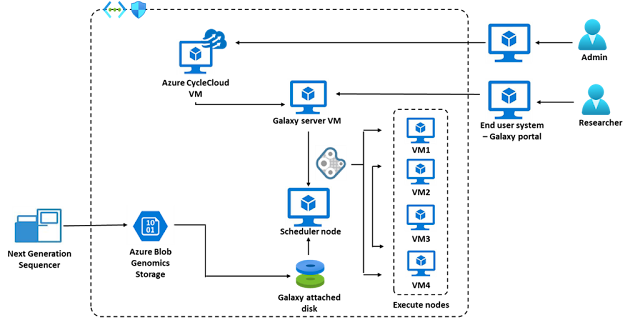
However, there are some research institutions that intend to deploy Galaxy in-house as an on-premises solution or a cloud-based solution. The remainder of this article describes how to deploy and run Galaxy on Microsoft Azure using Azure CycleCloud and grid engine cluster. The solution was built during the Microsoft hackathon (October 12 to 14, 2021) with code implementation assistance from Azure HPC Specialist, Jerry Morey. The architectural pattern described below can help organizations to deploy Galaxy in an Azure environment using CycleCloud and a scheduler of choice.

Azure CycleCloud, Azure Exam Prep, Azure Preparation, Azure Career, Azure Jobs, Azure Skills, Azure Learning

As a pre-requisite, genomic data should be available in a storage location, either cloud or on-premises. Azure CycleCloud should be deployed using the steps described in the “Install CycleCloud using the Marketplace image” documentation.

Cluster deployment that is truly supported by Galaxy on the cloud is called the unified method. In this method, the copy of Galaxy on the application server is the same copy as the one on the cluster nodes. The most common method to do this would be to put Galaxy in a network file system (NFS) somewhere that is accessible by the application server and the cluster nodes. This is the most common deployment method for Galaxy.

An admin user can SSH into Azure CycleCloud virtual machines or Galaxy server virtual machines to perform admin-related activities. It is recommended to close the SSH port when in production. Once the Galaxy server is running on a node, end users (researchers) can load the portal on their end device to perform analysis tasks which include loading data, installing, uploading tools, and more.

Access to functionalities (such as installing and deleting tools versus the usage of tools for analysis) are controlled by parameters defined in galaxy.yml that resides in the Galaxy server. Once a user accesses a functionality, they are converted to jobs that are submitted to the grid engine cluster for further execution.

Deployment scripts are available to ease deployment. These scripts can be used to deploy the latest version of Galaxy on Azure CycleCloud.

Following are the steps to use the deployment scripts:

◉ Git clone this project (The project is in active development, so cloning the latest release is recommended).


◉ Upload project to CC locker.

cd galaxy-gridengine

Modify files (if needed)

cyclecloud locker list

Azure cycle Locker (az://mystorageaccount/cyclecloud

cyclecloud project upload "Azure cycle Locker"

◉ Import cluster template to CC.

cyclecloud import_cluster <cluster-name> -c <galaxy-folder-name> -f templates/gridengine-galaxy2.txt

NOTE: Substitute <cluster-name> with a name for your cluster—all lower case, no spaces.

◉ Navigate to CC Portal to configure and start the cluster.

Wait for 30 to 45 minutes for the Galaxy server to be installed.

To check if the server is installed correctly, SSH into Galaxy server node and check galaxy.log in /shared/home/<galaxy-folder-name> directory.

This deployment was adopted by a leading United States-based academic medical center. The Microsoft Industry Solutions team helped deploy this solution on the customer’s Azure tenant. Researchers at the center tested to assess the parity of this solution to existing Galaxy deployment on their on-premises HPC environment. They were able to successfully test the deployed Galaxy server that used Azure CycleCloud for job orchestration. Several common bioinformatics tools such as bedtools, fastqc, bcftools, picard, and snpeff were installed and tested. Galaxy supports local user by default. As part of this engagement, a solution to integrate their corporate active directory was tested and deployed. The solution was found to be on par with their on-premises deployment. With the increased number of execute nodes and size of those nodes, they found that the jobs were executed in less time.

Source: microsoft.com

Sunday, 25 October 2020

Quickly get started with samples in Azure Synapse Analytics

Get started immediately on your first project with the new Knowledge center in the Azure Synapse Studio.

To further accelerate time to insight in Microsoft Azure Synapse Analytics, we are introducing the Knowledge center to simplify access to pre-loaded sample data and to streamline the getting started process for data professionals. You can now create or use existing Spark and SQL pools, connect to and query Azure Open Datasets, load sample scripts and notebooks, access pipeline templates, and tour the Azure Synapse Studio—all from one place.

Azure Synapse Analytics, Azure Learning, Azure Exam Prep, Azure Tutorial and Material, Azure Guides

The Knowledge center can be accessed from the Azure Synapse Studio Homepage under Useful links or by clicking the Question mark icon on the Navigation bar.

Azure Synapse Analytics, Azure Learning, Azure Exam Prep, Azure Tutorial and Material, Azure Guides

Use samples immediately


The Knowledge center offers several one-click tutorials that create everything you need to instantaneously explore and analyze data.

Azure Synapse Analytics, Azure Learning, Azure Exam Prep, Azure Tutorial and Material, Azure Guides

In the Explore sample data with Spark tutorial, you can easily create an Apache Spark pool and use notebooks natively inside Azure Synapse to analyze New York City (NYC) Yellow Taxi data and customize visualizations. This is possible as Azure Synapse unifies both SQL and Spark development within the same analytics service.

Azure Synapse Analytics, Azure Learning, Azure Exam Prep, Azure Tutorial and Material, Azure Guides

In the Query data with SQL tutorial, you can query and analyze the same NYC Yellow Taxi dataset with a serverless SQL pool, which allows you to use T-SQL for fast data lake exploration without provisioning or managing dedicated resources. The tutorial also enables you to quickly visualize results with one click.

Azure Synapse Analytics, Azure Learning, Azure Exam Prep, Azure Tutorial and Material, Azure Guides

The Create external table with SQL tutorial allows you to use either a serverless or dedicated SQL pool to create an external table, giving you the flexibility to harness data on your own terms and choose the most cost-effective option for each use case. Dedicated SQL pools provide a broad set of workload management capabilities including workload isolation and workload priority.

Azure Synapse Analytics, Azure Learning, Azure Exam Prep, Azure Tutorial and Material, Azure Guides

Browse available samples


The new Knowledge center also contains numerous sample datasets, notebooks, scripts, and pipeline templates to allow you to quickly get started.

Azure Synapse Analytics, Azure Learning, Azure Exam Prep, Azure Tutorial and Material, Azure Guides

Add Azure Open Datasets to access sample data on COVID-19, public safety, transportation, economic indicators, and more. The datasets are automatically loaded into the Data hub on the main navigation under the Linked tab and then Azure Blog Storage. With the click of a button, you can run sample scripts to select the top 100 rows and create an external table or you can also create a new notebook.

Azure Synapse Analytics, Azure Learning, Azure Exam Prep, Azure Tutorial and Material, Azure Guides

Regardless of whether you prefer to use PySpark, Scala, or Spark.NET C#, you can try a variety of sample notebooks. These will open in the Develop hub of the Azure Synapse Studio under Notebooks.

Azure Synapse Analytics, Azure Learning, Azure Exam Prep, Azure Tutorial and Material, Azure Guides

In addition to sample notebooks, there are samples for SQL scripts like Analyze Azure Open Datasets using SQL On-demand, Generate your COPY Statement with Dynamic SQL, and Query CSV, JSON, or Parquet files. Once these scripts are published in your workspace, they will open in the Develop hub of the main navigation under SQL scripts.

Azure Synapse Analytics, Azure Learning, Azure Exam Prep, Azure Tutorial and Material, Azure Guides

Furthermore, there are around 30 different templates for pipelines, including templates for copying data from various sources.

Azure Synapse Analytics, Azure Learning, Azure Exam Prep, Azure Tutorial and Material, Azure Guides

Tour Azure Synapse Studio


The Knowledge center offers a comprehensive tour of the Azure Synapse Studio to help familiarize you with key features so you can get started right away on your first project.

Azure Synapse Analytics, Azure Learning, Azure Exam Prep, Azure Tutorial and Material, Azure Guides

Tuesday, 25 August 2020

How Azure Synapse Analytics can help you respond, adapt, and save

Business disruptions, tactical pivots, and remote work have all emphasized the critical role that analytics plays in all organizations. Uncharted situations demand proven performance insights so that businesses can quickly determine what is and is not working. In recent months, the urgency for business-guiding insights has only been heightened, leading to a need for real-time analytics solutions. Equally important is the need to discover and share these insights in the most cost-effective manner.

Not only has COVID-19 been a challenge to world health but also has created new economic challenges to businesses worldwide. These challenges have resulted in an increased need for tools that quickly deliver insights to business leaders—empowering informed decisions. This is where Microsoft Azure Synapse Analytics can help.

New circumstances demand new solutions


Azure Synapse Analytics is a new type of analytics platform that enables you to accelerate your time-to-insight with a unified experience and—just as important—save on costs while doing so. It is up to 14 times faster and costs 94 percent less than other cloud providers. Let’s dive into how Azure Synapse can help you respond, adapt, and save.

Respond to disruption and adapt to a new normal


History shows that proven analytics technologies, such as Azure Synapse, have a strong track record of enabling more dynamic and exploratory responses that can guide businesses through difficult times. Traditional data warehouses and reports can’t scale to provide the intelligence and insight that business executives demand in today’s world.

To make good strategic decisions, businesses need to quickly and effectively find new insights in their data. This can only come through more advanced tools and an improved understanding of how to get the most from them.

Azure Synapse Analytics, Azure Tutorial and Materials, Azure Exam Prep, Azure Tutorial and Material, Azure Guides

Each recent global economic crisis can be correlated with a follow-up increase in data analytics projects as companies worldwide lean on data analytics to boost their recovery.

To enable teams to collaborate and innovate, they need tools and services that help them discover, explore, and quickly and efficiently find new insights.

Azure Synapse Analytics, Azure Tutorial and Materials, Azure Exam Prep, Azure Tutorial and Material, Azure Guides

Azure Synapse has an intelligent architecture that makes it industry-leading in unifying big data workloads with traditional data warehousing while at the same time encouraging collaboration and reducing costs.

Using Azure Synapse, businesses can empower their teams to collaborate, adapt, and create new strategies that are driven by data. Azure Synapse not only makes it easy to start and scale in the cloud, but it has key security, governance, and monitoring tools that are critical for successful data analytics solutions.

Save on costs with Azure Synapse


The current economic challenges have certainly made us all—individuals and businesses—more conscious of our spending. Businesses are looking for new ways to improve productivity and efficiency on limited budgets. Cloud analytics in general, and Azure Synapse in particular, are a great fit for this requirement because it helps businesses start small and scale as needed.

Azure Synapse offers a cost-effective service due to its intelligent architecture, which separates storage, compute power, and resources—but makes them seamlessly available when needed. This means that you do not have to keep paying for cloud services if you experience unexpected events that cause business disruptions and tactical pivots. Services can simply be paused to release resources and save costs. You can also scale compute separately from storage, which brings even more cost savings.

Azure Synapse Analytics, Azure Tutorial and Materials, Azure Exam Prep, Azure Tutorial and Material, Azure Guides

Azure Synapse has been found to offer a significantly better price-to-performance ratio when compared with similar services from other cloud providers. This chart from an independent study shows the price-performance comparison (lower is better).

In a recent study, GigaOm, an independent emerging technology research firm, found that Azure Synapse has the best price-to-performance ratio on the market. The study surveyed many services from all of the major cloud providers and took both performance and cost into account. Besides being powerful and cost-effective, Azure Synapse offers industry-leading features when it comes to governance, monitoring, and collaboration that address key challenges for data analytics projects. These features provide businesses with the right tools to control not only costs but also the entire analytics lifecycle, including security, performance, and accuracy.

Thursday, 20 August 2020

Share big data at scale with Azure Data Share in-place sharing for Azure Data Explorer

Microsoft Azure Data Share is an open, easy, and secure way to share data at scale by enabling organizations to share data in-place or as a data snapshot. Microsoft Azure Data Explorer is a fast and highly scalable data analytics service for telemetry, time-series, and log data.

Fueled by digital transformation, modern organizations want to increasingly enable fluid data sharing to drive business decisions. Seamlessly sharing data for inter-departmental and inter-organizational collaboration can unlock tremendous competitive advantage. Maintaining control and visibility, however, remains an elusive goal. Even today, data is shared using File Transfer Protocols (FTPs), application programming interfaces (APIs), USB devices, and email attachments. These methods are simply not secure, cannot be governed, and are inefficient at best.

Azure Data Share in-place Sharing for Azure Data Explorer, now generally available, enables you to share big data easily and securely between internal departments and with external partners, vendors, or customers for near real-time collaboration.

Once data providers share data, recipients (data consumers) always have the latest data without needing any additional intervention. Additionally, data providers maintain control over the sharing and can revoke access at will. By being able to centrally manage all shared relationships, data providers gain full control of what data is shared and with whom. Operating within a fully managed environment that can scale on-demand, data providers can focus on the logic while Data Share manages the infrastructure.

How in-place data sharing works


Data providers can initiate sharing by specifying the Azure Data Explorer cluster or database they want to share, who to share with, and terms of use. Next, the Data Share service sends an email invitation to the data consumer who can accept the sharing.

Microsoft Online Exam, Microsoft Prep, Azure Tutorial and Materials, Azure Certification

After the sharing relationship is established, Data Share creates a symbolic link between the provider and consumer's Azure Data Explorer cluster. This enables the data consumer to read and query the data in near real-time. Access to the data uses compute resources from the consumer's Azure Data Explorer cluster.

Microsoft Online Exam, Microsoft Prep, Azure Tutorial and Materials, Azure Certification

With Azure Data Explorer, data is cached, indexed, and distributed on the compute nodes within the cluster and persisted on Azure storage. Since the compute and storage are decoupled, multiple consuming clusters can be attached to the same source storage with different set of caching policies without impacting the performance and security of the source cluster.

The in-place sharing capability is a game changer for organizations looking for near real-time big data collaboration between internal departments or with external partners and customers.

Tuesday, 30 June 2020

Advancing Azure service quality with artificial intelligence: AIOps

As Mark mentioned when he launched this Advancing Reliability blog series, building and operating a global cloud infrastructure at the scale of Azure is a complex task with hundreds of ever-evolving service components, spanning more than 160 datacenters and across more than 60 regions. To rise to this challenge, we have created an AIOps team to collaborate broadly across Azure engineering teams and partnered with Microsoft Research to develop AI solutions to make cloud service management more efficient and more reliable than ever before. We are going to share our vision on the importance of infusing AI into our cloud platform and DevOps process. Gartner referred to something similar as AIOps (pronounced “AI Ops”) and this has become the common term that we use internally, albeit with a larger scope. Today’s post is just the start, as we intend to provide regular updates to share our adoption stories of using AI technologies to support how we build and operate Azure at scale.

Why AIOps?


There are two unique characteristics of cloud services:

◉ The ever-increasing scale and complexity of the cloud platform and systems
◉ The ever-changing needs of customers, partners, and their workloads

To build and operate reliable cloud services during this constant state of flux, and to do so as efficiently and effectively as possible, our cloud engineers (including thousands of Azure developers, operations engineers, customer support engineers, and program managers) heavily rely on data to make decisions and take actions. Furthermore, many of these decisions and actions need to be executed automatically as an integral part of our cloud services or our DevOps processes. Streamlining the path from data to decisions to actions involves identifying patterns in the data, reasoning, and making predictions based on historical data, then recommending or even taking actions based on the insights derived from all that underlying data.

Azure Study Material, Azure Guides, Azure Learning, Azure Certification, Azure Exam Prep

Figure 1. Infusing AI into cloud platform and DevOps.

The AIOps vision


AIOps has started to transform the cloud business by improving service quality and customer experience at scale while boosting engineers’ productivity with intelligent tools, driving continuous cost optimization, and ultimately improving the reliability, performance, and efficiency of the platform itself. When we invest in advancing AIOps and related technologies, we see this ultimately provides value in several ways:

◉ Higher service quality and efficiency: Cloud services will have built-in capabilities of self-monitoring, self-adapting, and self-healing, all with minimal human intervention. Platform-level automation powered by such intelligence will improve service quality (including reliability, and availability, and performance), and service efficiency to deliver the best possible customer experience.

◉ Higher DevOps productivity: With the automation power of AI and ML, engineers are released from the toil of investigating repeated issues, manually operating and supporting their services, and can instead focus on solving new problems, building new functionality, and work that more directly impacts the customer and partner experience. In practice, AIOps empowers developers and engineers with insights to avoid looking at raw data, thereby improving engineer productivity.

◉ Higher customer satisfaction: AIOps solutions play a critical role in enabling customers to use, maintain, and troubleshoot their workloads on top of our cloud services as easily as possible. We endeavor to use AIOps to understand customer needs better, in some cases to identify potential pain points and proactively reach out as needed. Data-driven insights into customer workload behavior could flag when Microsoft or the customer needs to take action to prevent issues or apply workarounds. Ultimately, the goal is to improve satisfaction by quickly identifying, mitigating, and fixing issues.

My colleagues Marcus Fontoura, Murali Chintalapati, and Yingnong Dang shared Microsoft’s vision, investments, and sample achievements in this space during the keynote AI for Cloud–Toward Intelligent Cloud Platforms and AIOps at the AAAI-20 Workshop on Cloud Intelligence in conjunction with the 34th AAAI Conference on Artificial Intelligence. The vision was created by a Microsoft AIOps committee across cloud service product groups including Azure, Microsoft 365, Bing, and LinkedIn, as well as Microsoft Research (MSR). In the keynote, we shared a few key areas in which AIOps can be transformative for building and operating cloud systems, as shown in the chart below.

Azure Study Material, Azure Guides, Azure Learning, Azure Certification, Azure Exam Prep

Figure 2. AI for Cloud: AIOps and AI-Serving Platform.

AIOps


Moving beyond our vision, we wanted to start by briefly summarizing our general methodology for building AIOps solutions. A solution in this space always starts with data—measurements of systems, customers, and processes—as the key of any AIOps solution is distilling insights about system behavior, customer behaviors, and DevOps artifacts and processes. The insights could include identifying a problem that is happening now (detect), why it’s happening (diagnose), what will happen in the future (predict), and how to improve (optimize, adjust, and mitigate). Such insights should always be associated with business metrics—customer satisfaction, system quality, and DevOps productivity—and drive actions in line with prioritization determined by the business impact. The actions will also be fed back into the system and process. This feedback could be fully automated (infused into the system) or with humans in the loop (infused into the DevOps process). This overall methodology guided us to build AIOps solutions in three pillars.

Azure Study Material, Azure Guides, Azure Learning, Azure Certification, Azure Exam Prep

Figure 3. AIOps methodologies: Data, insights, and actions.

AI for systems


Today, we're introducing several AIOps solutions that are already in use and supporting Azure behind the scenes. The goal is to automate system management to reduce human intervention. As a result, this helps to reduce operational costs, improve system efficiency, and increase customer satisfaction. These solutions have already contributed significantly to the Azure platform availability improvements, especially for Azure IaaS virtual machines (VMs). AIOps solutions contributed in several ways including protecting customers’ workload from host failures through hardware failure prediction and proactive actions like live migration and Project Tardigrade and pre-provisioning VMs to shorten VM creation time.

Of course, engineering improvements and ongoing system innovation also play important roles in the continuous improvement of platform reliability.

◉ Hardware Failure Prediction is to protect cloud customers from interruptions caused by hardware failures. We shared our story of Improving Azure Virtual Machine resiliency with predictive ML and live migration back in 2018. Microsoft Research and Azure have built a disk failure prediction solution for Azure Compute, triggering the live migration of customer VMs from predicted-to-fail nodes to healthy nodes. We also expanded the prediction to other types of hardware issues including memory and networking router failures. This enables us to perform predictive maintenance for better availability.

◉ Pre-Provisioning Service in Azure brings VM deployment reliability and latency benefits by creating pre-provisioned VMs. Pre-provisioned VMs are pre-created and partially configured VMs ahead of customer requests for VMs. As we described in the IJCAI 2020 publication, As we described in the AAAI-20 keynote mentioned above,  the Pre-Provisioning Service leverages a prediction engine to predict VM configurations and the number of VMs per configuration to pre-create. This prediction engine applies dynamic models that are trained based on historical and current deployment behaviors and predicts future deployments. Pre-Provisioning Service uses this prediction to create and manage VM pools per VM configuration. Pre-Provisioning Service resizes the pool of VMs by destroying or adding VMs as prescribed by the latest predictions. Once a VM matching the customer's request is identified, the VM is assigned from the pre-created pool to the customer’s subscription.

AI for DevOps


AI can boost engineering productivity and help in shipping high-quality services with speed. Below are a few examples of AI for DevOps solutions.

◉ Incident management is an important aspect of cloud service management—identifying and mitigating rare but inevitable platform outages. A typical incident management procedure consists of multiple stages including detection, engagement, and mitigation stages. Time spent in each stage is used as a Key Performance Indicator (KPI) to measure and drive rapid issue resolution. KPIs include time to detect (TTD), time to engage (TTE), and time to mitigate (TTM).

Azure Study Material, Azure Guides, Azure Learning, Azure Certification, Azure Exam Prep

Figure 4. Incident management procedures.

As shared in AIOps Innovations in Incident Management for Cloud Services at the AAAI-20 conference, we have developed AI-based solutions that enable engineers not only to detect issues early but also to identify the right team(s) to engage and therefore mitigate as quickly as possible. Tight integration into the platform enables end-to-end touchless mitigation for some scenarios, which considerably reduces customer impact and therefore improves the overall customer experience.

◉ Anomaly Detection provides an end-to-end monitoring and anomaly detection solution for Azure IaaS. The detection solution targets a broad spectrum of anomaly patterns that includes not only generic patterns defined by thresholds, but also patterns which are typically more difficult to detect such as leaking patterns (for example, memory leaks) and emerging patterns (not a spike, but increasing with fluctuations over a longer term). Insights generated by the anomaly detection solutions are injected into the existing Azure DevOps platform and processes, for example, alerting through the telemetry platform, incident management platform, and, in some cases, triggering automated communications to impacted customers. This helps us detect issues as early as possible.

For an example that has already made its way into a customer-facing feature, Dynamic Threshold is an ML-based anomaly detection model. It is a feature of Azure Monitor used through the Azure portal or through the ARM API. Dynamic Threshold allows users to tune their detection sensitivity, including specifying how many violation points will trigger a monitoring alert.

◉ Safe Deployment serves as an intelligent global “watchdog” for the safe rollout of Azure infrastructure components. We built a system, code name Gandalf, that analyzes temporal and spatial correlation to capture latent issues that happened hours or even days after the rollout. This helps to identify suspicious rollouts (during a sea of ongoing rollouts), which is common for Azure scenarios, and helps prevent the issue propagating and therefore prevents impact to additional customers.

AI for customers


To improve the Azure customer experience, we have been developing AI solutions to power the full lifecycle of customer management. For example, a decision support system has been developed to guide customers towards the best selection of support resources by leveraging the customer’s service selection and verbatim summary of the problem experienced. This helps shorten the time it takes to get customers and partners the right guidance and support that they need.

AI-serving platform


To achieve greater efficiencies in managing a global-scale cloud, we have been investing in building systems that support using AI to optimize cloud resource usage and therefore the customer experience. One example is Resource Central (RC), an AI-serving platform for Azure that we described in Communications of the ACM. It collects telemetry from Azure containers and servers, learns from their prior behaviors, and, when requested, produces predictions of their future behaviors. We are already using RC to predict many characteristics of Azure Compute workloads accurately, including resource procurement and allocation, all of which helps to improve system performance and efficiency.

Looking towards the future


We have shared our vision of AI infusion into the Azure platform and our DevOps processes and highlighted several solutions that are already in use to improve service quality across a range of areas. Look to us to share more details of our internal AI and ML solutions for even more intelligent cloud management in the future. We’re confident that these are the right investment solutions to improve our effectiveness and efficiency as a cloud provider, including improving the reliability and performance of the Azure platform itself.