Showing posts with label ADF Visual tools. Show all posts

Tuesday, 29 January 2019

Development, source control, and CI/CD for Azure Stream Analytics jobs

Do you know how to develop and source control your Microsoft Azure Stream Analytics (ASA) jobs? Do you know how to setup automated processes to build, test, and deploy these jobs to multiple environments? Stream Analytics Visual Studio tools together with Azure Pipelines provides an integrated environment that helps you accomplish all these scenarios. This article will show you how and point you to the right places in order to get started using these tools.

In the past it was difficult to use Azure Data Lake Store Gen1 as the output sink for ASA jobs, and to set up the related automated CI/CD process. This was because the OAuth model did not allow automated authentication for this kind of storage. The tools being released in January 2019 support Managed Identities for Azure Data Lake Storage Gen1 output sink and now enable this important scenario.

This article covers the end-to-end development and CI/CD process using Stream Analytics Visual Studio tools, Stream Analytics CI.CD NuGet package, and Azure Pipelines. Currently Visual Studio 2019, 2017, and 2015 are all supported. If you haven’t tried the tools, follow the installation instructions to get started!

Job development


Let’s get started by creating a job. Stream Analytics Visual Studio tools allows you to manage your jobs using a project. Each project consists of an ASA query script, a job configuration, and several input and output configurations. Query editing is very efficient when using all the IntelliSense features like error markers, auto completion, and syntax highlighting.

Azure Tutorial and Material, Azure Guides, Azure Learning, Azure Study Material

If you have existing jobs and want to develop them in Visual Studio or add source control, just export them to local projects first. You can do this from the server explorer context menu for a given ASA job. This feature can also be used to easily copy a job across regions without authoring everything from scratch.

Azure Tutorial and Material, Azure Guides, Azure Learning, Azure Study Material

Developing in Visual Studio also provides you with the best native authoring and debugging experience when you are writing JavaScript user defined functions in cloud jobs or C# user defined functions in Edge jobs.

Source control


When created as projects, the query and other artifacts sit on the local disk of your development computer. You can use the Azure DevOps, formerly Visual Studio Team Service, for version control or commit code directly to any repositories you want. By doing this you can save different versions of the .asaql query as well as inputs, outputs, and job configurations while easily reverting to previous versions when needed.

Azure Tutorial and Material, Azure Guides, Azure Learning, Azure Study Material

Testing locally


During development, use local testing to iteratively run and fix code with local sample data or live streaming input data. Running locally starts the query in seconds and makes the testing cycle much shorter.

Testing in the cloud


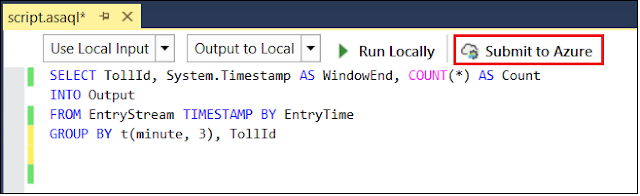
Once the query works well on your local machine, it’s time to submit to the cloud for performance and scalability testing. Select “Submit to Azure” in the query editor to upload the query and start the job running. You can then view the job metrics and job flow diagram from within Visual Studio.

Azure Tutorial and Material, Azure Guides, Azure Learning, Azure Study Material

Azure Tutorial and Material, Azure Guides, Azure Learning, Azure Study Material

Setup CI/CD pipelines


When your query testing is complete, the next step is to setup your CI/CD pipelines for production environments. ASA jobs are deployed as Azure resources using Azure Resource Manager (ARM) templates. Each job is defined by an ARM template definition file and a parameter file.

There are two ways to generate the two files mentioned above:

1. In Visual Studio, right click your project name and select “Build.”
2. On an arbitrary build machine, install Stream Analytics CI.CD NuGet package and run the command “build” only supported on Windows at this time. This is needed for an automated build process.

Performing a “build” generates the two files under the “bin” folder and lets you save them wherever you want.

Azure Tutorial and Material, Azure Guides, Azure Learning, Azure Study Material

The default values in the parameter file are the ones from the inputs/outputs job configuration files in your Visual Studio project. To deploy in multiple environments, replace the values via a simple power shell script in the parameter file to generate different versions of this file to specify the target environment. In this way you can deploy into dev, test, and eventually production environments.

Azure Tutorial and Material, Azure Guides, Azure Learning, Azure Study Material

As stated above, the Stream Analytics CI.CD NuGet package can be used independently or in the CI/CD systems such as Azure Pipelines to automate the build and test process of your Stream Analytics Visual Studio project.

Friday, 26 January 2018

Azure Data Factory: Visual Tools enabled in public preview

Our goal with visual tools for ADF v2 is to increase productivity and efficiency for both new and advanced users with intuitive experiences. You can get started by clicking the Author & Monitor tile in your provisioned v2 data factory blade.

Azure Tutorials and Materials, Azure Guides, Azure Learning, Microsoft Materials

Get Started Quickly


1. Create your first ADF v2 pipeline

2. Quickly Copy Data from a bunch of data sources using the copy wizard

3. Configure SSIS IR to lift and shift SSIS packages to Azure

4. Set up code repo (VSTS GIT) for source control, collaboration, versioning etc..

Azure Tutorials and Materials, Azure Guides, Azure Learning, Microsoft Materials

Visual Authoring


Author Control Flow Pipelines

Create pipelines, drag and drop activities, connect them on-success, on-failure, on-completion.

Azure Tutorials and Materials, Azure Guides, Azure Learning, Microsoft Materials

Create Azure & Self Hosted Integration runtimes

Create a self hosted integration runtime for hybrid data movement or an Azure-SSIS IR for lifting and shifting SSIS packages to Azure. Create linked service connections to your data stores or compute.

Azure Tutorials and Materials, Azure Guides, Azure Learning, Microsoft Materials

Support for all control flow activities running on Azure computes

Control Flow Activities:

◉ HDInsight Hive, HDInsight Pig, HDInsight Map Reduce, HDI Streaming, HDI Spark, U-SQL, Stored Procedure, Web, For Each, Get Metadata, Look up, Execute Pipeline

Support for Azure Computes:

◉ HDI (on-demand, BYOC), ADLA, Azure Batch

Iterative development and debugging

Do Test Runs before attaching a trigger on the pipeline and running on-demand or on a schedule.

Azure Tutorials and Materials, Azure Guides, Azure Learning, Microsoft Materials

Parameterize pipelines and datasets

Parameterize using expressions, system variables.

Azure Tutorials and Materials, Azure Guides, Azure Learning, Microsoft Materials

Rich Validation Support

You can now validate your pipelines to know about missed property configurations or incorrect configurations. Simply click the Validate button in the pipeline canvas. This will generate the validation output in side drawer. You can then click on each entry to go straight to the location of the missing validation.

Azure Tutorials and Materials, Azure Guides, Azure Learning, Microsoft Materials

Trigger pipelines

Trigger on-demand, run pipelines on schedule.

Azure Tutorials and Materials, Azure Guides, Azure Learning, Microsoft Materials

Use VSTS GIT

VSTS GIT for source control, collaboration, versioning, etc.

Azure Tutorials and Materials, Azure Guides, Azure Learning, Microsoft Materials

Copy Data

Data Stores (65)

Support for 65 data stores. 18 stores with first class support that require users to provide just configuration values. The remaining 47 stores can be used with JSON.

18 stores with first class support:

◉ Azure Blob, Azure CosmosDB, Azure Database for MySQL, Azure Data Lake Store, Amazon Redshift, Amazon S3, Azure SQL DW, Azure SQL, Azure Table, File System, HDFS, MySQL, ODBC, Oracle, Salesforce, SAP HANA, SAP BW, SQL Server

47 Stores with JSON support:

◉ Search Index, Cassandra, HTTP file, Mongo DB, OData, Relational table, Dynamics 365, Dynamics CRM, Web table, AWS Marketplace, PostgreSQL, Concur, Couchbase, Drill, Oracle Eloqua, Google Big Query, Greenplum, HBase, Hive, HubSpot, Apache Impala, Jira, Magento, MariaDB, Marketo, PayPal, Phoenix, Presto, QuickBooks, ServiceNow, Shopify, Spark, Square, Xero, Zoho, DB2, FTP, GE Historian, Informix, Microsoft Access, MongoDB, SAP Cloud for customer

Azure Tutorials and Materials, Azure Guides, Azure Learning, Microsoft Materials

Use copy wizard to quickly copy data from a bunch of data sources

The familiar ADF v1 copy wizard is now available in ADF v2 to do one-time quick import. Copy Wizard generates pipelines with copy activities on authoring canvas. The copy activities can now be extended to run other activities like Spark, USQL, Stored Proc etc. on-success, on-failure etc. and create the entire control flow pipeline.

Azure Tutorials and Materials, Azure Guides, Azure Learning, Microsoft Materials

Guided tour

Click on the Information Icon in the lower left. You can then click Guided tour to get step by step instructions on how to visually monitor your pipeline and activity runs.

Azure Tutorials and Materials, Azure Guides, Azure Learning, Microsoft Materials

Feedback

Click on the Feedback icon to give us feedback on various features or any issues that you may be facing.

Azure Tutorials and Materials, Azure Guides, Azure Learning, Microsoft Materials

Select data factory

Hover on the Data Factory icon on the top left. Click on the Arrow icon to see a list of Azure subscriptions and data factories that you can monitor.

Azure Tutorials and Materials, Azure Guides, Azure Learning, Microsoft Materials

Visual Monitoring


List View Monitoring

Monitor pipeline, activity & trigger runs with a simple list view interface. All the runs are displayed in local browser time zone. You can change the time zone and all the date time fields will snap to the selected time zone.

Monitor Pipeline Runs:

List view showcasing each pipeline run for your data factory v2 pipelines.

Azure Tutorials and Materials, Azure Guides, Azure Learning, Microsoft Materials

Monitor Activity Runs:

List view showcasing activity runs corresponding to each pipeline run. Click Activity Runs icon under the Actions column to view activity runs for each pipeline run.

Azure Tutorials and Materials, Azure Guides, Azure Learning, Microsoft Materials

Important note: You need to click the Refresh icon on top to refresh the list of pipeline and activity runs. Auto-refresh is currently not supported.

Monitor Trigger Runs:

Azure Tutorials and Materials, Azure Guides, Azure Learning, Microsoft Materials

Rich ordering and filtering

Order pipeline runs in desc/asc by Run Start and filter pipeline runs pipeline name, run start and run status.

Azure Tutorials and Materials, Azure Guides, Azure Learning, Microsoft Materials

Add/Remove columns to list view

Right click the list view header and choose columns that you want to appear in the list view.

Azure Tutorials and Materials, Azure Guides, Azure Learning, Microsoft Materials

Reorder columns widths in list view

Increase and decrease the column widths in list view by simply hovering over the column header.

Monitor Integration Runtimes

Monitor health of your Self Hosted, Azure, Azure-SSIS Integration runtimes.

Azure Tutorials and Materials, Azure Guides, Azure Learning, Microsoft Materials

Cancel/Re-run your pipeline runs

Cancel a pipeline run or re-run a pipeline run with already defined parameters.

Azure Tutorials and Materials, Azure Guides, Azure Learning, Microsoft Materials

This is the first public release of ADF v2 visual tools We are continuously working to refresh the released bits with new features based on customer feedback. Get more information and detailed steps for using the ADF v2 visual tools.