Tuesday, 21 January 2020

Azure Data Explorer and Stream Analytics for anomaly detection

Anomaly detection plays a vital role in many industries across the globe, such as fraud detection for the financial industry, health monitoring in hospitals, fault detection and operating environment monitoring in the manufacturing, oil and gas, utility, transportation, aviation, and automotive industries.

Anomaly detection is about finding patterns in data that do not conform to expected behavior. It is important for decision-makers to be able to detect them and take proactive actions if needed. Using the oil and gas industry as one example, deep-water rigs with various equipment are intensively monitored by hundreds of sensors that send measurements in various frequencies and formats. Analysis or visualization is hard using traditional software platforms, and any non-productive time on deep-water oil rig platforms caused by the failure to detect anomaly could mean large financial losses each day.

Companies need new technologies like Azure IoT, Azure Stream Analytics, Azure Data Explorer and machine learning to ingest, processes, and transform data into strategic business intelligence to enhance exploration and production, improve manufacturing efficiency, and ensure safety and environmental protection. These managed services also help customers dramatically reduce software development time, accelerate time to market, provide cost-effectiveness, and achieve high availability and scalability.

While the Azure platform provides lots of options for anomaly detection and customers can choose the technology that best suits their needs, customers also brought questions to field facing architects on what use cases are most suitable for each solution. We’ll examine the answers to these questions below, but first, you’ll need to know a couple definitions:

What is a time series? A time series is a series of data points indexed in time order. In the oil and gas industry, most equipment or sensor readings are sequences taken at successive points in time or depth.

What is decomposition of additive time series? Decomposition is the task to separate a time series into components as shown on the graph below.

Data Science, Azure, Azure Study Materials, Azure Certifications, Azure Guides, Azure Online Exam

Time-series forecasting and anomaly detection


Data Science, Azure, Azure Study Materials, Azure Certifications, Azure Guides, Azure Online Exam

Anomaly detection is the process to identify observations that are different significantly from majority of the datasets.

Data Science, Azure, Azure Study Materials, Azure Certifications, Azure Guides, Azure Online Exam

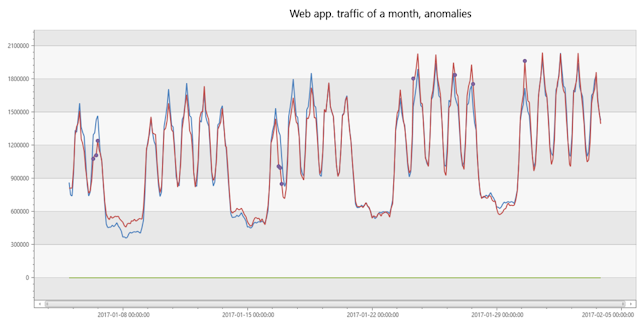
This is an anomaly detection example with Azure Data Explorer.

◉ The red line is the original time series.

◉ The blue line is the baseline (seasonal + trend) component.

◉ The purple points are anomalous points on top of the original time series.

To detect anomalies, either Azure Stream Analytics or Azure Data Explorer can be used for real-time analytics and detection as illustrated in the diagram below.

Data Science, Azure, Azure Study Materials, Azure Certifications, Azure Guides, Azure Online Exam

Azure Stream Analytics is an easy-to-use, real-time analytics service that is designed for mission-critical workloads. You can build an end-to-end serverless streaming pipeline with just a few clicks, go from zero to production in minutes using SQL, or extend it with custom code and built-in machine learning capabilities for more advanced scenarios.

Azure Data Explorer is a fast, fully managed data analytics service for near real-time analysis on large volumes of data streaming from applications, websites, IoT devices, and more. You can ask questions and iteratively explore data on the fly to improve products, enhance customer experiences, monitor devices, boost operations, and quickly identify patterns, anomalies, and trends in your data.

Azure Stream Analytics or Azure Data Explorer?


Use Case

Stream Analytics is for continuous or streaming real-time analytics, with aggregate functions support hopping, sliding, tumbling, or session windows. It will not suit your use case if you want to write UDFs or UDAs in languages other than JavaScript or C#, or if  your solution is in a multi-cloud or on-premises environment.

Data Explorer is for on-demand or interactive near real-time analytics, data exploration on large volumes of data streams, seasonality decomposition, ad hoc work, dashboards, and root cause analyses on data from near real-time to historical. It will not suit you use case if you need to deploy analytics onto the edge.

Forecasting

You can set up a Stream Analytics job that integrates with Azure Machine Learning Studio.

Data Explorer provides native function for forecasting time series based on the same decomposition model. Forecasting is useful for many scenarios like preventive maintenance, resource planning, and more.

Seasonality

Stream Analytics does not provide seasonality support, with the limitation of sliding windows size.

Data Explorer provides functionalities to automatically detect the periods in the time series or allows you to verify that a metric should have specific distinct period(s) if you know them.

Decomposition

Stream Analytics does not support decomposition.

Data Explorer provides function which takes a set of time series and automatically decomposes each time series to its seasonal, trend, residual, and baseline components.

Filtering and Analysis

Stream Analytics provides functions to detect spikes and dips or change points.

Data Explorer provides analysis to finds anomalous points on a set of time series, and a root cause analysis (RCA) function after anomaly is detected.

Filtering

Stream Analytics provides a filter with reference data, slow-moving, or static.

Data Explorer provides two generic functions:

• Finite impulse response (FIR) which can be used for moving average, differentiation, shape matching
• Infinite impulse response (IIR) for exponential smoothing and cumulative sum

Anomaly Detection

Stream Analytics provides detections for:

• Spikes and dips (temporary anomalies)
• Change points (persistent anomalies such as level or trend change)

Data Explorer provides detections for:

• Spikes & dips, based on enhanced seasonal decomposition model (supporting automatic seasonality detection, robustness to anomalies in the training data)
• Changepoint (level shift, trend change) by segmented linear regression
• KQL Inline Python/R plugins enable extensibility with other models implemented in Python or R

Saturday, 18 January 2020

Microsoft Sustainability Calculator helps enterprises analyze the carbon emissions of their IT infrastructure

Microsoft Tutorial and Materials, Azure Study Materials, Azure Learning, Azure Guides, Azure Online Exam

For more than a decade, Microsoft has been investing to reduce environmental impact while supporting the digital transformation of organizations around the world through cloud services. We strive to be transparent with our commitments, evidenced by our announcement that Microsoft’s cloud datacenters will be powered by 100 percent renewable energy sources by 2025. The commitments and investments we make as a company are important steps in reducing our own environmental impact, but we recognize that the opportunity for positive change is greatest by empowering customers and partners to achieve their own sustainability goals.

An industry first—the Microsoft Sustainability Calculator


Today we’re announcing the availability of the Microsoft Sustainability Calculator, a Power BI application for Azure enterprise customers that provides new insight into carbon emissions data associated with their Azure services. Migrating from traditional datacenters to cloud services significantly improves efficiencies, however, enterprises are now looking for additional insights into the carbon impact of their cloud workloads to help them make more sustainable computing decisions. For the first time, those responsible for reporting on and driving sustainability within their organizations will have the ability to quantify the carbon impact of each Azure subscription over a period of time and datacenter region, as well as see estimated carbon savings from running those workloads in Azure versus on-premises datacenters. This data is crucial for reporting existing emissions and is the first step in establishing a foundation to drive further decarbonization efforts.

Microsoft Tutorial and Materials, Azure Study Materials, Azure Learning, Azure Guides, Azure Online Exam

Providing transparency with rigorous methodology


The tool’s calculations are based on a customer’s Azure consumption, informed by the research in the 2018 whitepaper, “The Carbon Benefits of Cloud Computing: a Study of the Microsoft Cloud”, and have been independently verified by Apex, a leading environmental verification body. The calculator factors in inputs such as the energy requirements of the Azure service, the energy mix of the electric grid serving the hosting datacenters, Microsoft’s procurement of renewable energy in those datacenters, as well as the emissions associated with the transfer of data over the internet. The result is an estimate of the greenhouse gas (GHG) emissions, measured in total metric tons of carbon equivalent (MTCO2e) related to a customer’s consumption of Azure.

The calculator gives a granular view of the estimated emissions savings from running workloads on Azure by accounting for Microsoft’s IT operational efficiency, IT equipment efficiency, and datacenter infrastructure efficiency compared to that of a typical on-premises deployment. It also estimates the emissions savings attributable to a customer from Microsoft’s purchase of renewable energy.

Microsoft Tutorial and Materials, Azure Study Materials, Azure Learning, Azure Guides, Azure Online Exam

We also understand customers want transparency into the specific commitments we are making to build a more sustainable cloud. To make that information easily accessible, we’ve built a view within the tool of the renewable energy projects that Microsoft has invested in as part of its carbon neutral and renewable energy commitments. Each year Microsoft purchases renewable energy to cover its annual cloud consumption. Customers can use the world map to learn about projects in regions where they consume Azure services or have a regional presence. The projects are examples of the investments that Microsoft has made since 2012.

A path to actionable insight


Azure enterprise customers can get started by downloading the Microsoft Sustainability Calculator from AppSource now and following the included setup instructions. We’re excited by the opportunity this new tool provides for our customers to gain a deeper understanding of their current infrastructure and drive meaningful sustainability conversations within their organizations. We see this as a first step and plan to deepen and expand the tool’s capabilities in the future. We know our customers would like an even more comprehensive view of the sustainability benefits of our cloud services and look forward to supporting and enabling them in their journey.

Friday, 17 January 2020

The Best Microsoft 70-465 Exam Tips & Tricks for Passing the Test in Your First Try

About Designing Database Solutions for Microsoft SQL Server (70-465) Certification

Candidates for the Microsoft Designing Database Solutions for Microsoft SQL Server (70-465) exam are database professionals who design and develop database solutions in an organization. Microsoft suggests experience in building plans and designs for database structure, storage, objects and servers, and planning for the environment in which the database solution runs.
70-465, microsoft 70-465, microsoft 70-465 exam, 70-465 certification, 70-465 mock test, 70-465 practice quizzes
Attempting this 70-465 Designing Database Solutions for Microsoft SQL Server Preparation exam, candidates will prepare themselves for MS Exam 70-465 and learn to create plans and designs for database structure, storage, objects, and servers in hands-on labs and design tasks.

You can learn to design and monitor high performance, highly available data solutions with Microsoft SQL Server 2012 along with data concentration, high availability, data migration, security, and scalability.

Microsoft 70-465 Details:

  • Name: Designing Database Solutions for Microsoft SQL Server
  • Code: 70-465
  • Duration: 150 minutes
  • Questions: 40-60
  • Passing score: 700 out of 1000
  • Price: 165 USD
  • Languages: English, Chinese (Simplified), French, German, Japanese, Portuguese (Brazil)
  • Audiences: IT professionals
  • Technology: Microsoft SQL Server
  • Credit toward certification: MCSE

This 70-465 exam measures the following skills:

  • Private Clouds
  • Windows Azure SQL Database
  • High Availability
  • Clustering and Always On
  • Backup and Recovery

Prerequisites:

At least two years’ experience of operating with relational databases, including:
  • Planning and implementing databases
  • Managing databases
  • Querying with Transact-SQL
  • Some basic knowledge of high availability and failure recovery
  • Some basic knowledge of Microsoft Azure technologies and concepts around cloud computing

Microsoft 70-465 Exam Preparation Tips and Tricks

1. Take the Overview of the 70-465 Exam

Ones beginning to learn a new course, you must always keep in mind to give yourself an introduction to the same. Such a practice can aid you in dealing with a subject in a better way possible. Knowing a plan from start to end can also create a level of confidence in you and to mentally prepare you for the upcoming topics.

2. Make a Plan

Once you have collected the study material, take a look at the certification that you need to cover, and then make a study plan for yourself. Always remember that you cannot crack the Microsoft 70-461 exam if you do not have a proper study plan. In your study plan, include information such as the time you will give to the studies and the type of study you will be doing. If you do not understand the subject, start preparing as quickly as possible.

3. Take 70-465 Practice Quizzes

As you are working through the plan, take quizzes whose questions are about those topics to receive feedback. Remember, what you understand is key. There is no want to spend time on the topic you understand. Taking quizzes will help you get where you need. Also, getting in the way of reading and answering questions is good training for the final Microsoft 70-465 exam.

4. Work Sample Queries

Working problem sets are an excellent way to put your knowledge to use and commit it to long term memory.

5. Classify Weak Areas and Focus

After you study a topic and taking a practice quiz, look at what questions you are missing. Double back on those subjects and review. It important that you gain a solid knowledge of a topic before moving on. Many topics in SQL build upon each other. That is why the plan is so great. It outlines what you require to learn first.

6. Take a Microsoft 70-465 Mock Test

Once you have finished your studies, do a full mock test by doing all the practice quiz problems? The practice quiz would not be the same as the final 70-465 exam, but the training is valuable, never-the-less.

Doing a final practice quiz assists, you gain confidence in knowing you can sit for a long time and answer questions. Believe it or not, taking a test can be fatiguing.

Also, it is a confidence booster. It gives you confirmation that you know the material and a final opportunity to detect any weaknesses and address them the week before the exam.

7. Involve in Regular Practice

It is essential to your preparation process. Irrespective of how hard you study, if you do not take out time to practice what you have learned, there is no method you can know the extent of your assimilation and knowledge level. You must take the practice test as you continue in your studies.

Go online and search for sites that give 70-465 practice questions. You might want to check the free options of practice tests available and ensure you put in your best in providing the best correct answers to the questions. Check the practice test as if you are in the real exam setting and give it all you have got. Check your scores and review areas you get wrong to be fully implemented in answering them.
Taking a practice test will aid you to know your weak areas so that you can focus on them and be able to perform better in succeeding practice.

8. Relax and Rest

Take a couple of days off before the 70-465 exam. Do some light review, but do not cram! By the time you get a couple of days before the exam, you should have all your considering made and be ready. Just rest and do not stress yourself out.

9. Rock the 70-465 Exam

Get a good night’s sleep, clear your day of any stressful work, have an excellent healthy breakfast, then do it!

Conclusion

If you can invest sufficient preparation, knowledge, and practice in your Microsoft 70-465 certification examination, you should be sure to sit for the exam and pass it perfectly well. Remember, it takes preparation to achieve success. So, read your exam all you have got and think about your success.

Good Luck….!!!

Thursday, 16 January 2020

New Azure blueprint for CIS Benchmark

We’ve released our newest Azure blueprint that maps to another key industry-standard, the Center for Internet Security (CIS) Microsoft Azure Foundations Benchmark. This follows the recent announcement of our Azure blueprint for FedRAMP moderate and adds to the growing list of Azure blueprints for regulatory compliance, which now includes ISO 27001, NIST SP 800-53, PCI-DSS, UK OFFICIAL, UK NHS, and IRS 1075.

Azure Tutorial and Material, Azure Guides, Azure Learning, Azure Certification, Azure Online Exam, Azure Exam Prep

Azure Blueprints is a free service that enables cloud architects and central information technology groups to define a set of Azure resources that implements and adheres to an organization's standards, patterns, and requirements. Azure Blueprints makes it possible for development teams to rapidly build and stand up new trusted environments within organizational compliance requirements. Customers can apply the new CIS Microsoft Azure Foundations Benchmark blueprint to new subscriptions as well as existing environments.

CIS benchmarks are configuration baselines and best practices for securely configuring a system developed by CIS, a nonprofit entity whose mission is to ”identify, develop, validate, promote, and sustain best practice solutions for cyber defense.” A global community collaborates in a consensus-based process to develop these internationally recognized security standards for defending IT systems and data against cyberattacks. Used by thousands of businesses, they offer prescriptive guidance for establishing a secure baseline system configuration. System and application administrators, security specialists, and others who develop solutions using Microsoft products and services can use these best practices to assess and improve the security of their applications.

Each of the CIS Microsoft Azure Foundations Benchmark recommendations are mapped to one or more of the 20 CIS Controls that were developed to help organizations improve their cyber defense. The blueprint assigns Azure Policy definitions to help customers assess their compliance with the recommendations. Major elements of all nine sections of the recommendations from the CIS Microsoft Azure Foundation Benchmark v1.1.0 include:

Identity and Access Management (1.0)


◉ Assigns Azure Policy definitions that help you monitor when multi-factor authentication isn't enabled on privileged Azure Active Directory accounts.

◉ Assigns an Azure Policy definition that helps you monitor when multi-factor authentication isn't enabled on non-privileged Azure Active Directory accounts.

◉ Assigns Azure Policy definitions that help you monitor for guest accounts and custom subscription roles that may need to be removed.

Security Center (2.0)


◉ Assigns Azure Policy definitions that help you monitor networks and virtual machines where the Security Center standard tier isn't enabled.

◉ Assigns Azure Policy definitions that helps you ensure that virtual machines are monitored for vulnerabilities and remediated, endpoint protection is enabled, system updates are installed on virtual machines.

◉ Assigns an Azure Policy definition that helps you ensure virtual machine disks are encrypted.

Storage Accounts (3.0)


◉ Assigns an Azure Policy definition that helps you monitor storage accounts that allow insecure connections.

◉ Assigns an Azure Policy definition that helps you monitor storage accounts that allow unrestricted access.

◉ Assigns an Azure Policy definition that helps you monitor storage accounts that don't allow access from trusted Microsoft services.

Database Services (4.0)


◉ Assigns an Azure Policy definition that helps ensure SQL Server auditing is enabled as well as properly configured, and logs are retained for at least 90 days.

◉ Assigns an Azure Policy definition that helps you ensure advanced data security notifications are properly enabled.

◉ Assigns an Azure Policy definition that helps you ensure that SQL Servers are configured for encryption and other security settings.

Logging and Monitoring (5.0)


◉ Assigns Azure Policy definitions that help you ensure a log profile exists and is properly configured for all Azure subscriptions, and activity logs are retained for at least one year.

Networking (6.0)


◉ Assigns an Azure Policy definition that helps you ensure Network Watcher is enabled for all regions where resources are deployed.

Virtual Machines (7.0)


◉ Assigns an Azure Policy definition that helps you ensure disk encryption is enabled on virtual machines.

◉ Assigns an Azure Policy definition that helps you ensure that only approved virtual machine extensions are installed.

◉ Assigns Azure Policy definitions that help you ensure that system updates are installed, and endpoint protection is enabled on virtual machines.

Other Security Considerations (8.0)


◉ Assigns an Azure Policy definition that helps you ensure that key vault objects are recoverable in the case of accidental deletion.

◉ Assigns an Azure Policy definition that helps you ensure role-based access control is used to managed permissions in Kubernetes service clusters

AppService (9.0)


◉ Assigns an Azure Policy definition that helps you ensure web applications are accessible only over secure connections.

◉ Assigns Azure Policy definitions that help you ensure web applications are only accessible using HTTPS, use the latest version of TLS encryption, and are only reachable by clients with valid certificates.

◉ Assigns Azure Policy definitions to ensure that .Net Framework, PHP, Python, Java, and HTTP versions are the latest.

Azure customers seeking to implement compliance with CIS Benchmarks should note that although this Azure Blueprint may help customers assess compliance with particular configuration recommendations, it does not ensure full compliance with all requirements of the CIS Benchmark and CIS Controls. In addition, recommendations are associated with one or more Azure Policy definitions, and the compliance standard includes recommendations that aren't addressed by any Azure Policy definitions in blueprints at this time. Therefore, compliance in Azure Policy will only consist of a partial view of your overall compliance status.  Customers are ultimately responsible for meeting the compliance requirements applicable to their environments and must determine for themselves whether particular information helps meet their compliance needs.

Tuesday, 14 January 2020

IoT Signals retail report: IoT’s promise for retail will be unlocked addressing security, privacy and compliance

Few industries have been disrupted by emerging technology quite like retail. From exploding online sales to the growth of mobile shopping, the industry has made a permanent shift to accommodate digital consumers.

Microsoft Tutorial and Material, Azure Certification, Azure Learning, Azure Online Exam, Azure Prep, Internet of Thing

The rise of IoT has forced the retail industry to take notice; IDC expects that by 2025 there will be 41.6 billion connected IoT devices or ‘things,’ generating more than 79 zettabytes (ZB) of data. These billions of devices are creating unprecedented visibility into a business, leading to transformation of operations, from the supply chain to automated checkout, personalized discounts, smart shelves, and other advances powered by IoT. In fact, IoT can help brick-and-mortar stores create customer experiences that rival that of online stores; for instance, customers can be sent alerts about discounts relevant to them when they get close to a store, and those stores can use IoT to keep track of inventory and increase efficiency.

Today we're sharing a new IoT Signals report focused on the retail industry that provides an industry pulse on the state of IoT adoption to help inform how we better serve our partners and customers, as well as help retail leaders develop their own IoT strategies. We surveyed 168 decision makers in enterprise retail organizations to deliver an industry-level view of the IoT ecosystem, including adoption rates, related technology trends, challenges, and benefits of IoT.

The study found that while IoT is almost universally adopted in retail and considered critical to success, companies are challenged by compliance, privacy concern, and skills shortages. To summarize the findings:

1. Retail IoT is strong and improving customer experience is a growth opportunity. Retailers’ future planning focuses on IoT projects that help customers get in and out quickly, which increases revenue. Areas like automated checkout and optimizing inventory and layout are key, and survey respondents rank store analytics (57 percent) and supply chain optimization and inventory tracking (48 percent) as the top two IoT use cases.

2. AI is integral to IoT and retailers who incorporate it achieve greater IoT success. For many retail IoT decision makers (44 percent), AI is a core component of their IoT solutions. Furthermore, retailers who leverage AI say they are able to use their IoT solutions more quickly and more fully. They also plan to use IoT even more in the future than those not integrating AI. Those surveyed who use AI as a core part of their solutions are more likely to use it for layout optimization, digital signage, smart shelving, and in-store contextualized marketing (including beacons).

3. Across regions, unique retail benefits and challenges emerge around IoT, but all are committed. Globally, IoT is being widely adopted in retail, with the survey respondents in the US, UK, and France all reporting 92 percent IoT in adoption. In the US, IoT is often utilized for security and store analytics (65 percent each), while store analytics (49 percent) and supply chain and store optimization (43 percent) are more popular uses in Europe. Despite a variety of adoption barriers across regions, retailers are dedicated to overcoming challenges and leveraging IoT even more in the future.

4. IoT is seen as critical to retail business success. Nearly 9 in 10 (87 percent) surveyed consider IoT as critical to their business success. Looking forward, respondents believe the biggest benefits they will see from IoT adoption include increased efficiency (69 percent), cost savings (64 percent), increased competitive advantage (62 percent), and new revenue streams (56 percent).

5. The biggest barriers to success for retailers include budget, privacy concerns, compliance challenges, and talent. In the US, the top three concerns of retailers surveyed are a lack of budget, consumer privacy concerns, and lack of technical knowledge. In Europe, compliance and regulatory challenges top the list, followed by human resources and timing and deployment issues. Despite these challenges, the future of IoT looks bright, with 82 percent of US and 73 percent of European respondents anticipating greater IoT implementation in the future.

Microsoft is leading the charge to address these IoT challenges


We're committed to helping retail customers bring their vision to life with IoT, and this starts with simplifying and securing IoT. Our customers are embracing IoT as a core strategy to drive better business outcomes, and we are heavily investing in this space committing $5 billion in IoT and intelligent edge innovation by 2022 and growing our IoT and intelligent edge partner ecosystem to over 10,000.

We're dramatically simplifying IoT to enable every business on the planet to benefit. We have the most comprehensive and complete IoT platform and are going beyond that to simplify IoT. Some key examples include Azure IoT Central, which enables customers and partners to provision an IoT app in seconds, customize it in hours, and go to production the same day. To help ensure that retailers have a robust talent pool of IoT developers, we've developed both an IoT School and an AI School, which provides free training for common application patterns and deployments.

Security is crucial for trust and integrity in IoT cloud- and edge-connected devices because they may not always be in trusted custody. Azure Sphere takes a holistic security approach from silicon to cloud, providing a highly secure solution for connected microcontroller units (MCUs), which go into devices ranging from connected home devices to medical and industrial equipment. Azure Security Center provides unified security management and advanced threat protection for systems running in the cloud and on the edge.

Finally, we’re helping our retail customers leverage their IoT investments with AI at the intelligent edge. Azure IoT Edge enables customers to distribute cloud intelligence to run in isolation on IoT devices directly and Azure Databox Edge builds on Azure IoT Edge and adds virtual machine and mass storage support. Going forward, Azure Digital Twins (currently in preview) will enable retailers to create complete virtual models of physical environments, making it easy to unlock insights into their retail environments.

When IoT is foundational to a retailer’s transformation strategy, it can have a significantly positive impact on the bottom line, customer experiences, and products. We are invested in helping our partners, customers, and the broader industry to take the necessary steps to address barriers to success.

Source: azure.microsoft.com

Monday, 13 January 2020

Best Guide to Pass Microsoft 70-483 Certification Exam

Many professionals find it difficult to prepare for a certification exam. Well, of course, certification exams are generally industry-recognized confirmations of a specific skillset. And preparing for such IT certification exams involves acute groundwork, high fees, and a huge amount of commitment. But all these investments (financially, mentally, and emotionally) will pay off once you obtain your certifications.

And regarding reliable certifications, Microsoft is indeed a leading provider. With a lot of certifications to offer, Microsoft makes it easy for professionals to decide their favored line of expertise. Plus, the introduction of role-based certifications also reinforces their global prestige. These new technical certifications support applicants for the rapidly growing IT industry.

An Overview of Microsoft 70-483 Certification Exam

It’s very important to comprehend the topics included in the exam completely. This way, you will strengthen your knowledge together with your technical skills. Understand the 70-483 exam objectives carefully, so you will not have a tough time passing the exam. And for the 70-483 exam, you’ve got a series of C# programming topics to be covered. The topics included in the Microsoft 70-483 exam are as follow:
  • Manage program flow (25-30%)
  • Create and use types (25-30%)
  • Debug applications and implement security (25-30%)
  • Implement data access (25-30%)
Microsoft exam 70-483 was released back in 2012, with available languages such as English, French, German, Chinese, Japanese, and Portuguese. It is presently priced at $165.

Study Guide to Assure Success in Microsoft 70-483 Exam

1) Get references from exam ref books

Though advanced learning tools have been common nowadays, you’ll never go wrong with a book. There are two options for the Exam Ref 70-483: Programming in C#―the July 15, 2013 edition, and the April 27, 2018 edition. Both books can be obtained from the Microsoft Press Store. And luckily, they also give an eBook copy of these files, making it more useful and effective to study wherever you go.

2) Learn from both self-paced and instructor-led lectures

If you wish a more interactive kind of learning, online courses are just within reach. You can opt for either the self-paced or the instructor-led courses. Both of these emphasize the official training content, which suggests you are updated with the approved list of exam topics. According to your choice, you can exploit these courses in just five days or a couple of weeks.

3) Take the Microsoft 70-483 Practice Test

To assess your learning, Microsoft also offers a practice test for the 70-483 exam. For this practice test, you will be able to answer more than a hundred practice questions that all include the exam objectives. And this practice test is a timed one with an immediate score report. Moreover, each question provides thorough answers and even some references for your guidance.
Read: How Can Passing Microsoft 70–483 Exam Be Useful for Your Career
You can also avail of practice tests from various different online platforms. You can take practice tests after completion of your studies all the possible study resources.
These practice tests give you a feeling of the actual exam. However, you shouldn’t just remember the questions featured in the practice tests because that will surely lead to failure. Use these 70-483 practice tests as a tool to foster your learning. This will make your learning more purposeful and even productive!

Other Important Points to Keep in Mind

Completion of 70-483 exam does not instantly award you an MCSA: Web Applications certification. You will need to undergo and pass the other exam, which is 70-786 Developing ASP.NET MVC Web Applications. Another option to earn this MCSA certification is to complete both exams 70-480 & 70-486. Now, you are completely equipped with the information which exams you required to pass to become MCSA: Web Applications certified and how to pass your 70-483 exam.

Conclusion
Passing exam 70-483 is worth putting your time, effort, and money. It’s because you’re getting closer to obtaining an MCSA certification, which is quite a rare pearl in the present Microsoft certification track. So, find your way to accomplish all your career goals with your very own Microsoft certification! Use the tips given in this article to pass 70-483 exam.

Sunday, 12 January 2020

Make your data science workflow efficient and reproducible with MLflow

Microsoft Tutorial and Material, Microsoft Certifications, Microsoft Learning, Microsoft Online Exam

When data scientists work on building a machine learning model, their experimentation often produces lots of metadata: metrics of models you tested, actual model files, as well as artifacts such as plots or log files. They often try different models and parameters, for example random forests of varying depth, linear models with different regularization rates, or deep learning models with different architectures trained using different learning rates. With all the bookkeeping involved, it is easy to miss a test case, or waste time by repeating an experiment unnecessarily. After they finalize the model that they want to use for predictions, they have to do multiple things in order to create a deployment environment and then create a webservice (http endpoint) from their model.

For small proof-of-concept machine learning projects, data scientists might be able to keep track of their project using manual bookkeeping with spreadsheets and versioned copies of training scripts. However, as their project grows, and they work together with other data scientists as a team, they’ll need a better tracking solution that allows them to:

◉ Analyze the performance of the model while tuning parameters.

◉ Query the history of experimentation to find the best models to take to production.

◉ Revisit and follow up on promising threads of experimentation.

◉ Automatically link training runs with related metadata.

◉ View snapshots and audit previous training runs.

Once a data scientist has created a model, a model management, and model deployment solution is needed. This solution should allow for:

◉ Storing multiple models and multiple versions of the same model in a common workspace.

◉ Easy deployment and creation of a scalable web service.

◉ Monitoring the deployed web service.

Azure Machine Learning and MLflow


Azure Machine Learning service provides data scientists and developers with the functionality to track their experimentation, deploy the model as a webservice, and monitor the webservice through existing Python SDK, CLI, and Azure Portal interfaces.

MLflow is an open source project that enables data scientists and developers to instrument their machine learning code to track metrics and artifacts. Integration with MLflow is ideal for keeping training code cloud-agnostic while Azure Machine Learning service provides the scalable compute and centralized, secure management and tracking of runs and artifacts.

Microsoft Tutorial and Material, Microsoft Certifications, Microsoft Learning, Microsoft Online Exam

Data scientists and developers can take their existing code, instrumented using MLflow, and simply submit it as a training run to Azure Machine Learning. Behind the scenes, Azure Machine Learning plug-in for MLflow recognizes they’re within a managed training run and connects MLflow tracking to their Azure Machine Learning Workspace. Once the training run has completed, they can view the metrics and artifacts from the run at Azure Portal. Later, they can query the history of your experimentation to compare the models and find the best ones.

Microsoft Tutorial and Material, Microsoft Certifications, Microsoft Learning, Microsoft Online Exam

Once the best model has been identified it can be deployed to a Kubernetes cluster (Azure Kubernetes service), from within the same environment using MLflow.

Example use case


At Spark + AI Summit 2019, our team presented an example of training and deploying an image classification model using MLflow integrated with Azure Machine Learning. We used the PyTorch deep learning library to train a digit classification model against MNIST data, while tracking the metrics using MLflow and monitoring them in Azure Machine Learning Workspace. We then saved the model using MLflow’s framework-aware API for PyTorch and deployed it to Azure Container Instance using Azure Machine Learning Model Management APIs.

Where can I use MLflow with Azure Machine Learning?


One of the benefits of Azure Machine Learning service is that it lets data scientists and developers scale up and scale out their training by using compute resources on Azure cloud. They can use MLflow with Azure Machine Learning to track runs on:

◉ Their local computer

◉ Azure Databricks

◉ Machine Learning Compute cluster

◉ CPU or GPU enabled virtual machine

MLflow can be used with Azure Machine Learning to deploy models to:

◉ Azure Container Instance (ACI)

◉ Azure Kubernetes Service (AKS)