Imagine the benefits to communities and organizations that have access to improved bandwidth, reliability, and reduced latency, while leveraging the rich capabilities of cloud-to-edge technology without compromise to security, critical services, or key workloads.
With the most complete offerings for the telecommunications industry, Microsoft is the ideal cloud provider to help operators with their digital transformation journey and enable them to deliver these innovative services to their consumer, enterprise, and public sector customers.
The hybrid cloud platform built for the future of telecommunications
Operators are continually looking toward digital transformation to improve competitiveness, deliver new services, and yield positive financial results through both innovation and growth. We believe telecom digital transformation starts with the modernization of network core systems and operations.
In June 2021, Microsoft acquired the AT&T Network Cloud 2.7 Software technology, an
industry-first collaboration. The AT&T Network Cloud supports AT&T's 5G core and FirstNet today, representing seven years of experience developing on-premises cloud for network workloads. We’ve taken the acquisition of this technology, moved the engineering and program organization from AT&T’s Network Cloud organization into Azure for Operators, and directly integrated the intellectual property into a new Azure offering. We continue to make significant enhancements to the acquired technology itself, including security across AT&T’s entire Network Cloud deployment.
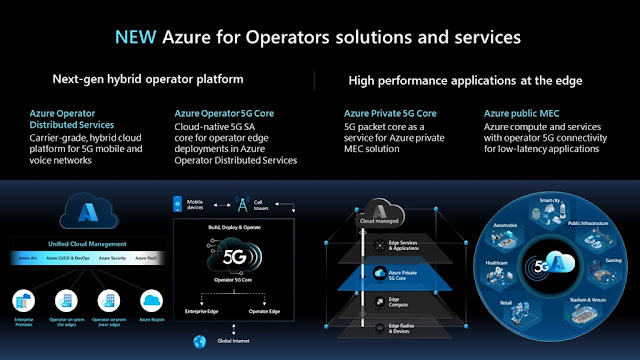
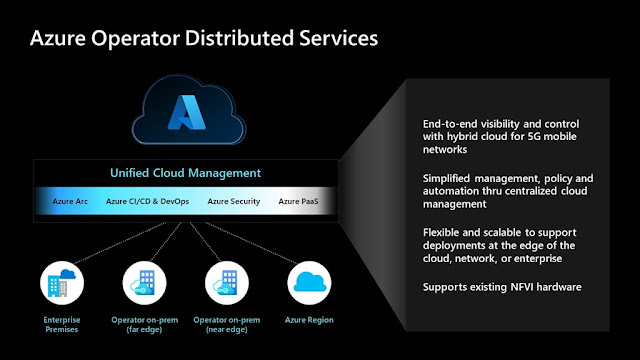
Today we are announcing the next-generation hybrid cloud platform for operators—Azure Operator Distributed Services—which combines the enhanced version of the acquired AT&T technology with the best of Azure, including our industry-leading security, monitoring, analytics, AI, machine learning, and so much more.
Built from the ground up and proven to run network-intensive workloads and mission-critical applications, Azure Operator Distributed Services meets the security, resiliency, observability, manageability, and performance needs required by operators to achieve meaningful results from digital transformation. It will enable operators to run all their workloads (such as core, RAN, mobile and voice core, OSS, and BSS) on a single carrier-grade hybrid platform. With Azure Operator Distributed Services, business operations can be streamlined, providing operators with simplified management, policy, and automation delivered through unified cloud management using Azure Services, Azure Arc management, Azure Security, and platform as a service with Azure. Azure Operator Distributed Services provides the flexibility and scalability to support customer deployments at the edge of the cloud, the edge of the network, or the enterprise edge. Now, operators can effectively create new services to monetize their network, all while gaining robust network and customer insights that are necessary to facilitate proactive decision-making, critical action, and the creation of real value.
With Azure Operator Distributed Services, we are delivering a carrier-grade hybrid cloud service to the market and AT&T where it can run at AT&T on-premises or on Azure public cloud. Azure Operator Distributed Services is designed to support the AT&T mobile core network that today spans more than 60 containerized network functions (CNFs) and virtual network functions (VNFs) from 15 different vendors, which currently are deployed and running on the AT&T Network Cloud platform. AT&T will continue to select and manage VNFs and CNFs and their configurations to deliver mobility services to AT&T customers. AT&T and Microsoft are closely collaborating on the deployment of Azure Operator Distributed Services with initial testing stages planned for later this year.
“AT&T's 5G network is built on an agile, future-ready mobile core that's designed to boost innovation, resiliency, and security for our customers. Our 5G mobility core is fully cloud-based, integrating Network Functions from multiple vendors that today are hosted on Network Cloud infrastructure based on a cloud software stack that Microsoft acquired from AT&T last year. We are pleased with Microsoft’s plan to evolve Network Cloud and integrate it with Azure technologies to create hybrid telco-grade Azure Operator Distributed Services. This will enable AT&T and other operators to host Network Functions on clouds spanning telco premises and public cloud and will help us realize the many benefits of the cloud-native approach and Azure innovation including additional speed, resiliency, security, cost, and operational improvements.“—Andre Fuetsch, Executive Vice President and CTO Network Services, AT&T
We designed the Azure Operator Distributed Services for use by all operators while maintaining security and without losing differentiation. In terms of security and privacy, we want to make clear that operators using Azure Operator Distributed Services continue to hold access to their customer data, Microsoft cannot access or see it. With this product, we want to enable operators to deliver new services faster and more flexibly across Azure public cloud and on-premises with common tooling and services, reducing time-to-market with a cloud-native approach. True to our mission of empowering everyone to achieve more, we are collaborating with the broader partner ecosystem, including Ericsson and Nokia, to build on our next-gen hybrid cloud platform for operators.
“Combined with cloud capabilities, 5G has the potential to accelerate the digital transformation of virtually any sector of industry or society. The combination of Azure Operator Distributed Services and Ericsson’s market-leading cloud-native network functions and orchestration suite promise significant benefits for customers. Microsoft and Ericsson are jointly exploring enterprise 5G use cases in conjunction with leading operators.”—Jan Karlsson, Senior Vice President and Head of Business Area Digital Services, Ericsson
“Open collaboration is key to the development of new and innovative high value 5G use cases that will equip our customers with the tools they need for digital transformation. This is part of Nokia’s continued commitment to leading an open mobile future, making it simple for our customers to take advantage of the 5G world, helping to drive it forward. We are enthusiastic to work closely with Microsoft to integrate our
Cloud RAN technology with Microsoft Azure, offer
Microsoft Azure IoT Edge Services allowing industries to realize new capabilities at the edge, and bring
Nokia’s new SaaS-based NetGuard Cybersecurity Dome as well as other Cloud and Network Services software to Azure.”—Chris D. Jones, Vice President Strategic Partnerships, Strategy and Technology, Nokia
Next-generation packet core services
Today, we are also announcing the private preview of the Azure Operator 5G Core and public preview of the Azure Private 5G Core. The Azure Operator 5G Core deploys on the Azure Operator Distributed Services to meet the needs of operators seeking automated, operational efficiency in a mobile network that can scale hundreds of millions of subscribers and devices. Azure Private 5G Core is available as part of the
Azure private MEC solution, enabling operators and system integrators to provide a simple, scalable, and secure deployment of private 4G and 5G networks at the enterprise edge. Both services are deployed and managed through Azure.
Azure Operator 5G Core
Microsoft Azure Operator 5G Core is an Azure service that enables operators to build, deploy, and manage scalable mobile networks. Operator networks need to handle unprecedented amounts of data as 5G unleashes a broad set of low-latency, high throughput consumer, industry 4.0, IoT, and massive machine-type communications. Using Azure Operator 5G Core, operators can seamlessly deploy network workloads on Azure and manage their networks at scale with agility and cost efficiency while keeping up with the evolving demands of 5G.
Azure Operator 5G Core is built on a distributed architecture and includes cloud management, service automation, life cycle management, network slicing, and integrated analytics. This allows operators to provide an enhanced and customized user experience and leverage open APIs to easily integrate with their existing environments. Azure Operator 5G Core and Microsoft’s vast ecosystem of first and third-party tools enable operators to achieve greater enterprise value by creating new vertical solutions (such as gaming, energy, smart cities, autonomous vehicles, agriculture, etc.). We are working with a select number of partners and customers during the private preview and are excited to make this available to all operators soon.
Azure Private 5G Core
This packet core as-a-service offer allows operators and system integrators to rapidly deploy enterprise private mobile networks and low latency applications on Azure Arc-connected edge platforms, such as Azure Stack Edge. Through Azure, partners can unify the cloud management of multiple, globally distributed private wireless networks, with the flexibility to also choose and integrate components from technology and solution partners, including a wide range of 4G and 5G Standalone RAN and SIM providers.
We are enabling a growing list of global partners to deliver next-generation private wireless solutions. Operators developing solutions using Azure private MEC include AT&T, Etisalat, Swisscom, and Telefonica. Our list of global system integrator partners continues to expand, with Accenture, Amdocs, ATOS, Capgemini, Cognizant, Harman, HCL, Intelsat, Lockheed Martin, Northrop Grumman, Tampnet, TCS, and Tech Mahindra. Azure Private 5G Core is also validated with technology partners to speed up integration with RAN partners including ASOCS, AirSpan, CommScope, Fujitsu, Parallel Wireless, and Qualcomm.
Partners are actively working with enterprise customers on proof of concepts and trials:
◉
AT&T is looking to bring private 4G and 5G wireless networks as an integrated platform with connectivity and applications to enable low-latency services at the edge. Target customers include businesses, universities, and the public sector. Currently under development with Microsoft, the AT&T Private 5G Edge service is using Microsoft’s Azure private MEC and Azure Private 5G Core.
◉
Lockheed Martin is collaborating with Microsoft on 5G.MIL®solutions. Lockheed Martin 5G.MIL integrates 5G technologies into military communication networks for resilient and secure next-generation connectivity in highly dynamic environments. Using Azure Private 5G Core in 5G.MIL solutions will enable high performance in a small footprint and the ability to support, secure, and scale interconnection between 5G wireless and military networks. “Lockheed Martin’s strategic collaboration with Microsoft unlocks new capabilities that will provide a decisive edge for military personnel across all domains,” said Dan Rice, Vice President of 5G.MIL® Programs at Lockheed Martin. “Leveraging Microsoft’s expertise in cloud computing and distributed system orchestration, we are accelerating the scale and speed of critical military communications, which will be necessary in increasingly contested environments.”
◉ HARMAN Digital Transformation Solutions (DTS) has employed Azure private MEC to successfully advance digital transformation at one of the largest airports in the United States. The solution improved operational efficiencies for the airport’s manual cargo handling process. "Advances in technologies like 5G yield significant opportunity to accelerate innovation across nearly every industry—from transportation and healthcare to manufacturing and education,” said David Owens, Senior Vice President and General Manager, Digital Transformation Solutions, HARMAN. “HARMAN's deep knowledge and experience in the communications domain and Azure private MEC offers a comprehensive solution to enterprises planning to deploy private networks and cloud computing applications. We are glad to join hands with Microsoft in re-shaping the future by elevating experiences for our customers and end consumers."
◉ "Northrop Grumman’s advanced battle management technologies allow military forces to effectively communicate and securely share mission-critical data across all domains. With the integration of the Azure private MEC platform, we are leveraging Microsoft’s commercial-edge computing capabilities to inform tactical mobile ad hoc networks for the U.S. Navy’s Information Warfare Research Project.”—Tom Pieronek, Chief Technology Officer, Aeronautics Systems, Northrop Grumman
◉ "As a pioneer in digital transformation, Fujitsu is committed to helping enterprises and telcos accelerate adoption of 5G. Our market-leading O-RAN solutions and managed services offerings, combined with the power of Microsoft’s Azure private MEC offering, will play an important role in delivering 5G solutions to market, enabling rich customer experiences at the convergence of 5G, digital, and the edge.”—Shingo Mizuno, Corporate Executive Officer, Fujitsu Limited
◉ "We are entering a new era of enterprise digital transformation that will be fueled by private networks, edge computing, secure access service edge, and amplification of industry-specific applications. Along with Microsoft, we are making it easy for enterprises to order, provision, and consume full suite of infrastructure capabilities and applications—the cloud way"—Manish Mangal, Global Head of 5G and Network Services, Tech Mahindra
Delivering the value of cloud to the edge for enterprises with MEC solutions
In
June 2021, we announced a new category, the
Azure private MEC. Today we extend this MEC category with the introduction of Azure public MEC solution. An evolution of Azure Edge Zones with an operator, the Azure public MEC solution integrates Azure compute and services with mobile operator 5G connectivity, elevating application performance at the operator edge. Through the Azure private and public MEC solutions, we are collaborating and co-innovating with operators and system integrators, as well as bringing the broader technology and developer ecosystem to deliver innovative solutions that meet enterprise needs at the edge.
Azure public MEC
With Azure public MEC, we are collaborating with strategic operators to enable enterprises and developers to deliver innovative high-performance, low-latency applications at the operator edge, using operators’ public 5G network connectivity. Applications that run on Azure public MEC offer customers the unique ability to analyze data closer to where it is being captured from users and edge-enabled devices (such as industrial IoT devices, cars, and smartphones). The resulting timely, detailed insights pave the way for proactive responses to and solutions for real-world enterprise problems.
With Azure public MEC, enterprises and developers can select the low-latency components they need from the cloud to deliver at the edge while managing everything else in the cloud. This level of flexibility allows customers to rapidly deploy innovative MEC solutions, increasing efficiency, and optimizing costs by reducing the need for on-premises servers and the amount of traffic to the public cloud.
We are co-innovating with global strategic operators and independent software vendors (ISVs) to deliver public MEC solutions across the globe. We recently announced Azure public MEC
with AT&T and Azure public MEC
with Singtel, and others to follow. We are also working with many ISV partners to offer innovative networking, security, and low-latency applications that meet enterprise needs. Check out demos with
Check Point,
Couchbase,
Game Cloud,
Summit Tech, and
VMware to learn how these partners are delivering innovative solutions at the edge with Azure public MEC.
Our partners in their own words
Partners are at the heart of what we do at Microsoft. Through strategic collaborations and scale ecosystem engagements, we are working with operators, system integrators, technology partners, and solutions partners to build innovative solutions that enable the telecommunications industry transformation. Read and watch what some of our partners are saying about working with Microsoft to deliver innovative solutions to capitalize on the promise of 5G for next-generation business outcomes.
“Combining the high bandwidth and low latency of 5G with cloud and edge compute capabilities opens an entirely new world of opportunities for businesses and other organizations to serve their customers in new ways. This will enable entirely new use cases in manufacturing, retail, health care, automotive, touching virtually every industry vertical. AT&T’s collaboration with Microsoft is about enabling organizations to harness the power of 5G, cloud and edge quickly with the ability to scale on demand.”—Rasesh Patel, Executive Vice President, and Chief Product and Platform Officer, AT&T
“This unique solution by Singtel and Microsoft leverages the strength and performance of Singtel's innovative edge cloud platform to deliver assured low latency, high throughput, intelligent connectivity, data analytics, and AI services to enterprises. This enables enterprises to accelerate their digital transformation journeys through adopting advanced technologies such as autonomous robots, vehicles, and drones, as well as Metaverse applications, into their enterprise operations through a single unified platform.”—Bill Chang, CEO, Group Enterprise, Singtel
Telstra announced customer trials of Australia’s first 5G-enabled edge compute solution for enterprises (Branch Offload) through a collaboration with Microsoft and Ericsson that will use technologies including Telstra’s 5G and fixed connectivity, Azure Stack Edge, Secure Edge, SD-WAN and service orchestration, and will be delivered as a managed service by Telstra Purple. Nikos Katinakis, Telstra’s Group Executive for Networks and IT said, “Telstra’s collaboration with our major strategic partners, Microsoft and Ericsson, continues to enable us to break new ground, leveraging new technologies and our smarter network to standardize solutions and that will help Australian businesses adapt for the digital future.”
“Technical trials demonstrated how Azure public MEC and AT&T’s 5G mobile network-enabled Summit Tech’s Odience 360 8K live streaming platform with built-in e-commerce to bring immersive and interactive experiences to use cases such as shopping, live concerts, sports stadiums, and eSports. MEC video processing yielded up to 80 percent bandwidth reduction, imperceptible motion-to-photon delay, and impressive glass-to-glass low latency for true two-way interactivity.
"As the requirements of modern applications continue to evolve, Couchbase is collaborating with Microsoft and Azure public MEC to bring the cloud and the edge closer together for customers. Azure public MEC and Couchbase’s modern database enables developers to build next-gen edge use cases."—Matt McDonough, SVP Business Development and Strategy, Couchbase
Watch this
ISV testimonial to hear from Citrix, Spirent, Game Cloud, VMware, and Fortinet about how they are working with Microsoft to build and deliver public MEC solutions.
Source: microsoft.com




 Posts
Posts

