Showing posts with label Microsoft Fabric. Show all posts

Saturday, 1 August 2026

Elevate Your Fabric Data Engineering Career with DP-700

A professional data engineer confidently engaging with a dynamic, glowing holographic projection that visualizes the interconnected architecture of Microsoft Fabric. The projection clearly displays data streams and components, with 'DP-700' subtly integrated, symbolizing career elevation and mastery. The image title 'DP-700: Elevate Your Fabric Career' is clearly visible in a modern sans-serif font within the scene.

In the rapidly evolving landscape of data, organizations are continually seeking skilled professionals capable of transforming raw data into actionable insights. Microsoft Fabric emerges as a unified analytics platform designed to empower data professionals, making the 'DP-700 Fabric Data Engineering' certification a critical credential for anyone looking to solidify their expertise and advance their career. This comprehensive guide will explore the profound impact of the DP-700 exam, providing insights into its objectives, benefits, and an effective preparation strategy.

The 'Implementing Data Engineering Solutions Using Microsoft Fabric' exam (DP-700) is more than just a test; it's a gateway to becoming a 'Microsoft Certified - Fabric Data Engineer Associate'. This certification validates your ability to design, implement, and monitor data engineering solutions using the full capabilities of Microsoft Fabric. As data becomes the new gold, mastering the tools and techniques to refine it is paramount, and the DP-700 is designed to prove exactly that mastery.

Understanding the DP-700: Your Path to Fabric Data Engineering Mastery

The 'Microsoft Certified - Fabric Data Engineer Associate' certification, earned by passing the 'DP-700' exam, signifies a professional's proficiency in leveraging Microsoft Fabric for robust data engineering tasks. This credential demonstrates your expertise in handling large-scale data ingestion, transformation, and optimization within the Fabric ecosystem.

What is Microsoft Fabric and Why is it Essential?

Microsoft Fabric is an end-to-end, unified analytics platform that brings together all data and analytics tools into one environment. It encompasses capabilities from data movement to data science, Real-Time Analytics, and Business Intelligence (BI). For data engineers, Fabric's integrated experience, including components like Lakehouse, Data Factory, Synapse Data Engineering, and Data Warehousing, simplifies complex data pipelines and enhances productivity.

The platform's foundation, OneLake, is a single, logical data lake for your entire organization, making data sharing and governance seamless. By centralizing data storage and processing, Fabric reduces the overhead of managing disparate systems and fosters a collaborative environment for data teams. Understanding these core components is central to the 'DP-700 Fabric Data Engineering' domain.

Key Benefits of Earning Your Microsoft Fabric Data Engineer Certification

Obtaining the 'Microsoft Certified - Fabric Data Engineer Associate' certification offers a multitude of advantages, both personally and professionally. It's a testament to your specialized skills in a highly demanded area.

  • Validated Expertise: The certification officially confirms your ability to implement data engineering solutions using Microsoft Fabric, setting you apart in a competitive job market.
  • Career Advancement: Certified professionals often qualify for higher-level positions and increased responsibilities. Roles such as Data Engineer, Analytics Engineer, and Data Architect frequently list this expertise as a preference. The demand for such skills is consistently growing, as evidenced by the general positive outlook for computer and information technology professionals.
  • Enhanced Earning Potential: While specific figures for the 'MCA Fabric Data Engineer average salary' can vary by region and experience, certified professionals typically command higher salaries than their uncertified counterparts.
  • Industry Recognition: Microsoft certifications are globally recognized and respected, enhancing your professional credibility within the tech community.
  • Access to Microsoft's Ecosystem: Being certified often provides access to exclusive resources, communities, and updates from Microsoft, keeping your skills current.
  • Improved Project Outcomes: With a deep understanding of Microsoft Fabric's capabilities, you can design and implement more efficient, scalable, and robust data solutions for your organization.

For a deeper dive into the certification details and its prerequisites, you can visit the official Microsoft certification page.

Detailed Look at the DP-700 Exam Syllabus

The 'Microsoft DP-700 exam syllabus' is structured to assess your competence across critical areas of data engineering within Microsoft Fabric. Understanding these objectives is the first step in formulating an effective study plan. For a comprehensive guide to the Microsoft Certified - Fabric Data Engineer Associate certification, including objectives and preparation strategies, you can explore resources like this comprehensive guide to the Microsoft Certified - Fabric Data Engineer Associate certification.

Implement and Manage an Analytics Solution (30-35%)

This section focuses on the foundational aspects of setting up and overseeing your data engineering environment within Fabric. It covers critical areas such as:

  • Planning and configuring a Microsoft Fabric workspace: This involves understanding workspace roles, permissions, and capacity settings to ensure optimal performance and security.
  • Managing Fabric items: You'll need to be proficient in creating, managing, and governing various Fabric items, including Lakehouses, warehouses, and data pipelines.
  • Configuring and managing a Lakehouse: This includes understanding the architecture of a Lakehouse, managing tables (Delta Lake format), and ensuring data quality and consistency. You'll need to grasp key 'Microsoft Fabric Lakehouse data engineering concepts'.
  • Implementing source control: Utilizing Git integration for version control of your data engineering assets is a key skill to ensure collaborative development and maintainability.

Ingest and Transform Data (30-35%)

This core component of 'DP-700 Fabric Data Engineering' delves into the practical aspects of moving and shaping data to make it usable for analytics. Key topics include:

  • Ingesting data into a Lakehouse or warehouse: This requires knowledge of various data sources, connection methods, and ingestion patterns using tools like Data Factory pipelines, Spark notebooks, and T-SQL.
  • Transforming data in a Lakehouse or warehouse: Proficiency in using Spark (PySpark, Scala, Spark SQL) for complex transformations, as well as T-SQL for data manipulation in warehouses, is essential. This includes understanding techniques like data cleansing, aggregation, and enrichment.
  • Working with Dataflows Gen2: Mastering the use of Dataflows Gen2 for low-code data ingestion and transformation is a significant part of this section, enabling efficient data preparation.
  • Implementing change data capture (CDC) strategies: Understanding how to capture and process changes in source data efficiently is crucial for maintaining up-to-date analytics solutions.

Monitor and Optimize an Analytics Solution (30-35%)

The final major section focuses on ensuring the performance, reliability, and cost-effectiveness of your data engineering solutions in Fabric. This includes:

  • Monitoring data pipelines and Lakehouse operations: Using Fabric monitoring tools and logs to track pipeline execution, identify bottlenecks, and troubleshoot issues.
  • Optimizing data processing performance: Implementing strategies for optimizing Spark jobs, T-SQL queries, and data storage in Delta Lake to improve efficiency and reduce costs. This involves understanding partitioning, indexing, and caching.
  • Managing data quality and security: Establishing data quality checks, implementing data governance policies, and ensuring data security through appropriate access controls and encryption.
  • Troubleshooting common data engineering issues: Being able to diagnose and resolve issues related to data ingestion, transformation, and performance within the Fabric environment.

A thorough understanding of these 'DP-700 exam objectives Microsoft' will form the backbone of your preparation.

DP-700 Exam Details at a Glance

Before diving into your study routine, it's beneficial to be aware of the administrative details of the exam. This information can help you plan your study schedule and manage expectations regarding the 'Implementing Data Engineering Solutions Using Microsoft Fabric exam cost' and format.

  • Exam Name: Microsoft Certified - Fabric Data Engineer Associate
  • Exam Code: DP-700
  • Exam Price: $165 (USD) - Note: Prices may vary by region.
  • Duration: 120 minutes
  • Number of Questions: 40-60 multiple-choice, drag-and-drop, and case study questions.
  • Passing Score: 700 / 1000

Crafting Your DP-700 Exam Study Plan

A structured approach is vital for success in the 'DP-700 Fabric Data Engineering' exam. Here's a roadmap to guide your preparation, incorporating various resources and strategies.

Official Microsoft Learning Resources

Microsoft provides robust learning paths specifically designed for its certifications. The most direct and authoritative resource for your 'Microsoft DP-700 exam study guide' is the official training course.

  • Microsoft Learn Path: Engage with the free learning modules on Microsoft Learn that align with the DP-700 syllabus. These modules offer theoretical knowledge, practical exercises, and knowledge checks.
  • Official Courseware: Consider enrolling in the official DP-700T00-A course. This instructor-led training provides in-depth coverage of the exam topics and hands-on lab exercises, which are invaluable for practical understanding. This is a crucial step for 'Implementing Data Engineering Solutions Using Microsoft Fabric course' participants.

Hands-on Experience with Microsoft Fabric

Theoretical knowledge alone is insufficient. Practical experience is crucial for truly understanding how to 'implement data engineering solutions using Microsoft Fabric'. Set up a Microsoft Fabric trial environment and:

  • Create Lakehouses and Warehouses: Practice ingesting data from various sources (Azure Data Lake Storage, Azure SQL Database, etc.) into your Lakehouse using different methods (Data Factory pipelines, Spark notebooks).
  • Data Transformation: Experiment with transforming data using Spark (PySpark or Scala) and SQL within Fabric notebooks and warehouses. Focus on common data engineering patterns like slowly changing dimensions, aggregations, and data cleansing.
  • Monitoring and Optimization: Actively monitor your pipelines, Spark jobs, and warehouse queries. Learn to interpret logs and apply optimization techniques such as partitioning, indexing, and using appropriate Spark configurations.
  • Security and Governance: Practice configuring workspace roles, item permissions, and understanding how to apply security best practices within Fabric.

Practice Exams and Assessment Tools

To gauge your readiness and identify areas for improvement, utilize 'DP-700 practice exam questions' and assessment tools.

  • Microsoft Practice Assessments: Microsoft often provides free practice assessments directly from the certification page. These are excellent for understanding the exam format and question types.
  • Third-Party Practice Tests: Invest in reputable third-party practice exams that simulate the actual testing environment. These can help build confidence and manage your time effectively during the exam.

Community and Peer Learning

Engage with the wider data engineering community for insights and support. Join online forums, LinkedIn groups, and local meetups focused on Microsoft Fabric and data engineering. Discussing concepts and challenges with peers can deepen your understanding and expose you to different perspectives. Exploring effective Microsoft certification preparation strategies can also provide valuable guidance.

Preparing for Success: Tips and Strategies

Beyond studying the syllabus, adopting smart preparation strategies can significantly improve your chances of passing the DP-700 exam.

  • Understand the 'MCA Fabric Data Engineer certification path': Knowing where this certification fits into the broader Microsoft ecosystem can help contextualize your learning and future career progression.
  • Focus on Scenario-Based Questions: The DP-700 often includes scenario-based questions that test your ability to apply knowledge to real-world problems. Practice analyzing scenarios and choosing the most appropriate solution. Understanding 'Microsoft Fabric data engineering solutions architecture' is crucial here.
  • Time Management: During the exam, allocate your time wisely. If you're stuck on a question, mark it for review and move on. Return to it later if time permits.
  • Review Core Concepts: Ensure a solid grasp of core data engineering principles, such as ETL/ELT, data warehousing concepts, data lakes, and distributed processing, as these underpin many Fabric functionalities.
  • Stay Updated: Microsoft Fabric is a dynamic platform. Keep an eye on official Microsoft announcements and documentation for any updates or new features that might impact the exam syllabus.

Scheduling Your DP-700 Exam

Once you feel confident in your preparation, it's time to schedule your exam. You can schedule your DP-700 exam through Pearson VUE, Microsoft's official testing partner. Choose a date and time that allows you to be well-rested and focused. Many candidates find it beneficial to schedule the exam a few weeks in advance to create a concrete deadline for their study plan.

The Path Beyond DP-700: Continuous Growth

Earning your 'Microsoft Certified - Fabric Data Engineer Associate' certification is a significant milestone, but it's also a stepping stone. The world of data engineering is constantly evolving, and continuous learning is key to staying relevant and valuable.

Consider exploring advanced certifications or specializations within Microsoft Azure or Fabric as they become available. Keep practicing your skills, engaging with new Fabric features, and contributing to data engineering projects. The 'benefits of Microsoft Certified Fabric Data Engineer Associate' extend far beyond the initial certification; they open doors to a career of continuous learning and innovation.

Conclusion

The 'DP-700 Fabric Data Engineering' certification is a powerful credential for any data professional aspiring to excel in the modern data landscape. It equips you with the skills to leverage Microsoft Fabric's unified platform, transforming data engineering challenges into opportunities for innovation. By committing to a thorough preparation strategy, gaining hands-on experience, and continuously learning, you can confidently pass the 'Implementing Data Engineering Solutions Using Microsoft Fabric' exam and unlock a world of professional possibilities. Don't just aim to pass; aim to master the concepts and tools that will define the future of data engineering.

Take the first step towards a rewarding career as an 'MCA Fabric Data Engineer' and prepare to elevate your expertise. Embrace the journey of learning and discovery that comes with mastering Microsoft Fabric. For more insights on maximizing your professional growth and unlocking your full potential with Microsoft certifications, explore our other resources.

Frequently Asked Questions (FAQs)

1. What is the Implementing Data Engineering Solutions Using Microsoft Fabric exam cost?

The standard 'Implementing Data Engineering Solutions Using Microsoft Fabric exam cost' for the DP-700 exam is $165 USD. However, prices may vary depending on your geographic region and local currency exchange rates.

2. Are there recommended MCA Fabric Data Engineer certification training courses?

Yes, Microsoft offers official training resources, including free learning paths on Microsoft Learn and an instructor-led course, DP-700T00-A: Implement data engineering solutions using Microsoft Fabric, which is highly recommended for comprehensive 'MCA Fabric Data Engineer certification training'.

3. What are the Microsoft Certified Fabric Data Engineer Associate requirements?

There are no formal prerequisites to take the DP-700 exam. However, candidates should have foundational knowledge of data processing concepts, experience with Azure data services, and familiarity with data manipulation languages like SQL and Python. These are the general 'Microsoft Certified Fabric Data Engineer Associate requirements' for success.

4. What is the scope of Microsoft Fabric data engineering solutions architecture?

The 'Microsoft Fabric data engineering solutions architecture' encompasses designing and implementing end-to-end data pipelines using Fabric components like Lakehouse, Data Factory, Synapse Data Engineering, and OneLake. It involves ingesting, transforming, and preparing data for analytics, ensuring scalability, performance, and security across the unified platform.

5. What are the key benefits of Microsoft Certified Fabric Data Engineer Associate certification?

The 'benefits of Microsoft Certified Fabric Data Engineer Associate' certification include validated expertise, enhanced career prospects in data engineering roles, increased earning potential, global industry recognition, and access to a rich ecosystem of Microsoft resources. It demonstrates your ability to leverage cutting-edge tools for data solutions.

Tuesday, 21 July 2026

Is the DP-600 Microsoft Fabric Exam a Smart Career Investment

A futuristic digital roadmap with glowing blue and purple lines, leading from a stylized 'DP-600 Microsoft Fabric exam' text towards a bright, abstract digital landscape representing career growth and ROI. The image title 'DP-600 Fabric Exam: Smart Career Path?' is prominently displayed. The scene evokes strategic investment and future opportunities in data analytics.

In the rapidly evolving landscape of data analytics, professionals are constantly seeking ways to validate their skills and enhance their career trajectory. Microsoft Fabric, a unified analytics platform, has emerged as a game-changer, integrating data engineering, data warehousing, data science, Real-Time Analytics, and Business Intelligence into a single Software-as-a-Service (SaaS) solution. As organizations increasingly adopt Microsoft Fabric to streamline their data operations, the demand for skilled professionals who can implement and manage these solutions is skyrocketing.

This is where the DP-600 Microsoft Fabric exam comes into play. Officially titled "Implementing Analytics Solutions Using Microsoft Fabric," this certification is designed for Fabric Analytics Engineers who are responsible for designing, developing, and implementing solutions that use Microsoft Fabric components. But with any significant investment of time and money, the crucial question arises: Is the DP-600 Microsoft Fabric exam truly a smart career investment? This comprehensive guide will delve into the costs, time commitment, and potential return on investment (ROI) associated with pursuing the Microsoft Certified - Fabric Analytics Engineer Associate certification, offering a transparent and practical perspective to help you make an informed decision about your professional future.

Understanding the DP-600 Microsoft Fabric Exam

The DP-600 exam is a pivotal certification for anyone looking to establish themselves as a proficient analytics engineer within the Microsoft ecosystem. It validates your ability to implement Microsoft Fabric analytics solutions, demonstrating expertise across a broad spectrum of data-related tasks. This includes preparing and transforming data, implementing and managing semantic models, and maintaining a data analytics solution.

About the Microsoft Certified - Fabric Analytics Engineer Associate Certification

Passing the DP-600 Microsoft Fabric exam earns you the prestigious Microsoft Certified - Fabric Analytics Engineer Associate certification. This associate-level certification signifies your foundational yet robust capabilities in leveraging Microsoft Fabric for comprehensive data analytics. It confirms your proficiency in core data engineering practices, data modeling, and reporting within the Fabric environment.

The certification is highly respected in the industry, reflecting Microsoft's commitment to setting high standards for its platform specialists. Achieving this credential signals to employers that you possess the practical skills and theoretical knowledge required to contribute effectively to data-driven projects using Microsoft Fabric. You can explore more about the benefits and requirements of this certification directly on its official Microsoft certification page.

Who Should Consider the DP-600 Exam?

The DP-600 Microsoft Fabric exam is ideally suited for data professionals who are involved in designing, creating, and deploying analytics solutions using Microsoft Fabric. This includes roles such as data analysts, business intelligence developers, data engineers, and data scientists who wish to specialize in the Fabric platform. If you have a background in data warehousing, ETL processes, data modeling, and have some experience with Power BI or Azure data services, this certification can be a natural progression and a significant boost to your career.

It is particularly beneficial for those aiming to validate their expertise in integrating various data workloads—from ingestion and transformation to analysis and reporting—within a unified environment. The certification caters to individuals who are keen on demonstrating their practical skills in building scalable and efficient data analytics solutions.

DP-600 Exam Details: Costs, Duration, and Logistics

Understanding the specifics of the DP-600 Microsoft Fabric exam is crucial for planning your journey. This section breaks down the essential details, including the financial commitment, the exam format, and how to schedule your test.

Cost of the DP-600 Exam

The standard price for the DP-600 Microsoft Fabric exam is $165 (USD). It's important to note that exam prices can vary by country or region due to local taxes and currency exchange rates, so always verify the exact cost in your specific location before registration. This fee covers your attempt at the Implementing Analytics Solutions Using Microsoft Fabric exam.

Beyond the initial exam fee, consider potential additional costs:

  • Retake Fees: If you don't pass on your first attempt, you'll incur additional fees for each subsequent attempt. Microsoft has a retake policy that typically requires a waiting period before you can retake an exam.
  • Study Materials: While some official resources are free, you might invest in paid practice exams, study guides, or instructor-led training courses. These can range from tens to hundreds of dollars depending on the provider and depth of content.
  • Training Courses: Enrolling in official or third-party training can be a significant cost. For instance, the official DP-600T00-A course is typically offered by certified learning partners and can cost a substantial amount, though it often includes comprehensive instruction and resources.

When evaluating the total cost, it's essential to factor in these potential expenses to get a realistic picture of your investment.

Exam Format and Logistics

The DP-600 Microsoft Fabric exam is a timed assessment designed to thoroughly test your knowledge and practical skills. Here's a breakdown of its key characteristics:

  • Duration: You will have 120 minutes to complete the exam. This includes time for reviewing instructions and answering questions.
  • Number of Questions: The exam typically features between 40 and 60 questions. These can include multiple-choice, drag-and-drop, case studies, and performance-based items that require you to complete tasks within a simulated environment.
  • Passing Score: To pass the DP-600 exam, you need to achieve a score of 700 out of 1000. This is a common passing threshold for Microsoft certification exams, indicating a strong understanding of the subject matter.
  • Scheduling: The exam is administered through Pearson VUE. You can schedule your DP-600 exam through the Pearson VUE Microsoft scheduling portal, choosing between taking it at a local testing center or online with a proctor.

For comprehensive details on exam structure and registration, you might also find resources like this one valuable: MCA Fabric Analytics Engineer exam information.

DP-600 Exam Objectives and Syllabus

A deep understanding of the Implementing Analytics Solutions Using Microsoft Fabric syllabus is paramount for effective preparation. The DP-600 exam objectives are categorized into three main areas, each carrying a specific weight, indicating the importance and depth of coverage you should expect.

Here's a detailed breakdown of the DP-600 exam topics covered:

Maintain a Data Analytics Solution (25-30%)

This section focuses on the operational aspects of managing and monitoring a Microsoft Fabric analytics solution. It covers the skills needed to ensure data quality, optimize performance, and handle data refresh processes effectively. Key tasks include:

  • Monitoring and Optimizing Performance: This involves identifying performance bottlenecks in data pipelines, queries, and reports within Microsoft Fabric. You'll need to understand how to use Fabric monitoring tools, query insights, and optimize data loading and transformation processes.
  • Managing Data Load and Transformation Failures: Analytics engineers must be adept at troubleshooting issues that arise during data ingestion and transformation. This includes understanding error logging, data validation techniques, and methods for reprocessing failed data loads.
  • Maintaining Data Quality: Ensuring data integrity and accuracy is critical. This objective covers implementing data validation rules, handling duplicates, and managing data quality across different Fabric components. It also involves understanding data profiling and cleansing techniques.
  • Implementing and Monitoring Data Refresh: You will be tested on configuring and monitoring data refresh schedules for datasets and reports, understanding refresh types (incremental, full), and troubleshooting refresh failures in Power BI and other Fabric artifacts.

Prepare Data (45-50%)

This is the most heavily weighted section of the DP-600 Microsoft Fabric exam, emphasizing the crucial skills of data ingestion, transformation, and storage. It covers everything from connecting to various data sources to shaping and cleaning data for analytical purposes.

  • Ingest Data into Microsoft Fabric: You need to demonstrate proficiency in connecting to various data sources (databases, data lakes, streaming sources) and ingesting data into Fabric Lakehouses and Warehouses. This includes using data pipelines, Spark notebooks, and Dataflows Gen2.
  • Transform Data in Microsoft Fabric: This objective assesses your ability to use different tools and languages within Fabric (e.g., Spark SQL, PySpark, Dataflows Gen2, KQL for Real-Time Analytics) to clean, filter, aggregate, and reshape data. It also covers techniques like handling missing values, standardizing data, and enriching datasets.
  • Create and Optimize Data Lakehouse and Warehouse Structures: You'll be tested on designing and implementing optimal table structures in Lakehouses (Delta Lake format) and Warehouses, understanding partitioning strategies, and managing data storage for performance and cost efficiency. This includes working with different file formats and schemas.
  • Implement and Manage Security for Data: Data security is paramount. This covers implementing row-level security (RLS) and object-level security (OLS) within Fabric, managing access control, and ensuring compliance with data governance policies.

Implement and Manage Semantic Models (25-30%)

This section focuses on the creation, deployment, and optimization of semantic models, which are critical for enabling intuitive and efficient business intelligence reporting and analysis within Microsoft Fabric.

  • Design and Build Semantic Models: You'll need to demonstrate skills in creating robust and scalable semantic models using Power BI Desktop, Tabular Editor, or other tools. This includes defining tables, relationships, measures (DAX), calculated columns, and hierarchies. Understanding star schema and snowflake schema designs is crucial.
  • Optimize Semantic Models: This objective covers techniques for improving the performance of semantic models, such as optimizing DAX queries, managing cardinality, implementing aggregation tables, and fine-tuning storage modes (Import, DirectQuery, Composite).
  • Implement and Manage Security for Semantic Models: Similar to data security, you'll be tested on applying RLS and OLS within semantic models to control user access to data at a granular level. This also involves managing roles and permissions for model consumers.
  • Deploy and Manage Semantic Models: This includes publishing semantic models to Microsoft Fabric workspaces, configuring deployment pipelines, managing model metadata, and version control. You should also be familiar with refresh options and troubleshooting deployment issues.

Prerequisites and Recommended Experience for the DP-600 Exam

While Microsoft does not enforce strict prerequisites for taking the DP-600 Microsoft Fabric exam, it strongly recommends a foundational level of knowledge and experience to maximize your chances of success. The exam is designed for individuals who are not new to data concepts but are looking to validate their expertise specifically within the Microsoft Fabric platform.

Ideal candidates for the DP-600 certification path should have:

  • Experience with Data Analytics Solutions: A solid background in designing, building, and maintaining data analytics solutions, including experience with data ingestion, data transformation, data modeling, and reporting.
  • Familiarity with Data Warehousing Concepts: Understanding of dimensional modeling, fact tables, dimension tables, and star/snowflake schemas.
  • Knowledge of ETL/ELT Processes: Experience with Extract, Transform, Load (ETL) or Extract, Load, Transform (ELT) operations using various tools and techniques.
  • Proficiency in SQL: A strong grasp of SQL is essential for querying data, creating views, and performing data manipulation.
  • Experience with Power BI: Since Power BI is an integral part of Microsoft Fabric for reporting and semantic models, hands-on experience with Power BI Desktop, Power Query, and DAX (Data Analysis Expressions) is highly beneficial.
  • Basic Understanding of Azure Data Services: While not strictly an Azure exam, Fabric integrates with many Azure services. General knowledge of Azure data concepts (e.g., Azure Data Lake Storage, Azure Synapse Analytics) can be helpful.
  • Programming Skills: Familiarity with Python or Spark (PySpark) is an advantage, especially for the data preparation section involving notebooks.

Without this recommended background, the implementing Microsoft Fabric analytics DP-600 exam can be significantly challenging. It's advisable to gain practical experience with Microsoft Fabric components and services before attempting the exam.

Preparing for the DP-600 Microsoft Fabric Exam

Effective preparation is the cornerstone of success for any certification exam, and the DP-600 Microsoft Fabric exam is no exception. Given its comprehensive nature, a structured and disciplined approach to studying is essential. Here are some key strategies and resources to help you ace the exam.

Official Microsoft Learning Path and Training

Microsoft provides robust resources to guide your study. The most authoritative source is the official Microsoft learning path and training course:

  • DP-600T00-A: Microsoft Fabric Analytics Engineer: This is the recommended instructor-led course that dives deep into all the DP-600 exam objectives. It provides hands-on labs and expert instruction, making it an invaluable resource for thorough preparation. You can find details about this official Microsoft Fabric training course directly on Microsoft Learn.
  • Microsoft Learn Modules: Complementing the official course, Microsoft Learn offers free, self-paced learning modules tailored to the DP-600 syllabus. These modules provide theoretical knowledge, practical exercises, and knowledge checks, allowing you to learn at your own pace.

Practice Exams and Study Guides

Beyond official training, supplementing your studies with practice materials is crucial for effective DP-600 exam preparation tips.

  • DP-600 Practice Exam Questions: Engaging with practice exams is one of the best ways to gauge your readiness and identify areas that need more attention. Look for reputable providers offering high-quality DP-600 practice exam questions that simulate the actual exam environment and question types.
  • Microsoft Certified Fabric Analytics Engineer Associate Study Guide: A good study guide will condense the vast amount of information, highlighting key concepts, providing examples, and offering structured exercises. These guides can serve as an excellent companion to official documentation and training.
  • Books and Whitepapers: While specific books for DP-600 might be emerging, general books on data warehousing, Power BI, and data engineering principles are highly relevant and can deepen your understanding of the underlying concepts tested in the Implementing Analytics Solutions Using Microsoft Fabric syllabus.

Effective Study Strategies

To make the most of your study time, consider these practical tips:

  • Hands-on Practice: Microsoft Fabric is a practical platform. Dedicate significant time to hands-on labs, building your own solutions, and experimenting with different features. Practical experience solidifies theoretical knowledge.
  • Understand Each Objective: Don't just memorize facts. For each DP-600 exam objective, understand the "why" and "how." How do you maintain data analytics solutions? Why is preparing data so crucial?
  • Time Management: Allocate specific study blocks. Given the DP-600 Microsoft Fabric exam details and the breadth of topics, consistent study over several weeks or months is more effective than cramming.
  • Join Study Groups or Forums: Collaborating with peers can provide new perspectives, help clarify doubts, and keep you motivated. Online forums and communities are great places to discuss challenges and share insights about Microsoft Fabric data analytics solutions.
  • Review Weak Areas: Utilize practice exam results to pinpoint your weakest areas and dedicate extra time to those topics.

To further enhance your certification journey, understanding effective exam strategies can be crucial, as outlined in guides such as this comprehensive article on acing your Microsoft certification.

Career Opportunities and ROI of the DP-600 Certification

The true value of any certification lies in its ability to enhance your career prospects and provide a tangible return on investment. The Microsoft Certified - Fabric Analytics Engineer Associate certification, backed by the DP-600 Microsoft Fabric exam, stands to offer significant advantages in the current job market.

Demand for Microsoft Fabric Analytics Engineers

Microsoft Fabric is a relatively new but rapidly adopted platform. As more organizations transition to or implement Fabric for their unified analytics needs, the demand for skilled professionals who can design, implement, and manage these complex solutions will continue to surge. Employers are actively seeking individuals who can demonstrate proven expertise in implementing Microsoft Fabric analytics DP-600 solutions.

Key roles that benefit from this certification include:

  • Fabric Analytics Engineer: Directly responsible for building and maintaining analytics solutions on the Fabric platform.
  • Data Engineer: Specializing in data ingestion, transformation, and warehousing within Fabric.
  • BI Developer: Focusing on semantic model creation, report development, and data visualization using Power BI within Fabric.
  • Data Architect: Designing scalable and efficient data architectures leveraging Microsoft Fabric components.
  • Analytics Consultant: Advising clients on best practices for implementing and optimizing Fabric solutions.

The ability to work with an integrated platform like Fabric makes you a versatile asset, capable of handling diverse data roles within an organization.

Salary Expectations

While specific salary data for the "Fabric Analytics Engineer" role is still emerging due to the platform's relative newness, we can infer potential earnings based on comparable roles in the data analytics and engineering fields. According to the U.S. Bureau of Labor Statistics (BLS), the median annual wage for Computer and Information Technology occupations, which includes data engineers and business intelligence analysts, was significantly higher than the average for all occupations. Professionals with specialized skills in advanced platforms like Microsoft Fabric are typically positioned at the higher end of these salary ranges.

A Microsoft certification often translates into a competitive salary edge. Studies by various IT compensation firms frequently show that certified professionals earn more than their uncertified counterparts. The unique and in-demand skills validated by the DP-600 exam can command premium compensation, making the Fabric Analytics Engineer Associate exam cost a worthwhile investment.

Long-Term Career Growth and Benefits

Beyond immediate job prospects and salary, the DP-600 certification offers substantial long-term career growth:

  • Enhanced Credibility: The Microsoft Certified - Fabric Analytics Engineer Associate certification is a globally recognized credential that instantly boosts your professional credibility.
  • Career Progression: It serves as a strong foundation for advancing into senior data engineering, data architect, or lead analytics roles. The DP-600 certification path opens doors to more complex and impactful projects.
  • Adaptability and Future-Proofing: By mastering Microsoft Fabric, you gain skills in a platform that is central to Microsoft's data strategy. This positions you well for future advancements and evolving industry demands in data analytics.
  • Networking Opportunities: Being part of the Microsoft certified community can open up valuable networking opportunities with other professionals and experts in the field.

Is the DP-600 Microsoft Fabric Exam a Smart Career Investment?

Considering the detailed breakdown of costs, time investment, and potential career benefits, the answer is a resounding yes: the DP-600 Microsoft Fabric exam is indeed a smart career investment for data professionals. In an era where data is the new oil, and analytics platforms like Microsoft Fabric are powering organizational intelligence, having a validated skill set in this area provides a significant competitive advantage.

The initial outlay of $165 (USD) for the exam, along with the time and effort dedicated to study, pales in comparison to the potential increase in earning potential, expanded job opportunities, and long-term career stability and growth. The demand for professionals skilled in Microsoft Fabric data analytics solutions is only projected to increase, making this certification a timely and strategic move for anyone looking to solidify their place in the data analytics industry. Investing in the DP-600 Microsoft Fabric exam is not just about earning a badge; it's about investing in a future-proof skill set that aligns with the forefront of data technology.

Frequently Asked Questions About the DP-600 Microsoft Fabric Exam

1. What is the DP-600 Microsoft Fabric exam?

The DP-600 Microsoft Fabric exam, officially "Implementing Analytics Solutions Using Microsoft Fabric," is a certification test designed by Microsoft to validate the skills of analytics engineers in designing, developing, and implementing solutions using the Microsoft Fabric platform. Passing this exam earns you the Microsoft Certified - Fabric Analytics Engineer Associate certification.

2. How long does it typically take to prepare for the DP-600 exam?

The preparation time for the DP-600 Microsoft Fabric exam can vary significantly based on your existing experience with data analytics, Power BI, and Azure data services. For individuals with a solid background, 1-3 months of dedicated study (10-15 hours per week) might suffice. Those newer to these concepts may require 3-6 months or more to fully grasp the Implementing Analytics Solutions Using Microsoft Fabric syllabus and gain practical experience.

3. Is the DP-600 exam difficult?

The DP-600 Microsoft Fabric exam is considered challenging and requires a deep understanding of Microsoft Fabric components, data engineering principles, and semantic model implementation. It includes a mix of question types, including performance-based tasks, which demand practical application of knowledge. Success hinges on extensive hands-on experience and thorough preparation covering all DP-600 exam objectives.

4. How long is the Microsoft Certified - Fabric Analytics Engineer Associate certification valid?

Microsoft role-based certifications, including the Fabric Analytics Engineer Associate, are typically valid for one year from the date you earn them. To maintain your certification, you must renew it annually by passing a free online assessment on Microsoft Learn, which tests your knowledge of the latest updates and features relevant to the certification.

5. What kind of career opportunities can I expect after passing the DP-600 exam?

Passing the DP-600 Microsoft Fabric exam opens up numerous career opportunities in roles such as Fabric Analytics Engineer, Data Engineer, BI Developer, Data Architect, and Analytics Consultant. It validates your expertise in a rapidly growing platform, making you a highly sought-after professional capable of building and managing end-to-end data analytics solutions within Microsoft Fabric, potentially leading to increased earning potential and career advancement.

Conclusion

The journey to becoming a Microsoft Certified - Fabric Analytics Engineer Associate through the DP-600 Microsoft Fabric exam is an investment—an investment of time, effort, and financial resources. However, as this guide has thoroughly explored, the potential returns far outweigh these initial expenditures. In today's data-centric world, where organizations are constantly seeking to harness the power of their information, a certification demonstrating expertise in a cutting-edge platform like Microsoft Fabric is an invaluable asset.

From the competitive edge it provides in the job market to the potential for higher earning potential and robust long-term career growth, the DP-600 certification positions you at the forefront of modern data analytics. It validates not just your theoretical knowledge, but your practical ability to implement sophisticated data solutions, making you a vital contributor to any data-driven enterprise. By pursuing this certification, you are not merely earning a credential; you are future-proofing your career and unlocking a world of opportunities in the dynamic field of data analytics. For more insights into navigating complex certification exams and maximizing your study time, explore valuable resources on preparing for Microsoft exams.

Tuesday, 25 June 2024

Leverage AI to simplify CSRD reporting

Leverage AI to simplify CSRD reporting

Organizations around the world are navigating complex reporting frameworks to meet sustainability goals. For companies working in—or with—the European Union, the Corporate Sustainability Reporting Directive (CSRD) is a sweeping set of requirements to provide non-financial public disclosures on environmental, social, and governance (ESG) topics. CSRD rules began rolling out in 2024, requiring over 11,000 companies to disclose non-financial information. An increase of an additional 50,000 companies that are incorporated, listed, or doing business in the European Union is estimated. As companies are working to comply, allocating the time and resources is a challenge. Microsoft is developing solutions to address the diverse reporting needs of our customers and investing in our partners to create a variety of options that organizations can engage.

To address this growing need, Microsoft Cloud for Sustainability data solutions in Microsoft Fabric (preview) can help organizations take sustainability data in any format, organize, and normalize the data for sustainability regulatory reporting. This quantitative data reporting approach is complemented by a joint solution from Accenture and Avanade that leverages generative AI to provide qualitative insights. This enables organizations to manage workflows associated with multiple sustainability reporting frameworks globally, including CSRD, Global Report Initiative (GRI), and the International Sustainability Standards Board (ISSB). Organizations can optimize both quantitative data from Microsoft Cloud for Sustainability solutions and qualitative data with Accenture and Avanade’s generative AI-powered solution. 

The solution integrates seamlessly with Microsoft Sustainability Manager, offering a comprehensive platform for managing sustainability key performance indicators (KPIs) across different frameworks. The solution’s collaborative features, generative AI-enhanced insights, and streamlined data integration can help organizations simplify compliance-related processes. Meanwhile, the improved richness of its sustainability reporting enables organizations to take more effective actions to achieve their ESG targets.

Navigate the complexities of reporting frameworks


All ESG reporting frameworks carry their own complexities. However, the CSRD has been top of mind in 2024 for organizations in and outside of the European Union as they begin to gather, analyze, and report the required data. This is no simple task—the CSRD encompasses 12 standards and 82 reporting requirements, which amounts to approximately 500 KPIs and over 10,000 underlying data points. In addition to managing this large array of ESG data, companies face other significant challenges associated with CSRD compliance and data management including reporting on the entire value chain versus only on their own organization. The evolving nature of sustainability criteria and metrics further complicates the reporting process. 

Navigating the intricacies of a multitude of reporting frameworks and intricate regulations necessitates extensive data gathering and assimilation. The process of ESG reporting often engages various departments and resources within an organization, introducing its own set of risks and costs. The more manual a process, the more opportunities there are for errors to occur, and the complexities of each reporting framework require time, diligence, and accuracy. A proficient solution can help simplify the process and effectively aid in the generation of accurate reports with fewer resources required. 

Accenture and Avanade’s generative AI-powered solution allows users to select from different reporting frameworks and adapts to the specific requirements of the chosen framework, displaying relevant categories and reporting structures. Users can access the breadth and depth of their data and translate it into the necessary reporting frameworks. This flexibility is crucial for organizations that are subject to multiple reporting obligations or need to adhere to international standards beyond local mandates. 

Leverage AI to simplify CSRD reporting

Streamlining data management using Microsoft Azure OpenAI Service


Accenture and Avanade’s solution addresses the dual challenges of qualitative and quantitative data in sustainability reporting, utilizing Azure OpenAI for enhancing its reporting capabilities, especially for qualitative data input. Using Azure OpenAI to create an AI assistant, Accenture and Avanade’s solution offers a unified platform for sustainability reporting, simplifying the process of compiling CSRD reports, making it easier for users to interact with data and generate reports quickly.

◉ Qualitative data management: Leveraging Azure OpenAI integration, Accenture and Avanade’s solution assists in drafting responses to qualitative questions, such as detailing a company’s sustainability policies, practices, and goals. This AI assistant ensures that responses are not only in keeping with reporting standards but also reflective of best practices and forward-thinking sustainability strategies.
◉ Quantitative data management: The integration of Microsoft Sustainability Manager allows for the automatic import of calculated quantitative metrics. This means that insights or recommendations provided by Accenture and Avanade’s solution is informed by the data in the user’s ESG platform. The AI assistant enables identification of trends and patterns in both qualitative and quantitative data sources, aiding in a more holistic analysis. 

An enhanced collaborative workflow


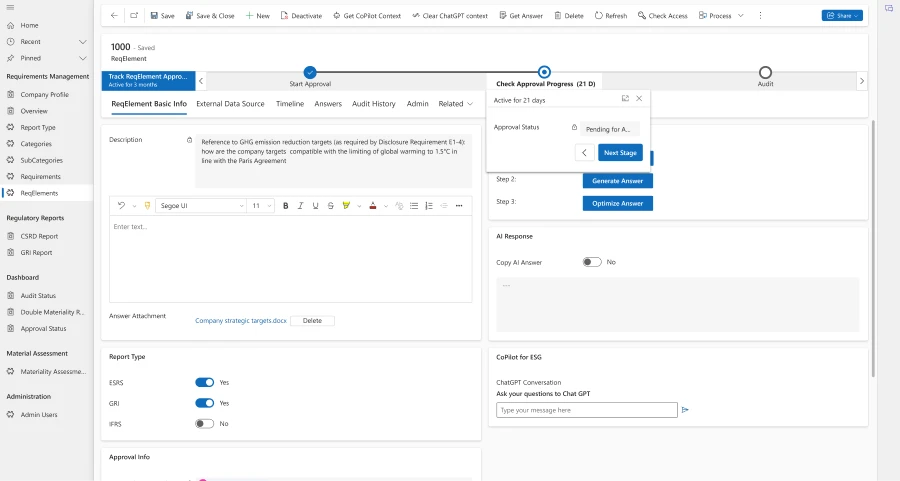
One of the biggest pain points that companies have related to ESG reporting is managing the approval workflow with multiple process and approval steps. It’s important to have a trail of accountability, which depending on organization size, can exist across several departments and users. Accenture and Avanade’s solution enables organizations to assign responsibility and accountability, thereby streamlining the process of preparing the report and its associated approval processes. 

Importantly, team members can work on the same sections of the report simultaneously and the platform maintains comprehensive audit trails of all changes made to the report. This transparency is vital for accountability, enabling team leaders to monitor progress and ensure that all contributions align. 

Leverage AI to simplify CSRD reporting

Source: microsoft.com

Saturday, 16 March 2024

Foster a more data-driven culture with generative AI in Microsoft Fabric

Foster a more data-driven culture with generative AI in Microsoft Fabric

From the invention of steam power to putting the world’s knowledge at our fingertips with the advent of smartphones, the right tools have always sparked transformation. And now we are seeing the potential of the next great shift: the new era of AI. It is one of the most exciting shifts of our generation, and we, along with other leaders are seeing this impact take shape across individuals, entire teams, and every industry. Everything from enterprise chat for better knowledge mining, to content generation and speech analytics, to data analysis to uncover more insights and make data more accessible.

Take PricewaterhouseCoopers (PwC) for example, a leader in the professional services sector and a long-time technology innovator. PwC is applying generative AI to acquire, transform, and analyze data faster to better support its employees and provide better audit experiences for clients.

“We’re implementing Microsoft infrastructure to help future-proof NGA design, increasing the potential future adaptability of our assurance services and processes. Generative AI capabilities within the Azure OpenAI Service open up possibilities for us to enable natural language interfaces for enterprise data.” 

Winnie Cheng, Director of AI in Products and Technology at PwC

Connect your data with Fabric


PwC is not alone. Increasingly, organizations are turning to AI to transform their data cultures for better business outcomes. Traditionally, building this culture requires a few key ingredients:

1. Organizing your data into a logical data mesh to make it easier for users to discover, reuse, and enhance the best data available.
2. Creating a seamless analytics engine that can meet the demands of the business to uncover insights in real-time.
3. Infusing those insights into the applications your people use every day so they can make data-driven decisions.  

These steps are still vital, but now you can employ generative AI to accelerate the path to a data-rich culture by enhancing the productivity of your data teams and making analytics tools more accessible to everyone. In my webinar, Infusing AI into your Data Culture: A Guide for Data Leaders I walk through exactly how Microsoft can help you accomplish each step along this journey.

First, we’ll explore the blockers preventing users from discovering, accessing, and using data to innovate and make better decisions. I will also show you the promise of Microsoft Fabric’s single, SaaS, multi-cloud data lake, OneLake, designed to connect to any data across the organization and serve everyone who needs access to data in an organized, intuitive data hub. Your data teams can use the OneLake data hub to manage your data, endorse high-quality data to encourage use, and manage access. Users can easily find, explore, and use the data items that they have access to—from inside data tools like Fabric or even applications like Teams and Excel. For more on OneLake, read our e-book, Lakehouse Analytics with Microsoft Fabric and Azure Databricks. 

With your data accessible to those who need it, you also need to equip them with powerful analytics tools that can help them scale to the needs of the business. That’s where Microsoft Fabric further shines. With Fabric, data teams can use a single product with a unified experience and architecture that provides all the capabilities required for analysts to extract insights from data and present them to the business user. Each role in the analytics process has the tools they need, so data engineers, data scientists, data analysts, business users, and data stewards feel right at home. By delivering the experience as a SaaS platform, everything is automatically integrated and optimized, and users can sign up within seconds and unlock significant business value within minutes.  

With your data in a single place and your data teams empowered to uncover insights faster than ever, the next step is to get insights into the hands of everyone in your organization. I’ll show you how Power BI can infuse reports and insights into your apps like Microsoft 365, Dynamics 365, Power Platform, and even third-party apps like Salesforce and SAP.  

And now, as we enter a future built on AI, I’ll walk you through three key ways generative AI can help foster a more data-rich culture: 

1. Take advantage of out-of-the-box experiences like Copilot in Fabric which helps you accelerate the productivity of your data teams.  
2. Employ powerful AI models right from Fabric to draw deeper insights from your data. 
3. Create custom AI experiences, grounded on your data, with native integration between Microsoft Fabric and Azure AI Studio.

Source: microsoft.com

Saturday, 27 January 2024

Unveiling Microsoft Fabric: A Comprehensive Exploration

Unveiling Microsoft Fabric: A Comprehensive Exploration

Introduction


In the ever-evolving landscape of technology, Microsoft Fabric stands out as a pivotal component, playing a crucial role in shaping modern digital experiences. As we delve into the intricate details of this innovative framework, we unravel the layers that make it an indispensable asset for developers and businesses alike.

Understanding Microsoft Fabric


What is Microsoft Fabric?

Microsoft Fabric, also known as Fluent UI, is a design system crafted by Microsoft to create consistent and visually appealing user interfaces across various platforms. It encompasses a set of design guidelines, components, and tools that empower developers to build seamless, responsive, and user-friendly applications.

Core Principles

At the heart of Microsoft Fabric lie key principles that guide its development and application. Consistency, coherence, and adaptive design are the pillars that define the user experience, ensuring a unified and polished interface across different devices and screen sizes.

Features and Components


1. Adaptive Components

One of the standout features of Microsoft Fabric is its collection of adaptive components. These components dynamically adjust to the user's device, providing a consistent experience whether on a desktop, tablet, or mobile device. This adaptability ensures a smooth transition between various platforms, enhancing user engagement.

2. Fluent Design Language

Microsoft Fabric adopts the Fluent Design Language, an aesthetic framework that prioritizes depth, motion, and material. This design philosophy brings a sense of realism to digital interfaces, fostering a more intuitive and immersive user experience.

3. Theming and Styling

With Microsoft Fabric, developers have the flexibility to customize the look and feel of their applications. The theming and styling capabilities allow for seamless integration with a brand's identity, ensuring a cohesive visual representation across the entire software ecosystem.

Benefits for Developers


1. Accelerated Development

Microsoft Fabric provides a library of pre-built, responsive components that expedite the development process. This not only saves valuable time but also ensures a high level of quality and consistency in the final product.

Unveiling Microsoft Fabric: A Comprehensive Exploration
2. Cross-Platform Compatibility

Developers can rejoice in the cross-platform compatibility offered by Microsoft Fabric. Whether targeting Windows, iOS, or Android, the framework ensures a harmonious experience for end-users, transcending the limitations of individual platforms.

3. Continuous Updates and Support

Microsoft, renowned for its commitment to innovation, regularly updates and supports Fabric. This ensures that developers have access to the latest tools and features, keeping their applications at the forefront of technological advancements.

Real-World Applications


1. Enterprise Solutions

Many enterprises leverage Microsoft Fabric to build robust, visually appealing internal applications. The adaptability and consistency offered by the framework contribute to a more efficient and user-friendly working environment.

2. Web and Mobile Applications

From web applications to mobile apps, Microsoft Fabric proves to be a versatile solution. Its ability to seamlessly adapt to different screen sizes and resolutions makes it a top choice for developers aiming to create engaging and accessible applications.

Conclusion

In conclusion, Microsoft Fabric emerges as a powerful ally for developers and businesses venturing into the digital realm. Its adaptive components, Fluent Design Language, and myriad of features make it a cornerstone for creating modern, visually stunning applications. By embracing Microsoft Fabric, developers can ensure that their projects not only meet but exceed user expectations, fostering a competitive edge in the dynamic world of technology.