Showing posts with label Web Developer. Show all posts

Wednesday, 6 September 2023

The Future of Web Development: Azure App Service Unleashed

Web Development, Azure App Service, Microsoft Career, Microsoft Skills, Microsoft Jobs, Microsoft Prep, Microsoft Preparation, Microsoft Learning, Microsoft Tutorial and Materials

In the ever-evolving landscape of web development, staying ahead of the curve is essential. Technology is advancing at breakneck speed, and one of the most influential players in this arena is Azure App Service. In this article, we delve into the future of web development, with a specific focus on how Azure App Service is poised to revolutionize the way we build and deploy web applications.

Introduction


Web development has come a long way since its inception. What once started as simple HTML pages has now evolved into complex, interactive web applications that cater to a global audience. With the advent of cloud computing and platforms like Azure App Service, the possibilities are virtually limitless.

The Power of Azure App Service


Azure App Service is Microsoft's platform-as-a-service (PaaS) offering for building, deploying, and scaling web applications. It provides a comprehensive set of tools and services that make web development faster, more efficient, and cost-effective. Let's delve into some of the key features that make Azure App Service a game-changer.


1. Seamless Integration with Azure Ecosystem

One of the standout features of Azure App Service is its seamless integration with the broader Azure ecosystem. Developers can leverage Azure's vast array of services, including Azure SQL Database, Azure Functions, and Azure Cosmos DB, to build powerful and scalable web applications. This integration streamlines development, reduces complexity, and enables developers to focus on crafting exceptional user experiences.

2. Automatic Scaling

In the dynamic world of the internet, traffic spikes are inevitable. Azure App Service handles this with ease through its automatic scaling capabilities. Whether your application experiences a sudden surge in users or a gradual increase in traffic, Azure App Service can adapt in real-time, ensuring that your web app remains responsive and available.

3. DevOps Integration

Azure App Service is tailor-made for DevOps practices. It seamlessly integrates with popular DevOps tools like Azure DevOps, Jenkins, and GitHub Actions, enabling developers to automate the deployment pipeline. This results in faster release cycles, reduced errors, and improved collaboration among development and operations teams.

4. Security and Compliance

Security is paramount in web development, and Azure App Service doesn't disappoint. It offers robust security features, including identity and access management, DDoS protection, and compliance certifications like ISO 27001 and SOC 2. With Azure App Service, you can build applications that meet the most stringent security and compliance requirements.

5. Multi-language Support

Whether you're a fan of .NET, Node.js, Python, or any other programming language, Azure App Service caters to your preferences. It provides built-in support for multiple programming languages, ensuring that developers have the flexibility to choose the tools they're most comfortable with.

The Future of Web Development with Azure App Service


So, what does the future hold for web development with Azure App Service? The possibilities are both exciting and transformative.

1. Serverless Computing Integration

Azure App Service is set to further embrace serverless computing. This means developers can build applications without worrying about managing servers. With Azure Functions seamlessly integrated, developers can focus solely on writing code to deliver value to end-users.

2. AI and Machine Learning Integration

The future of web applications lies in AI and machine learning. Azure App Service is at the forefront of this transformation, offering pre-built AI models and integrations with Azure Machine Learning. This empowers developers to infuse intelligence into their applications, creating personalized and predictive user experiences.

3. Enhanced Performance Monitoring and Analytics

Performance is a critical factor in web development. Azure App Service is continuously evolving its performance monitoring and analytics tools. Expect real-time insights, advanced debugging capabilities, and optimization suggestions to help you deliver lightning-fast web applications.

4. Global Reach with Edge Computing

As web applications become increasingly global, Azure App Service is expanding its reach with edge computing capabilities. This ensures that your application is closer to your users, resulting in lower latency and a superior user experience, no matter where your audience is located.

Conclusion

The future of web development is undeniably intertwined with Azure App Service. With its powerful features, seamless integration, and a commitment to staying at the cutting edge of technology, Azure App Service is set to revolutionize the way we build, deploy, and manage web applications. As the digital landscape continues to evolve, embracing Azure App Service is not just a choice; it's a strategic imperative.

In conclusion, if you're looking to stay ahead in the competitive world of web development, Azure App Service is your ticket to success. With its extensive capabilities, it empowers developers to create innovative and performant web applications that will undoubtedly leave a mark in the digital realm.

Tuesday, 25 January 2022

Elastic and Microsoft Azure: Unified Observability for Spring Boot applications

Today, we are announcing the availability of Elastic integrations for unified observability of Spring Boot applications on Azure. You can seamlessly ship Microsoft Azure Spring Cloud logs and metrics into Elastic, instrument Spring Boot applications, and monitor every step of your cloud journey. You also get a holistic view across Spring Boot applications and other logs and metrics in your cloud and on-premises environments.

Over the past two years, we worked with many enterprise customers to learn about the scenarios they face. Many of these customers have thousands of Spring Boot applications running in on-premises data centers. As they migrate these applications to the cloud, they need to aggregate logs and metrics from these applications and instrument them for application performance monitoring (APM) using solutions their developers are familiar with and have been using for years. In addition, they must ensure continuity for existing server-side software that are already shipping logs and metrics and are pre-instrumented for end-to-end monitoring using systems like Elastic. You can gain deeper application visibility, reduce the time spent on root cause analysis, and provide a consistent customer experience in your web and mobile applications. Learnings from a 2021 survey also indicated that “end-to-end monitoring” is the second biggest challenge DevOps and IT managers face as they migrate Spring Boot applications to the cloud. With the integration of Azure Spring Cloud logs and metrics in Elastic, you can streamline your journey and easily instrument your Spring Boot applications for unified observability.

Microsoft Azure, Microsoft Azure Exam, Microsoft Azure Career, Microsoft Azure Skills, Microsoft Azure Job, Azure Preparation, Announcements, Web Developer, Cloud Strategy, Monitoring, Azure DevOps, Migration
Figure 1: Video screenshot with dashboards showing observability for Spring Boot applications using Elastic

Elastic can now seamlessly ingest logs and metrics from Microsoft Azure Spring Cloud so that DevOps and SREs can monitor their Spring Boot applications—whether in the cloud, on-premises, or in hybrid environments—and remove monitoring silos to increase operational efficiency and developer productivity. DevOps and SREs can monitor both Spring Boot logs and application metrics across all environments by automatically shipping them to Elastic. Teams can also correlate and add context to their Spring data with other observability data sets across their environments for holistic end-to-end monitoring.

"Microsoft is committed to making it easier for customers to modernize their Java applications in the cloud. The expanded native integration of Elastic on Azure includes support for Azure Spring Cloud that enables customers to simply achieve end-to-end observability of their Spring Boot applications."—Julia Liuson, President, Developer Division, Microsoft

Shipping Azure Spring Cloud logs to Elastic


Native integration makes it seamless to ship logs to the Elastic Observability solution. Once data is shipped into Elastic, you can jumpstart analysis in minutes with turnkey visualizations and dashboards.

Microsoft Azure, Microsoft Azure Exam, Microsoft Azure Career, Microsoft Azure Skills, Microsoft Azure Job, Azure Preparation, Announcements, Web Developer, Cloud Strategy, Monitoring, Azure DevOps, Migration
Figure 2: Diagnostic Setting blade for Azure Spring Cloud Service

Instrumenting Spring Boot applications


Run a "provisioning" automation for a completely hands-off experience for instrumenting and monitoring any new applications that you create and deploy using Elastic’s Terraform or ARM template. Or you can run it on-demand using the Azure command-line interface (CLI) for greater flexibility and control.

Microsoft Azure, Microsoft Azure Exam, Microsoft Azure Career, Microsoft Azure Skills, Microsoft Azure Job, Azure Preparation, Announcements, Web Developer, Cloud Strategy, Monitoring, Azure DevOps, Migration
Figure 3: Example of setting up Elastic instrumentation using the Azure CLI (command-line interface)

Analyzing Spring Boot application performance


After instrumenting and shipping logs from your Spring Boot application, you can use Elastic Observability to monitor, analyze, and search your data to keep your applications performing.

You can also use the out-of-the-box Azure Spring Cloud dashboards within Elastic Observability to gain instant insights from your Azure Spring Cloud logs.

Microsoft Azure, Microsoft Azure Exam, Microsoft Azure Career, Microsoft Azure Skills, Microsoft Azure Job, Azure Preparation, Announcements, Web Developer, Cloud Strategy, Monitoring, Azure DevOps, Migration
Figure 4: Out-of-the-box dashboards for Azure Spring Cloud Service logs in Elastic Observability

With Elastic application performance monitoring (APM), you can analyze and search your application performance data.

Microsoft Azure, Microsoft Azure Exam, Microsoft Azure Career, Microsoft Azure Skills, Microsoft Azure Job, Azure Preparation, Announcements, Web Developer, Cloud Strategy, Monitoring, Azure DevOps, Migration
Figure 5: Service Map for customer-service from Spring Petclinic Application

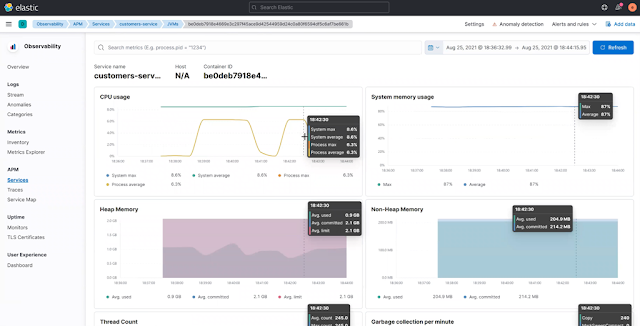
You can also use Elastic APM to look at Java Virtual Machine (JVM) metrics to understand heap memory usage, system memory usage, CPU usage, and other metrics that help you make evidence-based capacity planning decisions.

Microsoft Azure, Microsoft Azure Exam, Microsoft Azure Career, Microsoft Azure Skills, Microsoft Azure Job, Azure Preparation, Announcements, Web Developer, Cloud Strategy, Monitoring, Azure DevOps, Migration
Figure 6: JVM metrics in Elastic APM for customers-service

Utilizing the distributed tracing capabilities of Elastic APM, you can drill further into the performance of your applications to understand which transactions impact your customers the most and wherein those transactions is the most time being spent.

Microsoft Azure, Microsoft Azure Exam, Microsoft Azure Career, Microsoft Azure Skills, Microsoft Azure Job, Azure Preparation, Announcements, Web Developer, Cloud Strategy, Monitoring, Azure DevOps, Migration
Figure 7: Distributed tracing in Elastic APM for customers-service's GET owners operation

Machine learning automatically detects anomalies


With Elastic’s built-in machine learning capabilities, extracting new insights from your Azure Spring Cloud data is as simple as clicking a button—making machine learning truly operational.

The Elastic Stack processes data upon ingestion, ensuring that you have the metadata you need to identify root causes or add context to any event. Built-in tools like Data Visualizer help you find the jobs you're looking for and identify fields in your data that would pair well with machine learning.

You can derive actionable insights from your logs and APM data with the rich alerting and anomaly detection capabilities within Elastic Observability. For example, you can uncover irregular log rates or unusual behavior in the response times of your applications in Azure Spring Cloud

Microsoft Azure, Microsoft Azure Exam, Microsoft Azure Career, Microsoft Azure Skills, Microsoft Azure Job, Azure Preparation, Announcements, Web Developer, Cloud Strategy, Monitoring, Azure DevOps, Migration
Figure 8: Anomaly Explorer in Elastic

Use the same logs to stop threats at cloud scale


Since Elastic offers a common schema and single repository, the same observability data from Spring applications and other data sets can also be used for extended detection and response (XDR) to drive mean time to detection towards zero. Elastic Security brings together security information and event management (SIEM) and endpoint security, allowing organizations to ingest and retain large volumes of data from diverse sources, store and search data for longer, and augment threat hunting with detections and machine learning.

Focus on customer value while we keep the lights on


The native integration of Elastic in Azure is the easiest and fastest way to get started with Elastic on Azure. Quickly ship your Azure Spring Cloud logs and APM data to Elastic, access any type of data, from anywhere, when you need it the most—whether your data is on-prem, or in multi-cloud or hybrid cloud environments. This holistic view helps streamline migrating your Spring Boot applications to the cloud. Plus, Elastic Cloud handles the security, maintenance, and upkeep, allowing you to drive your business forward with increased visibility, improved operations, and cyber resilience.

Build your solutions and monitor them today


Azure Spring Cloud is jointly built, operated, and supported by Microsoft and VMware. It is a fully managed service for Spring Boot applications that abstracts away the complexity of infrastructure and Spring Cloud middleware management, so you can focus on building your business logic and let Azure take care of dynamic scaling, patches, security, compliance, and high availability. With a few steps, you can provision Azure Spring Cloud, create applications, deploy, and scale Spring Boot applications, and start monitoring in minutes. We will continue to bring more developer-friendly and enterprise-ready features to Azure Spring Cloud. We would love to hear how you are building impactful solutions using Azure Spring Cloud.

Source: microsoft.com

Thursday, 13 January 2022

Accelerate your websites with Azure Static Web Apps enterprise-edge

Site performance is crucial when creating applications on the modern web. It has a direct impact on user experience, search engine rankings, and user conversion rates. With Azure Static Web Apps, we're committed to building a platform that helps you deliver the best results for your users at a global scale. It provides streamlined full-stack development and hosting across static content and serverless APIs to power high productivity from source code to global high availability.

Today, we are announcing the preview of the Azure Static Web Apps enterprise-grade edge powered by Azure Front Door which enables faster page loads, enhanced security, and increased reliability for your global apps with no configuration or additional code required.

Azure Static Web Apps,
Figure 1: Azure Front Door's Global Points of Presence (POP) and global network.

“Static Web Apps has helped us deliver our solution EasyLife 365 in a fast and reliable way to our customers worldwide. I can recommend this service to everyone looking for enterprise-grade static content hosting on Azure.”—Patrick Lamber, CEO, EasyLife 365

This new feature includes enhanced protection against Distributed Denial of Service (DDoS) attacks, significantly reduces latency, and helps increase throughput for your global users.

Improve page speed


Today, with Azure Static Web Apps, when a user visits your site, our HTTP load balancer will determine the closest node to their location and serve your application from there. If any of our global regions is down, we intelligently re-route your user's requests to the closest healthy node in the network. This enables you to build your application resiliently across regions, failover instantly, and offer your users an "always-on" website availability. Enabling the enterprise-grade edge further increases your global presence by caching your website’s static content across 118+ points of presence (POP) across 100 metro cities. As a result, your app runs with lower latency and higher throughput to your end-users.

Figure 2: Load test for a static site with enterprise-grade edge enabled.

Faster page loads will not only improve your user's experience but will also have a positive impact on your search engine rankings and ultimately result in higher user conversion.

Secure your applications on a globally deployed network


As the number of users you serve increases, so do the chances of malicious attacks like DDoS. Enabling your applications on an enterprise-grade edge can prevent attackers from reaching your application and affecting your application's availability and performance. The full scale and capacity of our globally deployed network provide defense against common network layer attacks through always-on traffic monitoring and real-time mitigation.

With this feature enabled, you run your websites on top of Microsoft’s global application and content delivery network that has been running the most significant web workloads for many years, ensuring its resiliency and self-recovery capabilities. Global services like Azure DevOps, LinkedIn, and Xbox Live run on top of it and deliver blazing fast and reliable application experience.

Our enterprise-grade edge is a zero-config cloud content delivery service that includes CDN and application acceleration. Once you enable this feature for your production applications, we will migrate your live traffic to our enhanced global distributed network with no downtime.

Figure 3: Enable enterprise-grade edge using the Azure portal.

With this new feature, Azure Static Web Apps streamlines everything you need to deliver the most secure and fastest experience for your users. We continue to be amazed by what you are building and can't wait to see how this will empower you and your users to achieve more!

Source: microsoft.com

Tuesday, 29 June 2021

Deploy apps seamlessly with Red Hat JBoss EAP on Azure App Service—now generally available

Red Hat JBoss Enterprise Application Platform (EAP) on Azure App Service is a fully managed offering for Java EE (Jakarta EE) applications. Java developers have been deploying and scaling their Tomcat, Spring Boot, and other Java apps on App Service since 2014—when the platform first supported Java. Since then, our customers have told us they want the same hosting option for their Java EE (Jakarta EE) applications.

More Info: MB-300: Microsoft Dynamics 365 - Core Finance and Operations

We heard your feedback and partnered with Red Hat to offer JBoss EAP on App Service, which has been in preview since September 2020. Our customers are excited to have a managed platform for their Java EE (Jakarta EE) applications and the peace of mind that comes with joint support from Red Hat and Microsoft. Today, the offer is generally available, so you can deploy apps into Red Hat JBoss EAP on App Service with no Red Hat subscription or licenses required.

“Red Hat and Microsoft are both committed to extending choice and flexibility for organizations as they shift traditional Java applications to the cloud. Red Hat JBoss EAP on Azure offers customers a fully configured, jointly supported solution to make it easier for organizations to realize the benefits of cloud-based architecture. We look forward to continuing to build upon our long-standing relationship with Microsoft and expand support for our joint customers."—Rich Sharples, Senior Director of Product Management – Application Services, Red Hat

Azure App Service, Azure Tutorial and Material, Azure Certification, Azure Tutorial and Material, Azure Career
Figure 1. App service creation App Service interface showing the available options for creating a JBoss EAP application.

This means you can leverage all of App Service’s platform features for your Java EE (Jakarta EE) applications, such as:

◉ Automatic scaling based on metrics such as requests, CPU, memory utilization, or simply the time of day.

◉ Application insights auto-instrumentation for monitoring slow or failing requests, exception logging, and distributed tracing.

◉ Automatic updates for the Operating System, Java virtual machine, and Red Hat JBoss EAP server. You can also choose specific versions of JBoss and update them on your own terms.

◉ Deployment APIs and integrations with Maven, GitHub Actions, and popular IDEs.

◉ Networking integrations to secure and isolate your applications from the internet.

Purpose-built APIs to deploy and run your Java EE applications


Red Hat JBoss EAP on App Service is a jointly supported Pay-as-You-Go (PAYG) offer, which means you do not have to purchase a support subscription from Red Hat ahead of time. Simply create a JBoss EAP web app from the Azure portal or command-line interface (CLI) and start deploying your Java EE apps. If you run into an issue or have a question, create a support case with Microsoft or Red Hat, and support engineers from both companies will collaborate to resolve your case. A support fee for integrated support will automatically be applied to all JBoss EAP sites starting on August 1, 2021*.

Whether your Java applications are packaged in an EAR, WAR, or JAR, App Service has purpose-built APIs to deploy and run your applications. These are integrated into the Azure CLI, Maven plugin, and other tools for a seamless developer experience.

Azure App Service, Azure Tutorial and Material, Azure Certification, Azure Tutorial and Material, Azure Career
Figure 2. High-level architecture diagram showing Red Hat JBoss EAP on App Service connecting to other Azure services and users.

Red Hat JBoss EAP on App Service is offered on the Premium V3 and Isolated V2 App Service plan types. This means you can deploy Red Hat JBoss EAP onto the latest version of the App Service environment for added security and scale, or onto the multi-tenant variant of App Service. In either case, you can save on your hosting bill with Reserved Instance (RI) pricing, which allows you to make a one- or three-year commitment and save up to 35 percent and 55 percent, respectively.

Source: microsoft.com

Saturday, 22 May 2021

Develop production-scale modern web apps quickly with Azure Static Web Apps

Azure Exam Prep, Azure Certification, Azure Preparation, Azure Career

Azure Static Web Apps was first announced in preview in May 2020 and today we are happy to announce the general availability of Azure Static Web Apps, including a free plan for easy product exploration and a standard plan for advanced capabilities supported by an enterprise Service Level Agreement (SLA). The Azure Static Web Apps hosting service aligns with the growing demand from consumers and businesses to establish a web presence with global reach and minimal effort.

Modern web app design patterns leverage microservices best practices for performance, agility, and extensibility. Azure Static Web Apps is a turnkey service for these modern full-stack web apps with pre-built and pre-rendered static front-ends, and serverless API backends. Develop with popular front-end frameworks or static site generators, quickly build and test your apps locally, and deploy with a simple check-in. This enables you to focus on your app, while Azure takes care of the deployment and infrastructure.

With Azure Static Web Apps you can take advantage of features designed for high productivity:

◉ Globally distributed content for production apps

◉ Tailored CI/CD workflows from code to cloud

◉ Auto-provisioned preview environments

◉ Custom domain configuration and free SSL certificates

◉ Built-in access to a variety of authentication providers

◉ Route-based authorization

◉ Custom routing

◉ Integration with serverless APIs powered by Azure Functions

◉ A custom Visual Studio Code developer extension

◉ A feature-rich CLI for local development

From code to cloud with Azure Static Web Apps

Azure Static Web Apps works with both GitHub and Azure DevOps to keep your apps up to date as your code changes with no DevOps configuration required. Commits and pull requests trigger a tailored workflow to build and deploy your app to Azure. Preview environments are created for pull requests to make it easy to validate changes before you merge them.

Every Azure Static Web App gets a free SSL certificate that is fully managed and automatically renewed by Azure. You can bring your own custom domain, and we're also introducing full support for root domains through ALIAS records with this release.

Azure Static Web Apps integrates with Azure Functions to simplify extending your app with serverless API endpoints. Starting with this release you can even bring an existing Azure Functions project and use that as your API. This allows you to take advantage of the full set of triggers, bindings, and extensions that Azure Functions offers. Azure Functions scale dynamically so your app is always ready to meet market demand.

Authentication and authorization are built-in as well. You can use our authentication flow with granular route security. Plus, now you can bring your own authentication provider and integrate it with your static web app.

Development from Azure Static Web Apps benefits from a tailored VS Code extension. The extension is designed for high productivity and makes it easy to create static web apps, extend with serverless APIs, and establish a deployment workflow. The new Azure Static Web Apps CLI provides a high-fidelity local replica of the cloud production environment with mocked hosting platform features for authentication, custom routing, and authorization rules to support local development.

Azure Exam Prep, Azure Certification, Azure Preparation, Azure Career

Azure Static Web Apps is a great option to accelerate the development and time to market for full-stack modern web apps using commonly built libraries and frameworks like Angular, React, Svelte, Vue, or Blazor.

Source: microsoft.com

Sunday, 30 June 2019

Leveraging complex data to build advanced search applications with Azure Search

Data is rarely simple. Not every piece of data we have can fit nicely into a single Excel worksheet of rows and columns. Data has many diverse relationships such as the multiple locations and phone numbers for a single customer or multiple authors and genres of a single book. Of course, relationships typically are even more complex than this, and as we start to leverage AI to understand our data the additional learnings we get only add to the complexity of relationships. For that reason, expecting customers to have to flatten the data so it can be searched and explored is often unrealistic. We heard this often and it quickly became our number one most requested Azure Search feature. Because of this we were excited to announce the general availability of complex types support in Azure Search. In this post, I want to take some time to explain what complex types adds to Azure Search and the kinds of things you can build using this capability.

Azure Certifications, Azure Guides, Azure Learning, Azure Study Materials

Azure Search is a platform as a service that helps developers create their own cloud search solutions.

What is complex data?


Complex data consists of data that includes hierarchical or nested substructures that do not break down neatly into a tabular rowset. For example a book with multiple authors, where each author can have multiple attributes, can’t be represented as a single row of data unless there is a way to model the authors as a collection of objects. Complex types provide this capability, and they can be used when the data cannot be modeled in simple field structures such as strings or integers.

Complex types applicability


At Microsoft Build 2019,  we demonstrated how complex types could be leveraged to build out an effective search application. In the session we looked at the Travel Stack Exchange site, one of the many online communities supported by StackExchange.

The StackExchange data was modeled in a JSON structure to allow easy ingestion it into Azure Search. If we look at the first post made to this site and focus on the first few fields, we see that all of them can be modeled using simple datatypes, including tags which can be modeled as a collection, or array of strings.

{
   "id": "1",
    "CreationDate": "2011-06-21T20:19:34.73",
    "Score": 8,
    "ViewCount": 462,
    "BodyHTML": "<p>My fiancée and I are looking for a good Caribbean cruise in October and were wondering which
    "Body": "my fiancée and i are looking for a good caribbean cruise in october and were wondering which islands
    "OwnerUserId": 9,
    "LastEditorUserId": 101,
    "LastEditDate": "2011-12-28T21:36:43.91",
    "LastActivityDate": "2012-05-24T14:52:14.76",
    "Title": "What are some Caribbean cruises for October?",
    "Tags": [
        "caribbean",
        "cruising",
        "vacations"
    ],
    "AnswerCount": 4,
    "CommentCount": 4,
    "CloseDate": "0001-01-01T00:00:00",​

Azure Certifications, Azure Guides, Azure Learning, Azure Study Materials
However, as we look further down this dataset we see that the data quickly gets more complex and cannot be mapped into a flat structure. For example, there can be numerous comments and answers associated with a single document.  Even votes is defined here as a complex type (although technically it could have been flattened, but that would add work to transform the data).

"CloseDate": "0001-01-01T00:00:00",
    "Comments": [
        {
            "Score": 0,
            "Text": "To help with the cruise line question: Where are you located? My wife and I live in New Orlea
            "CreationDate": "2011-06-21T20:25:14.257",
           "UserId": 12
        },
        {
            "Score": 0,
            "Text": "Toronto, Ontario. We can fly out of anywhere though.",
            "CreationDate": "2011-06-21T20:27:35.3",
            "UserId": 9
        },
        {
            "Score": 3,
            "Text": "\"Best\" for what?  Please read [this page](http://travel.stackexchange.com/questions/how-to
            "UserId": 20
        },
        {
            "Score": 2,
            "Text": "What do you want out of a cruise? To relax on a boat? To visit islands? Culture? Adventure?
            "CreationDate": "2011-06-24T05:07:16.643",
            "UserId": 65
        }
    ],
    "Votes": {
        "UpVotes": 10,
        "DownVotes": 2
    },
    "Answers": [
        {
            "IsAcceptedAnswer": "True",
            "Body": "This is less than an answer, but more than a comment…\n\nA large percentage of your travel b
            "Score": 7,
            "CreationDate": "2011-06-24T05:12:01.133",
            "OwnerUserId": 74

All of this data is important to the search experience. For example, you might want to:

◈ Search for and highlight phrases not only in the original question, but also in any of the comments.

◈ Limit documents to those where an answer was provided by a specific user.

◈ Boost certain documents higher in the search results when they have a higher number of up votes.

In fact, we could even improve on the existing StackExchange search interface by leveraging Cognitive Search to extract key phrases from the answers to supply potential phrases for autocomplete as the user types in the search box.

All of this is now possible because not only can you map this data to a complex structure, but the search queries can support this enhanced structure to help build out a better search experience.