Tuesday, 2 November 2021

5 trends transforming business—2021 IoT Signals report

5 Trends Transforming Business—2021, IoT Signals Report, Azure Exam Prep, Azure Tutorial and Material, Azure Career, Azure Online Guides, Azure Prep, Azure Skills

The technology behind the internet of things (IoT) has been a long time in the making. But it wasn’t until the early 2000s when home automation solutions began hitting the market that IoT started becoming a household term.

Fast-forward a couple of decades and IoT has exploded, not only in power and sophistication but in importance, helping to fuel the fourth industrial revolution. Today, businesses across every industry are using IoT to drive efficiency, productivity, safety, and growth across their operations.

And it’s only picking up steam, as evidenced by the newly released 2021 IoT Signals report. As IoT evolves—along with innovations like AI, digital twins, and edge computing—businesses are combining these technologies to connect complex environments and deliver results never before imagined.

Below, we’ve highlighted five key adoption trends from the 2021 IoT Signals report. Plus, we’ll share how advancements in Azure IoT technology are helping customers streamline and secure solutions and revolutionize business.

5 key trends in IoT adoption for 2021

Now in its third edition, IoT Signals compiles inputs from more than 3,000 business and IT decision makers and developers, surfacing insights across industries and revealing trends, emerging technologies, common challenges, and more. This year’s edition also takes a deeper dive into areas such as security and best practices, implementation strategies, and IoT for sustainability.

1. 90 percent of the organizations surveyed are adopting IoT

IoT isn’t slowing down. Levels of IoT adoption remain high, on par with 2020, with 90 percent of adopters stating that IoT is critical to their success. The top reasons for adopting IoT include quality, security, and resource optimization. In fact, organizations that adopt IoT in the areas of cloud security, supply chain, and sustainability consider IoT as even more critical to their overall success.

2. COVID-19 continues to accelerate IoT adoption across industries

One of the unexpected impacts of the global health pandemic is that 44 percent of the organizations surveyed plan to invest even more in IoT as a result of COVID-19, compared to 31 percent in 2020. Most of these companies are already using IoT, and close to half attribute increased revenue to the technology. 

3. Reducing technical complexity helps speed IoT time to market

Technical challenges can slow progress, often stalling projects in the proof-of-concept (PoC) phase. The need to solve existing challenges before adding or using IoT thwarts a third of implementations and contending with technology demands impacts 28 percent. Solving these challenges can help organizations benefit from IoT more quickly and pave the way for widespread IoT adoption.

4. Unsurprisingly, IoT security is a major priority

In fact, 91 percent of survey participants expressed concerns about IoT security. Data privacy tops the list of security worries at 46 percent, followed by network-level security at 40 percent. Other concerns include device security endpoints, managing and tracking each device, and ensuring software and firmware updates are made. Interestingly, organizations are not using a common best practice approach to security, with only 43 percent designing measures that assume breaches at every level of their IoT projects.

5. The vast majority of IoT adopters integrate emerging technologies

Most organizations are leveraging technologies such as AI, digital twins, and edge computing as part of their IoT solutions. 81 percent of organizations that leverage edge computing or digital twins as part of IoT state that these technologies are core or secondary components. We will go into more detail on emerging tech below.

Streamlining highly secure IoT solutions

While IoT adoption is trending upward, it’s clear that solutions must be more secure and easier to implement. The Azure team continues to prioritize investments that remove friction and technical complexity and streamline solutions at scale. We’re also continuing to prioritize stringent, built-in, cloud-to-silicon security measures to help safeguard data, devices, and operating environments.

A great example is Azure IoT Central, which provides a common platform for creating and managing secure, enterprise-grade IoT solutions. Recent innovations are helping organizations to minimize technical and security hurdles and bring solutions to market more quickly. In late 2020, we released IoT Plug and Play, which simplifies secure, end-to-end IoT solutions through no-code device configuration, drastically reducing cost and development time. We’ve also added Azure IoT support for multi-tenant solutions, making it easier to scale, manage, and safeguard IoT across multiple organizations.

Integrating emerging technologies with IoT

Augmenting IoT with emerging technologies like AI, edge computing, and digital twins is a priority for most IoT adopters. Together with IoT, emerging technologies are connecting highly complex environments to power experiences and scenarios never before imagined. Microsoft offers a range of solutions that are helping bring these projects to fruition.

AI and IoT

According to IoT Signals, 79 percent of businesses are successfully adopting AI within their IoT solutions. The top reasons cited include predictive maintenance at 67 percent, followed by prescriptive maintenance at 65 percent. Additionally, 56 percent of organizations are combining AI and IoT to create a better user experience.

At the same time, 46 percent of businesses with AI strategies are struggling to get their projects past the PoC stage. Azure AI simplifies integration by enabling access to high-quality AI models—including vision, speech, language, and even decision-making—using simple API calls. Azure AI integrates with Azure IoT solutions, enabling organizations to unleash a multitude of custom use cases. For example, RXR Realty, one of the largest real estate companies in New York, combined Azure AI with Azure IoT to monitor building health, supporting a safer return to the office during COVID-19.

Edge computing and IoT

By shifting AI, analytics, and business logic to edge devices, edge computing can help solve speed, latency, security, and reliability challenges. Combining edge computing with IoT opens a world of possibilities.

52 percent of IoT Signals respondents indicate that they are very familiar with edge computing as compared to 42 percent one year ago. Of those organizations, 79 percent have an edge computing strategy, 81 percent of whom are combining edge computing and IoT. The most common use cases include cloud security at 40 percent, device and asset security at 36 percent, and quality assurance at 35 percent.

These organizations also face technical challenges in getting solutions out of PoC, which means removing friction and complexity are vital. Built on Azure IoT Hub, Azure IoT Edge simplifies running cloud workloads at the edge on certified IoT devices. Using familiar coding languages, developers can enable data processing at the device level, ensuring only what’s needed is sent to the cloud. Additionally, the tiny but mighty Azure RTOS seamlessly connects popular microcontroller units (MCUs) to the power of Azure IoT, providing embedded developers the ability to quickly build applications on resource-constrained devices.

To make it easier to combine AI and IoT at the edge, we recently introduced Azure Percept. This comprehensive solution contains prebuilt AI models and built-in security measures and works out-of-the-box with Azure Cognitive Services and Azure Machine Learning. The city of Kortrijk in Belgium used Azure Percept to gain insights into pedestrian movement and density to help keep people safer and improve city operations.

Digital twins and IoT

The ability of digital twins to replicate physical environments and model relationships and interactions is truly revolutionary. The technology has caught the attention of IoT Signals survey participants, most of whom indicate that they are aware of digital twins and 77 percent of whom have a strategy in place. Of the 81 percent that incorporates digital twins into their IoT solution, three quarters report improved quality as a benefit. In addition, 63 percent enjoy increased revenue and 59 percent experience reduced operation costs.

Again, these adopters list technical complexity as a challenge. To help alleviate complexity, Azure Digital Twins combines digital twins and IoT into a single platform. It allows organizations to model entire connected environments using an open modeling language. For example, Doosan worked with Bentley Systems to create a digital replica of wind farms using Azure Digital Twins. The digital twin enables them to maximize energy production and remotely monitor facilities. Other companies, like Johnson Controls, are using Azure Digital Twins to transform how buildings and spaces are built and managed.

Download the 2021 IoT Signals report

We’ve only just scratched the surface of how IoT is reshaping business and how Azure IoT is rising to the challenge of providing secure, streamlined solutions. As technologies evolve, IoT is becoming simpler and more affordable. To learn how IoT is accelerating growth for businesses like yours, we urge you to download the 2021 IoT Signals report.

Source: microsoft.com

Saturday, 30 October 2021

Microsoft powers transformation at NVIDIA GTC Fall—GPU technology conference

Microsoft Powers Transformation, NVIDIA GTC Fall—GPU Technology, Microsoft Exam Prep, Microsoft Certification, Microsoft Career, Microsoft Preparation, Microsoft Prep, Microsoft Jobs

Customers around the world rely on Microsoft Azure to drive innovations related to our environment, public health, energy sustainability, weather modeling, economic growth, and more. Finding solutions to these important challenges requires huge amounts of focused computing power. Customers are increasingly finding the best way to access such high-performance computing (HPC) through the agility, scale, security, and leading-edge performance of Azure’s purpose-built HPC and AI cloud services.

Azure’s market-leading vision for HPC and AI is based on a core of genuine and recognized HPC expertise, using proven HPC technology and design principles, enhanced with the best features of the cloud. The result is a capability that delivers performance, scale, and value, unlike any other cloud. This means applications are scaling 12 times higher than other public clouds. It means higher application performance per node. It means powering AI workloads for one customer with a supercomputer fit to be among the top five in the world. It also means delivering massive compute power into the hands of medical researchers over a weekend to prove out life-saving innovations in the fight against COVID-19.

This year during NVIDIA GTC 21, we’re spotlighting some of the most transformational applications powered by NVIDIA accelerated computing that highlights our commitment to edge, on-premises, and cloud computing. Registration is free, so sign up to learn how Microsoft is powering transformation.

AI and supercomputing scale

The AI and machine learning space continues to be one of the most inspiring areas of technical evolution since the internet. The trend toward using massive AI models to power a large number of tasks is changing how AI is built. Training models at this scale requires large clusters of hundreds of machines with specialized AI accelerators interconnected by high-bandwidth networks inside and across the machines. We have been building such clusters in Azure to enable new natural language generation and understanding capabilities across Microsoft products.

The work that we have done on large-scale compute clusters, leading network design, and the software stack, including Azure Machine Learning, ONNX Runtime, and other Azure AI services, to manage it is directly aligned with our AI at Scale strategy.

Machine learning at the edge

Microsoft provides various solutions in the intelligent edge portfolio to empower customers to make sure that machine learning not only happens in the cloud but also at the edge. The solutions include Azure Stack Hub, Azure Stack Edge, and IoT Edge.

Whether you are capturing sensor data and inferencing at the edge or performing end-to-end processing with model training in Azure and leveraging the trained models at the edge for enhanced inferencing operations—Microsoft can support your needs however and wherever you need to.

Visualization and GPU workstations

Azure enables a wide range of visualization workloads, which are critical for desktop virtualization as well as professional graphics such as computer-aided design, content creation, and interactive rendering. Visualization workloads on Azure are powered by NVIDIA’s world-class graphics processing units (GPUs) and RTX technology, the world’s preeminent visual computing platform.

With access to graphics workstations on Azure cloud, artists, designers, and technical professionals can work remotely, from anywhere, and from any connected device.

Recapping 2021 moments with Azure and NVIDIA technologies

Wildlife Protection Services

Microsoft Powers Transformation, NVIDIA GTC Fall—GPU Technology, Microsoft Exam Prep, Microsoft Certification, Microsoft Career, Microsoft Preparation, Microsoft Prep, Microsoft Jobs
From deforestation to wildfire management to protecting endangered animals, studying wildlife populations is essential to a sustainable future. Learn how Wildlife Protection Services works with Microsoft AI for Earth to provide the monitoring technology that conservation groups need to keep watch over wild places and protect wildlife, using an infrastructure of Azure High Performance Computing virtual machines with NVIDIA V100 GPUs.

Van Gogh Museum

Microsoft Powers Transformation, NVIDIA GTC Fall—GPU Technology, Microsoft Exam Prep, Microsoft Certification, Microsoft Career, Microsoft Preparation, Microsoft Prep, Microsoft Jobs
With tens of thousands of Chinese visitors each year, the Van Gogh Museum wanted to create something unique for this audience. Enter WeChat, an app that could transform portrait photos into digital paintings reminiscent of Van Gogh’s art. Users, able to see how the artist would have painted them, would ideally be drawn closer to his art through this unique, personal experience.

FLSmidth

Microsoft Powers Transformation, NVIDIA GTC Fall—GPU Technology, Microsoft Exam Prep, Microsoft Certification, Microsoft Career, Microsoft Preparation, Microsoft Prep, Microsoft Jobs
FLSmidth has an ambitious goal of zero emissions by 2030 but they were hampered by latency and performance limitations of their on-premises infrastructure. By moving to Microsoft Azure in collaboration with partner Ubercloud, FLSmidth found the perfect vehicle for optimizing the engineering simulation platforms that depend on high-performance computing. The switch has removed all latency, democratized their platform, and produced results 10 times faster than their previous infrastructure.

Previous 2021 Azure HPC and AI product launches

Azure announces general availability of scale-out NVIDIA A100 GPU Clusters: the fastest public cloud supercomputer—the Azure ND A100 v4 Virtual Machine—powered by NVIDIA A100 Tensor Core GPUs -  are designed to let our most demanding customers scale up and scale out without slowing down.

In the June 2021 TOP500 list Microsoft Azure took public cloud services to a new level, demonstrating work on systems that took four consecutive spots from No. 26 to No. 29 on the TOP500 list. They are parts of a global AI supercomputer called the ND A100 v4 cluster, available on demand in four global regions today.  These rankings were achieved on a fraction of our overall cluster size. Each of the systems delivered 16.59 petaflops on the HPL benchmark also known as Linpack, a traditional measure of HPC performance on 64-bit floating point math that’s the basis for the TOP500 rankings.

Azure announces the DeepSpeed-and Megatron-powered Megatron-Turing Natural Language Generation model (MT-NLG), the largest and the most powerful monolithic transformer language model trained to date, with 530 billion parameters. It is the result of a research collaboration between Microsoft and NVIDIA to further parallelize and optimize the training of very large AI models.

Join us at the NVIDIA GTC Fall 2021 conference

Microsoft Azure is sponsoring NVIDIA GTC 2021 conference workshops and training. The NVIDIA Deep Learning Institute (DLI) offers hands-on training in AI, accelerated computing, and accelerated data science to help developers, data scientists, and other professionals solve their most challenging problems. These in-depth workshops are taught by experts in their respective fields, delivering industry-leading technical knowledge to drive breakthrough results for individuals and organizations.

On-demand Microsoft sessions with GTC

Microsoft session recordings will be available on the GTC site starting April 12, 2021.

Source: azure.microsoft.com

Thursday, 28 October 2021

Upgrade your network protection with Azure Firewall Premium

Azure Exam Prep, Azure Tutorial and Materals, Azure Exam, Azure Materials, Azure Career, Azure Online Guides, Azure Firewall Premium

We continue to be amazed by the adoption, interest, positive feedback, and the breadth of use cases customers are finding for our service. Today, we are excited to share several new Azure Firewall Premium capabilities based on your feedback:

◉ Azure Firewall Premium availability in more regions. In Azure, we make it our mission to be the world’s computer and as part of fulfilling this mission we are available in more regions and data centers than any other public cloud. The Azure Firewall team follows the same ethos by bringing Firewall Premium’s next generation threat protection and security closer to the applications and customers.

◉ Terraform support for Firewall Policy Premium is now available. Terraform is a popular open-source tool used by DevOps for implementing infrastructure as code. Azure Firewall Premium supports a range of DevOps tools including Azure CLI, PowerShell, REST API. Customers can now use Terraform to manage their Azure Firewall Premium.

◉ Web categories Category Check is now available in preview. Web categories lets administrators allow or deny user access to web site categories such as gambling websites, social media websites, and others. Often customers want to check what categories does a specific URL fall under. Customers can now use the convenience of Azure Portal to determine URL web categories and share feedback if the category is not accurate.

◉ Migrate to Premium SKU using Stop/Start approach. Stop/Start is a convenient approach adopted by customers to stop firewall billing during evaluation period. This approach deallocates the firewall virtual instances while preserving the underlying firewall resource. Customers are looking for a simple migration to Azure Firewall Premium can now use the Stop/Start approach. This approach is supported for both Secure Hub and Hub VNET firewalls.

Azure Firewall Premium is now available in new regions

Azure Firewall Premium is now available in both Microsoft Government Cloud and Azure China 21Vianet. This expansion makes Azure Firewall Premium now available in 44 Azure regions.

◉ USGov Texas

◉ USGov Arizona

◉ USGov Virginia

◉ China North 2

◉ China East 2

Terraform support for Firewall Policy Premium

Terraform community recently added support for Firewall Policy Premium SKU properties. Customers using Firewall Policy can now leverage Terraform to manage both Standard and Premium SKU attributes.

Web categories—Category Check and Mis-Categorization request

Web categories is a feature that allows you to filter application traffic based on defined categories, such as gambling, social media, and download sites. With Web Categories Category Check, administrators can now perform a fully qualified domain name (FQDN) or URL check to identify which category a website falls under. This is particularly useful when defining your rules. In addition, you can now provide feedback by submitting a Mis-Categorization request if you believe a website should fall under a different category.

Azure Exam Prep, Azure Tutorial and Materals, Azure Exam, Azure Materials, Azure Career, Azure Online Guides, Azure Firewall Premium

Migrate to Premium SKU using Stop/Start approach


If you use Azure Firewall Standard SKU with Firewall Policy, you can use the Allocate/Deallocate method to upgrade your Firewall SKU to Premium. This migration approach is supported on both VNET Hub and Secure Hub Firewalls. Secure Hub deployments will be upgraded while preserving the public IP of the firewall.

Source: microsoft.com

Tuesday, 26 October 2021

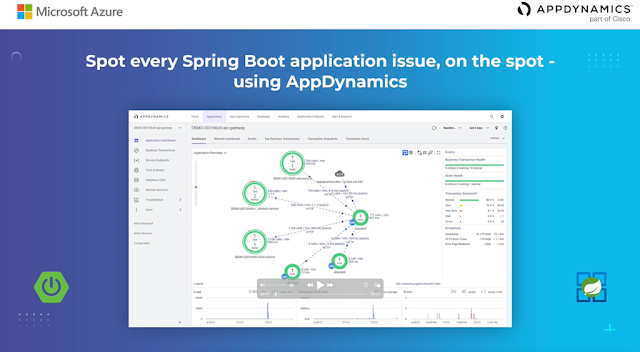
Spot every Spring Boot application issue on the spot using AppDynamics

Today, we are excited to announce the integration of AppDynamics in Azure Spring Cloud for full stack observability.

Over the past 20 months, we worked with many enterprise customers to learn about the scenarios they face. Many of these customers have thousands of Spring Boot applications running in on-premises data centers. As they migrate these applications to the cloud, they need to instrument them for application performance monitoring (APM) using solutions their developers are familiar with and have been using for years. In addition, they must ensure continuity for desktop and mobile applications that are already pre-instrumented for end-to-end monitoring using agents like AppDynamics, which automatically discovers and maps all applications, microservices, and infrastructure as well as any dependencies in dynamic hybrid, multicloud environments. With the integration of AppDynamics in Azure Spring Cloud, you can continue your journey and easily instrument your Spring Boot applications with AppDynamics.

"Our deployment of Azure Spring Cloud is just one component of a much broader multi-region, multicloud architecture. We’ve used AppDynamics at Digital Realty for several years and had a strong desire to have this single pane of glass to capture performance metrics and monitor availability across the full stack. But not only that, AppDynamics is a powerful APM tool that is one component of adopting an event-driven architecture. We are experimenting with self-healing and AIOps and need to expand our capabilities in this area, which we can now do."—Devon Yost, Enterprise Architect, Digital Realty Trust

"As our customers look to modernize their applications and leverage the ease of use and scaling of cloud platforms like Azure Spring Cloud, the need for full stack observability is more important than ever. Many of Presidio’s customers leverage the instrumentation capabilities of AppDynamics to run their Spring Boot applications in the high performing, cost efficient, and highly available manner that their businesses demand. As they plan their migrations to Azure and the Azure Spring Cloud Platform, they will need more than ever consistency of insights and visibility into their applications. Azure Spring Cloud support for AppDynamics brings together the two platforms and gives Presidio and its customers a clear path forward."—Rich Gondek, Senior Technical Director, Digital Business Solutions and Services, Presidio.

“I’m excited by our continued partnership with Microsoft. AppDynamics will provide developers working within Azure Spring Cloud with real-time visibility, with correlated insights that enable them to isolate the root cause of any performance issues and optimize microservices with context to the business impact.”—Gregg Ostrowski, Executive CTO at AppDynamics

“Microsoft is committed to making it easier for Spring developers to run their apps at scale on Azure. AppDynamics is a critical part of full stack observability for many of our customers, and through our partnership they can now get this functionality integrated into Azure Spring Cloud. Supporting APM tools of choice for developers—like AppDynamics—minimizes change so they can focus on delivering new capabilities.”—Julia Liuson, Corporate Vice President, Developer Division, Microsoft

Azure AppDynamics, Azure Prep, Azure Preparation, Azure Certification, Azure Career, Azure Guides, Azure Jobs, Azure Skills
Watch the video above to learn about using AppDynamics to monitor Spring Boot applications.

The ability to observe and correlate applications to the infrastructure, network, and security throughout the entire IT stack is now essential in a digitally transformed world. Technologists demand full-stack observability so they can foresee issues before they affect customers and the business. At the same time, developers continue to innovate and evolve the IT stack by adopting the latest and most agile cloud platforms like Azure Spring Cloud to deploy and run applications at scale quickly and easily. As they do, it is critical that they can move rapidly towards full-stack visibility, insights, and actions transforming siloed data into actionable insights that provide shared context to IT teams so they can deliver exceptional digital experiences, optimize for cost and performance, and maximize digital business revenue.

AppDynamics and Microsoft continue to partner together to ensure that Azure customers can maintain that level of business observability with cloud-native applications on Azure. Now, customers can observe what matters most across their services and workloads deployed on Azure Spring Cloud using AppDynamics—with no code changes required.

Azure AppDynamics, Azure Prep, Azure Preparation, Azure Certification, Azure Career, Azure Guides, Azure Jobs, Azure Skills

Activating the AppDynamics agent in an Azure Spring Cloud deployment is as simple as configuring the JVM options and environment variables when deploying a service via the Azure CLI.

Azure AppDynamics, Azure Prep, Azure Preparation, Azure Certification, Azure Career, Azure Guides, Azure Jobs, Azure Skills
Figure 1: Shows Azure CLI command to activate AppDynamics as part a deployment

The AppDynamics agent can also be activated within Azure Spring Cloud through the Azure Portal, by utilizing Azure Resource Manager (ARM) templates, Bicep templates, or via Terraform.

Upon activation, open the AppDynamics Portal to begin monitoring. In the view shown below, AppDynamics shows all the Spring Boot applications in Azure Spring Cloud.

Azure AppDynamics, Azure Prep, Azure Preparation, Azure Certification, Azure Career, Azure Guides, Azure Jobs, Azure Skills
Figure 2: Shows all the Spring Boot applications running in a production workload

You can also see automated flow maps that show the flow of data through your applications, revealing Spring Boot apps and their dependencies and the exact locations of any issues to be addressed to mitigate business impact. In the view shown below, automated flow maps are automatically available to you—no additional configuration required.

Azure AppDynamics, Azure Prep, Azure Preparation, Azure Certification, Azure Career, Azure Guides, Azure Jobs, Azure Skills
Figure 3: Shows automated app flow maps for Spring Boot applications and their dependencies

AppDynamics traces key business transactions based on production application behavior. It dynamically baselines performance and automatically discovers what is normal, so customers and developers get alerts only when thresholds are exceeded. In the view shown below, it shows the flow of data from api-gateway app to customers-services app, and then to a MySQL database.

Azure AppDynamics, Azure Prep, Azure Preparation, Azure Certification, Azure Career, Azure Guides, Azure Jobs, Azure Skills
Figure 4: Shows flow of data from one Spring Boot app to another Spring Boot app, and then to a MySQL database

You can also get deep diagnostics such as full call stacks and granular method-level code details and database queries. You can turn on development mode for occasional troubleshooting, in which certain default limits on the data that AppDynamics collects are turned off, giving you additional visibility on application activities. In the view shown below, we are zooming into all the database calls, in the last few hours, there were about 5 million calls with good response times.

Azure AppDynamics, Azure Prep, Azure Preparation, Azure Certification, Azure Career, Azure Guides, Azure Jobs, Azure Skills
Figure 5: Zooms into all the database calls from a Spring Boot application

You can look for slowest database calls. In the view shown below for customers-service app, these are the slowest database calls—particularly, plenty of time is spent in setting up connections. As always, there is some room for improvement.

Azure AppDynamics, Azure Prep, Azure Preparation, Azure Certification, Azure Career, Azure Guides, Azure Jobs, Azure Skills
Figure 6: Shows slowest database calls from a Spring Boot application

AppDynamics also has a good JVM metric browser where you can look at JVM metrics across time. In the view shown below, you can look at number of JVM threads versus JVM CPU usage. Certainly, you can draw out many more insights through the metric browser.

Azure AppDynamics, Azure Prep, Azure Preparation, Azure Certification, Azure Career, Azure Guides, Azure Jobs, Azure Skills
Figure 7: Shows JVM Metrics across time in AppDynamics Metric Browser

By using AppDynamics, you can enable seamless collaboration among developers, operators, and business teams. Unified monitoring and real-time insights bring these teams together to maintain application performance, the user experiences and business performance.

Build your solutions and monitor them today


Azure Spring Cloud is jointly built, operated, and supported by Microsoft and VMware. It is a fully managed service for Spring Boot applications that abstracts away the complexity of infrastructure and Spring Cloud middleware management, so you can focus on building your business logic and let Azure take care of dynamic scaling, patches, security, compliance, and high availability. With a few steps, you can provision Azure Spring Cloud, create applications, deploy and scale Spring Boot applications, and start monitoring in minutes. We will continue to bring more developer-friendly and enterprise-ready features to Azure Spring Cloud. We would love to hear how you are building impactful solutions using Azure Spring Cloud.

Source: microsoft.com

Saturday, 23 October 2021

Increase ROI and business impact with Azure Machine Learning

Azure Machine Learning, Azure Exam Prep, Azure Learning, Azure Certification, Azure Career, Azure Online Guides

A growing number of organizations are taking advantage of machine learning to increase efficiency, enhance customer experiences and drive innovation. With increasing use of machine learning, customers might wish to consider a cost-benefit and value analysis across infrastructure, operations, and processes—across their teams and organizations.

Azure Machine Learning is the enterprise-grade service to build and deploy models faster and accelerate the machine learning lifecycle. Thousands of customers, including many Fortune 100 customers are already realizing the impact and benefits provided by Azure Machine Learning. To provide a detailed analysis of the potential return on investment (ROI) with Azure Machine Learning, Microsoft commissioned the Forrester Consulting Total Economic Impact™ (TEI) study to examine the cost savings and business benefits enabled by Azure Machine Learning.

Key findings

Azure Machine Learning provides advanced machine learning operations (MLOps) capabilities for operationalizing the lifecycle. Forrester interviewed five customers that used Azure Machine Learning and surveyed 199 data science, machine learning, or AI decision makers. For the purposes of this study, Forrester aggregated the results from these customers into a single composite organization.

Forrester found that after investing in Azure Machine Learning, customers experienced many efficiencies in their ability to execute machine learning projects, drive greater revenue, and lower operating costs. Benefits were calculated for a three-year period and Forrester concluded that benefits scaled as the organization’s adoption of Azure Machine Learning increased.

Highlighted benefits of using Azure Machine Learning:

◉ Three-year projected ROI of 189 percent to 335 percent.

◉ Improved data scientist productivity by up to 25 percent and data engineering productivity by up to 40 percent.

◉ Up to 40 percent reduction in time to onboard new data scientists, resulting in reduced costs.

◉ Increase in operational efficiency by streamlining model development, training, validation, deployment, and monitoring.

◉ Improved time-to-value of machine learning initiatives and model accuracy resulting in increased revenue and cost savings.

◉ Cost savings from retiring legacy technology.

Source: microsoft.com

Thursday, 21 October 2021

The Enclave Device Blueprint for confidential computing at the edge

A major milestone towards making confidential computing in IoT mainstream for privacy and safety.

In collaboration with Arm® Technologies and Scalys BV, we are announcing the immediate availability of the Enclave Device Blueprint to help towards making confidential computing a mainstream computing paradigm at the edge. The exponential growth in intelligent processing at the edge and autonomous command and control in the internet of things (IoT) necessitates confidential computing to protect privacy and safety. Confidential computing at the edge demands the use of security-hardened and tamper-resistant computing isolations called Trusted Execution Environments (TEE) or simply enclaves. Enclave devices are extremely complex to engineer and operate, and their absence is holding back the fullest potential in edge computing. The Enclave Device Blueprint is here to help simplify the engineering of enclave devices and deploying confidential applications in IoT.

Cloud Strategy, Internet of Things, Azure Exam Prep, Azure Tutorial and Material, Azure Learning, Azure Guides, Azure Prep, Azure Career
Figure 1: Enclave Device Blueprint Architecture

The rising need for confidential computing


Confidential computing augments traditional computing paradigms with additional protections for computing workloads and data when in use. Traditional computing applies cryptography to encrypt content in the form of computing workloads, data, and AI models when in storage or in transit but must decrypt said content in memory when in use. This model continues to work reasonably well when operating air-gapped compute networks where there are lower concerns for data exfiltration or malicious tampering. IoT and cloud computing, on the other hand, ushers the age of computing characterized by hyperconnectivity, multitenant compute infrastructures, and data-driven autonomous command and control of many systems including critical infrastructure thereby calling for a higher bar for privacy and safety. Confidential computing using TEE offers compute isolations necessary to help deliver on both privacy and safety to help unleash the full power of digital transformations with IoT.

Special considerations for IoT


A major difference to observe in confidential computing in the cloud and at the edge is that while cloud solution providers set up and operate the requisite infrastructure in the cloud for their customers, IoT solution builders are responsible for coming up with enclave devices and the complexity in doing so holds them back.

In addition, while the infrastructure for confidential computing in the cloud resides in datacenters where they benefit from additional facility and operational security controls, IoT and enclave devices are generally deemed to be under constant threat of malicious physical access. To minimize this threat, enclave devices tend to favor binding trust directly or very close to the root of trust hardware (bare metal) over the use of supervisory software like hypervisors and container runtimes to keep the Trusted Computing Base (TCB) at a minimum. Supervisory software on the other hand help abstract from the hardware to enable scale across hardware technologies at a cost of a larger TCB. Having to avoid the scale advantages of supervisory software for higher security is one source of complexity in building, operating, and maintaining enclave devices.

The Enclave Device Blueprint at its core seeks to solve these challenges in a manner that still upholds security at the highest levels possible.

The Enclave Device Blueprint


The Enclave Device Blueprint comprises projects, resources, and guidance to abstract and simplify the development of enclave devices and facilitate the deployment of confidential applications at scale for IoT. It strives to complement traditional computing by filling in the architectural and component gaps towards making confidential computing mainstream in IoT.

The blueprint is agnostic of hardware technologies, operating systems, or solution cloud. It invites a community approach to solve a very complex problem where participants can mitigate cost through collaboration and foster higher security through the transparency that comes with open source. All blueprint components are currently in open source and were developed with the vision for complete community ownership and governance.

A real-world realization


More than just a collection of projects, resources, and guidance, we made sure to validate the efficacy of the Enclave Device Blueprint with a real-world device and project. The Enclave Device Blueprint was inspired by the real observation of the roadblocks holding back confidential computing at the edge. It was, therefore, important to ensure the blueprint address obstacles from real experiences and is backed by real product truth.

While in collaboration for the development of the Enclave Device Blueprint, Original Device Manufacturer (OEM) and secured devices builder, Scalys BV, in tandem engineered TrustBox Edge 201 from the blueprint to satisfy both Azure IoT Edge certified and tamper-resistant enclave device requirements for confidential computing in IoT.

Cloud Strategy, Internet of Things, Azure Exam Prep, Azure Tutorial and Material, Azure Learning, Azure Guides, Azure Prep, Azure Career
Figure 2: TrustBox Edge 201 (Source: Scalys 2021)

Building on Azure cloud and making use of fully managed services like Azure IoT Edge, Azure IoT Hub, Azure Functions, and Azure Key Vault, we incorporated the software components of the Enclave Device Blueprint to orchestrate an end-to-end at scale build-deploy pipeline for confidential applications in IoT. It is the modular nature of the Enclave Device Blueprint components that make it agnostic to technology, operating system, or the cloud. The full project is available on Azure Samples and ready to try out using TrustBox Edge 201 from Scalys BV. The Enclave Device Blueprint whitepaper provides a detailed explanation for the blueprint components.

The journey continues


The Enclave Device Blueprint delivers a major milestone aimed at spurring the creation of enclave devices and deploying confidential applications at scale in IoT. Enclave devices help provide privacy and safety protections necessary for IoT to unleash its fullest potential. Based on history, one can safely assume that this is only one of many milestones, the most obvious next being seamless integrations with confidential computing services in the cloud for uniform and pervasive cloud-edge confidential computing experiences.

Source: microsoft.com

Tuesday, 19 October 2021

Business as usual for Azure customers despite 2.4 Tbps DDoS attack

In early August, we shared Azure’s Distributed Denial-of-Service (DDoS) attack trends for the first half of 2021. We reported a 25 percent increase in the number of attacks compared to Q4 of 2020, albeit a decline in maximum attack throughput, from one terabit per second (Tbps) in Q3 of 2020 to 625 Mbps in the first half of 2021.

The last week of August, we observed a 2.4 Tbps DDoS attack targeting an Azure customer in Europe. This is 140 percent higher than 2020’s 1 Tbps attack and higher than any network volumetric event previously detected on Azure.

Azure Security, Azure Exam Prep, Azure Preparation, Azure Certification, Azure Guides, Azure Tutorial and Material, Azure Learning
Figure 1—maximum attack bandwidth (terabit per second) in 2020 vs. August 2021 attack.

The attack traffic originated from approximately 70,000 sources and from multiple countries in the Asia-Pacific region, such as Malaysia, Vietnam, Taiwan, Japan, and China, as well as from the United States. The attack vector was a UDP reflection spanning more than 10 minutes with very short-lived bursts, each ramping up in seconds to terabit volumes. In total, we monitored three main peaks, the first at 2.4 Tbps, the second at 0.55 Tbps, and the third at 1.7 Tbps.

Azure Security, Azure Exam Prep, Azure Preparation, Azure Certification, Azure Guides, Azure Tutorial and Material, Azure Learning
Figure 2—attack lifespan and progress.

Azure’s massive scale DDoS protection


Attacks of this size demonstrate the ability of bad actors to wreak havoc by flooding targets with gigantic traffic volumes trying to choke network capacity. However, Azure’s DDoS protection platform, built on distributed DDoS detection and mitigation pipelines, can absorb tens of terabits of DDoS attacks. This aggregated distributed mitigation capacity can massively scale to absorb the highest volume of DDoS threats, providing our customers the protection they need.

Attack mitigation lifecycle is orchestrated by our control plane logic that dynamically allocates mitigation resources to the most optimal locations, closest to the attack sources. In this case, attack traffic which originated in the Asia-Pacific region and the United States did not reach the customer region but was instead mitigated at the source countries.

Azure provides additional protections beyond ample mitigation capacity. Azure’s DDoS mitigation employs fast detection and mitigation of large attacks by continuously monitoring our infrastructure at many points across the network. When deviations from baselines are extremely large, our DDoS control plane logic cuts through normal detection steps, needed for lower-volume floods, to immediately kick-in mitigation. This ensures the fastest time-to-mitigation and prevents collateral damage from such large attacks.

Whether in the cloud or on-premises, every organization with internet-exposed workloads is vulnerable to DDoS attacks. Because of Azure's global absorption scale and advanced mitigation logic, the customer did not suffer any impact or downtime. If the customer had been running in their own datacenter, they would most probably have incurred extensive financial damage, alongside any intangible costs.

How to protect your workloads from DDoS attacks


The pace of digital transformation has accelerated significantly during the COVID-19 pandemic, alongside the adoption of cloud services. Bad actors, now more than ever, continuously look for ways to take applications offline. Therefore, organizations should give their utmost attention to developing a robust DDoS response strategy with Azure.

Azure DDoS Protection Standard provides enhanced DDoS mitigation features to defend against DDoS attacks. It is automatically tuned to protect all public IP addresses in virtual networks. Protection is simple to enable on any new or existing virtual network and does not require any application or resource changes.

Besides the timely protection against DDoS attacks, another key feature of Azure DDoS Protection Standard is cost protection, whereby customers enrolled in DDoS Protection Standard receive data-transfer and application scale-out service credit for resource costs incurred because of documented DDoS attacks. It is imperative to have such cost protection with large attacks that may incur significant costs.

Source: microsoft.com